


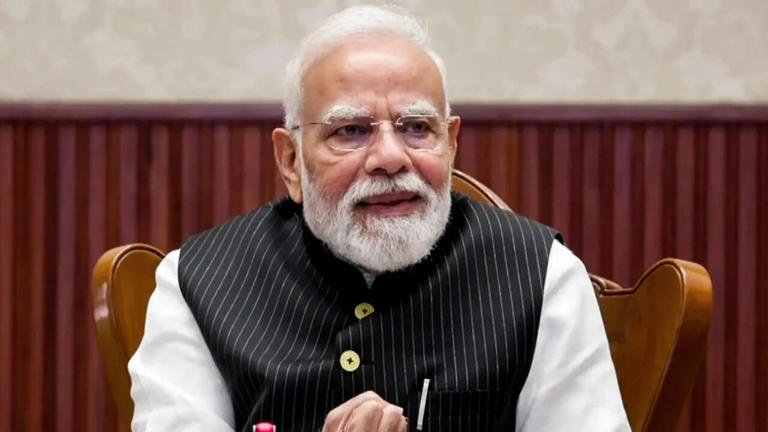
Prime Minister Narendra Modi is set to embark on a four-day visit to Uzbekistan and the Kyrgyz Republic from August 29 to September 1, with bilateral cooperation, regional security, economic engagement and multilateral diplomacy expected to dominate the agenda.
The Prime Minister will begin his tour with a two-day State Visit to Uzbekistan on August 29 and 30 at the invitation of President Shavkat Mirziyoyev. He will then travel to Bishkek, the capital of the Kyrgyz Republic, to attend the 26th Shanghai Cooperation Organisation (SCO) Summit on August 31 and September 1.
The visit comes at a time when India is seeking to deepen its strategic engagement with Central Asia and strengthen cooperation in areas ranging from trade and connectivity to security and critical resources. Modi’s visit to Uzbekistan will be his fourth to the Central Asian country, reflecting the importance New Delhi attaches to the bilateral strategic partnership.
Bilateral Talks With Uzbekistan President Shavkat Mirziyoyev
The first leg of the visit will take Modi to Tashkent, where he is scheduled to hold delegation-level talks with Uzbek President Shavkat Mirziyoyev.
The discussions are expected to focus on further strengthening the strategic partnership between India and Uzbekistan. Cooperation in trade, investment, connectivity, healthcare and other areas of mutual interest is likely to feature in the talks, alongside efforts to explore new opportunities for expanding bilateral engagement.
Uzbekistan occupies an important place in India’s engagement with Central Asia, and the visit is expected to provide an opportunity for both sides to review the progress of existing cooperation and identify areas for future collaboration.
The discussions could also focus on strengthening economic ties and encouraging greater business engagement between the two countries. With Central Asia gaining increasing strategic and economic significance, India has been working to deepen its partnerships across the region.
Trade, Critical Minerals and Healthcare in Focus
Economic cooperation is expected to form a key component of the discussions in Tashkent.
Trade and investment ties between India and Uzbekistan have expanded in recent years, and both countries are likely to explore ways to further strengthen commercial engagement. Critical minerals and healthcare are also expected to be among the important areas of discussion during Modi’s meetings with the Uzbek leadership.
Critical minerals have emerged as a strategic priority for countries seeking to strengthen supply chains for sectors such as clean energy, advanced manufacturing and emerging technologies. Cooperation in this area could therefore add a new dimension to the India-Uzbekistan partnership.
Healthcare and education links are also significant areas of engagement. Uzbekistan hosts a sizeable Indian student community, and educational cooperation has become an important bridge between the two countries. Around 16,000 Indian students are currently studying in Uzbekistan, according to reports.
Visit to Shastri Memorial and Mahatma Gandhi Centre
Beyond diplomatic and economic engagements, Modi’s itinerary in Tashkent also includes visits highlighting the historical and cultural connections between India and Uzbekistan.
The Prime Minister is expected to visit the Shastri Memorial, associated with former Prime Minister Lal Bahadur Shastri, as well as the Mahatma Gandhi Centre at the Tashkent State University of Oriental Studies.
These engagements are expected to underline the civilisational and people-to-people links that form an important part of India’s relationship with Central Asia.
Such cultural diplomacy is also likely to complement the broader strategic agenda of the visit, which seeks to strengthen ties not only between governments but also through educational, cultural and societal exchanges.
Modi Heads to Bishkek for SCO Summit
After completing his Uzbekistan visit, Modi will travel to Bishkek at the invitation of Kyrgyz President Sadyr Zhaparov to participate in the 26th SCO Summit.
The summit, scheduled for August 31 and September 1, will bring together leaders from across the Eurasian region and provide India with an important platform to engage on issues of regional and international significance.
Security, terrorism, regional stability, economic cooperation and connectivity are expected to be among the key issues discussed during the summit.
For India, the SCO remains an important multilateral platform for engaging with countries across Central Asia and Eurasia while advancing its position on regional security and economic cooperation.
Security and Regional Connectivity Likely to Dominate Discussions
The SCO summit comes amid continuing geopolitical uncertainty and evolving security challenges across the region.
India is expected to use the platform to highlight its concerns and priorities regarding terrorism and regional stability. Cooperation against terrorism has remained a significant area of engagement within the SCO framework.
Regional connectivity and economic opportunities are also likely to be discussed as member countries examine ways to strengthen cooperation and improve links across Eurasia.
India’s participation in the summit will allow New Delhi to engage with regional partners on these issues while reinforcing its broader strategic outreach to Central Asia.
Bilateral Meetings on SCO Sidelines
The SCO Summit could also provide Modi with opportunities for bilateral meetings with other world leaders attending the gathering.
A meeting between Modi and Russian President Vladimir Putin is scheduled on the sidelines of the summit, according to reports and official briefings. The interaction is expected to be closely watched given the importance of India-Russia strategic relations and the wider geopolitical developments affecting the region.
Additional bilateral interactions may also take place during the summit, depending on the final diplomatic schedule.
Such meetings could provide India with opportunities to discuss bilateral relations as well as major regional and global developments.
A Major Push for India’s Central Asia Engagement
Overall, Modi’s four-day visit is expected to combine bilateral diplomacy with multilateral engagement.
The Uzbekistan leg will focus on deepening India’s strategic partnership with Tashkent and expanding cooperation in economic and emerging sectors. The Kyrgyz Republic visit, meanwhile, will place India at the centre of discussions at the SCO Summit on security, connectivity and regional cooperation.
The tour also highlights India’s continuing effort to strengthen its presence and partnerships in Central Asia, a region of growing geopolitical and economic importance.
As Modi begins the visit on August 29, attention will remain on the outcomes of his talks with President Mirziyoyev, the discussions at the SCO Summit and the bilateral engagements held on its sidelines. The four-day tour is expected to reinforce India’s strategic outreach to Central Asia while opening fresh avenues for cooperation across trade, security, technology and people-to-people ties.