


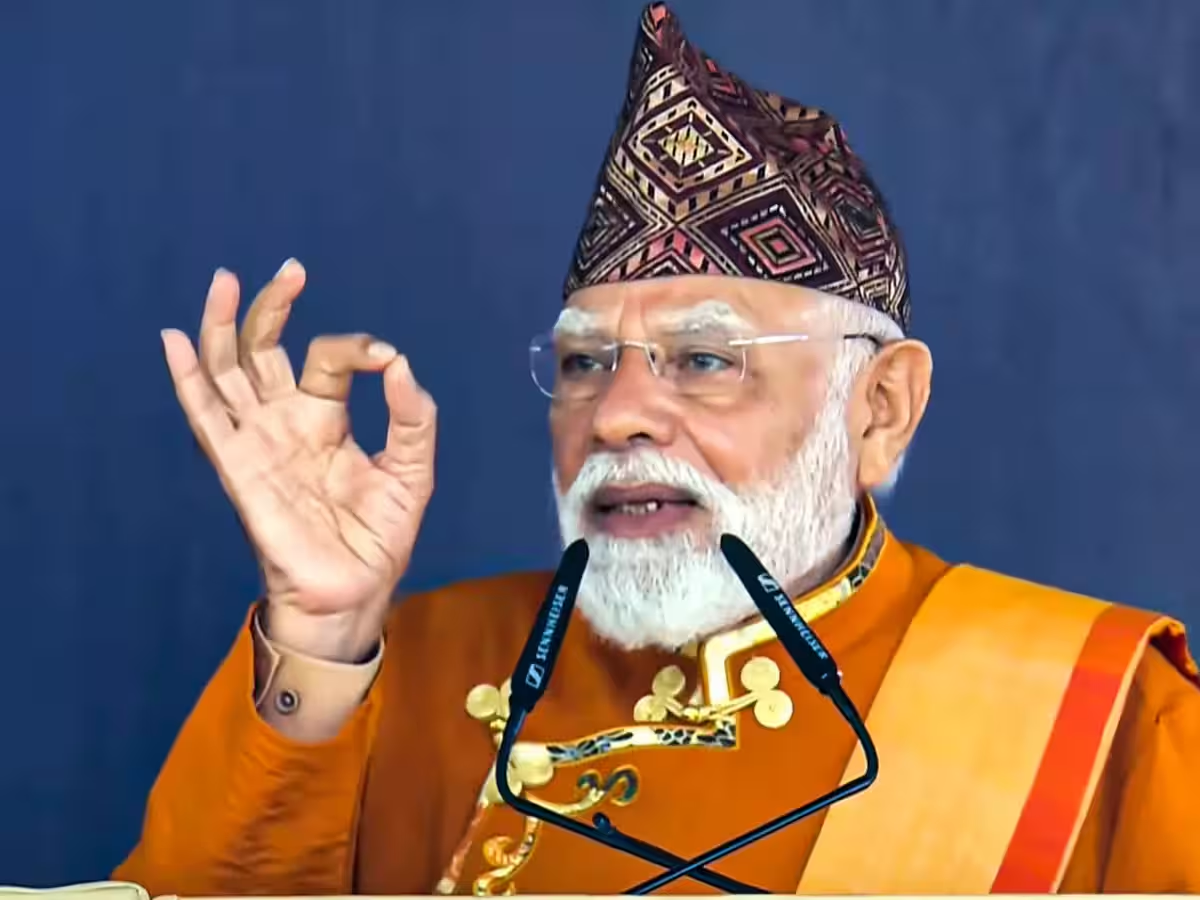
Prime Minister Narendra Modi has reaffirmed the Centre’s focus on the Northeast as a key link between India and Southeast Asia. His recent remarks and government initiatives place connectivity, trade and infrastructure at the centre of the region’s development strategy. The approach combines the long-standing Act East Policy with a stronger emphasis on faster implementation. Moreover, the government is seeking to strengthen roads, railways, waterways, airports and border trade infrastructure across the region.
Arunachal Hosts First-Ever Official Coffee Workshop to Map Cash Crop Potential
PM Modi Northeast Logistics Vision Gains Momentum
The PM Modi Northeast logistics vision rests on the idea that better connectivity can strengthen both regional development and India’s links with Southeast Asia. During his Sikkim visit, Modi described the Northeast as an important part of India’s development journey and said the government was pursuing the Act East Policy with the spirit of “Act Fast.”
The Prime Minister has also linked the Northeast’s geographic position with its potential role as a bridge to Southeast Asian markets. In March 2026, while addressing an event in Silchar, Modi described North-East India as the centre of India’s Act East Policy. He also said the Barak Valley could develop into a major logistics and trade hub for the wider region.
Furthermore, the government’s approach extends beyond individual road or railway projects. The Ministry of Development of North Eastern Region has described connectivity as a broad priority covering physical, digital, economic and people-to-people links. That framework places logistics within a wider strategy for economic integration.
The emphasis on speed also reflects the need to complete projects that can improve movement within the Northeast. Better internal links can reduce travel time between states, while stronger border infrastructure can support trade with neighbouring countries.
Connectivity Projects Strengthen Northeast Trade Routes
Several major infrastructure projects form part of the wider strategy. The Centre has identified the India-Myanmar-Thailand Trilateral Highway and the Kaladan Multi-Modal Transit Transport Project as flagship connectivity initiatives under the Act East Policy. Both projects are intended to improve access between the Northeast and markets in Southeast Asia.
The Kaladan project combines waterways and roads to create an alternative connectivity route involving Mizoram and Myanmar. According to the Ministry of Development of North Eastern Region, the waterway component was completed and inaugurated in May 2023. The road component includes a 109-kilometre two-lane highway between Paletwa and Zorinpui.
Meanwhile, the India-Myanmar-Thailand highway is being developed in stages. The Tamu-Kalewa section was completed earlier, while the Kalewa-Yargi section was completed and handed over to Myanmar in October 2025, according to the Centre.
Road connectivity within India also remains important. In March, Modi highlighted the proposed Shillong-Silchar High-Speed Corridor while discussing the Barak Valley’s future role in regional logistics. The project is intended to improve links with Mizoram, Manipur and Tripura and strengthen access towards Southeast Asian markets.
PM Modi Northeast Logistics Plan Links Infrastructure With Trade
The PM Modi Northeast logistics strategy also includes institutional efforts to coordinate infrastructure and trade policies. The Ministry of Development of North Eastern Region said an inter-ministerial committee was created in 2024 to assess the region’s logistics ecosystem and recommend measures for better logistics planning. A steering group involving the logistics division of DPIIT and other ministries monitors the resulting roadmap.
Additionally, the government is working on infrastructure at Integrated Check Posts and other border-trade facilities. Such infrastructure can improve the movement of goods and people while supporting formal cross-border commerce.
India’s connectivity with Bangladesh also forms part of this framework. The Centre has pointed to improved rail, road and inland waterway links between India and Bangladesh as important for Northeast connectivity and wider sub-regional integration. Joint mechanisms also cover trade infrastructure, land customs stations, Integrated Check Posts and Border Haats.
The strategy therefore combines domestic connectivity with international access. Roads and railways can connect production centres to markets, while border facilities can make cross-border trade more efficient. In addition, logistics improvements can support sectors such as agriculture, tourism, manufacturing and small businesses.
The government has also created a High-Level Task Force on the North East Economic Corridor. Its mandate includes identifying gaps in physical connectivity, trade facilitation and investment while developing strategies to attract public and private investment. The task force’s report was presented at the North Eastern Council’s 73rd plenary session in June 2026.
Faster Implementation Becomes Key to Northeast Growth
The focus on “Act Fast” places implementation alongside policy design. Infrastructure plans can deliver wider economic benefits only when projects progress through construction, clearances, coordination and eventual operation.
In June 2026, Union Minister Sarbananda Sonowal said the Northeast was emerging as a logistics, trade and connectivity corridor linking South Asia with Southeast Asia. The statement came at the North-East India Infrastructure Summit, where connectivity, digital infrastructure, logistics, energy and industry featured among the region’s development priorities.
Earlier, the government also reported that cumulative expenditure on Northeast development under the 10% Gross Budgetary Support mechanism reached ₹6.11 lakh crore between 2014-15 and 2024-25, against a cumulative allocation of ₹6.02 lakh crore. The figure covers the broader development effort rather than logistics alone.
Moreover, investment interest has expanded across several sectors. The Ministry of Development of North Eastern Region reported that the Rising Northeast Investors Summit and related roadshows generated investment interests worth ₹4.48 lakh crore through memoranda of understanding, letters of intent and qualified leads. Infrastructure and logistics were among the identified focus sectors.
The next stage will depend on how effectively these plans translate into operational infrastructure. Faster project execution, coordination between states and the Centre, border management and reliable transport networks will remain important factors.
Conclusion
The PM Modi Northeast logistics vision increasingly combines Act East diplomacy with domestic infrastructure development. Roads, railways, waterways, airports and border facilities are being positioned as parts of a wider network connecting the Northeast with the rest of India and Southeast Asia.
Furthermore, projects such as the Kaladan corridor, the India-Myanmar-Thailand highway and new domestic connectivity links show the practical dimension of the strategy. However, the long-term impact will depend on timely execution, effective coordination and the successful integration of transport and trade systems. If these priorities progress as planned, the Northeast could strengthen its role as an important logistics and commercial gateway to Southeast Asia.
FAQs
1. What is the PM Modi Northeast logistics vision?
The PM Modi Northeast logistics vision focuses on improving transport, trade and connectivity infrastructure so the region can support domestic economic growth and stronger links with Southeast Asia.
2. What does “Act East, Act Fast” mean for the Northeast?
“Act East” refers to India’s engagement with Southeast Asia, while “Act Fast” emphasises faster development and implementation in the Northeast. PM Modi used this formulation while discussing the region’s development and connectivity.
3. Which major projects support Northeast connectivity?
The Kaladan Multi-Modal Transit Transport Project and India-Myanmar-Thailand Trilateral Highway are among the major connectivity projects associated with the Act East Policy.
4. Why is logistics important for the Northeast?
Improved logistics can reduce transport barriers, connect producers with wider markets and strengthen trade links with neighbouring countries and Southeast Asia.
5. How does Bangladesh connectivity support the Northeast?
Improved rail, road and inland waterway links with Bangladesh can provide additional routes for movement and support trade and wider regional integration.