


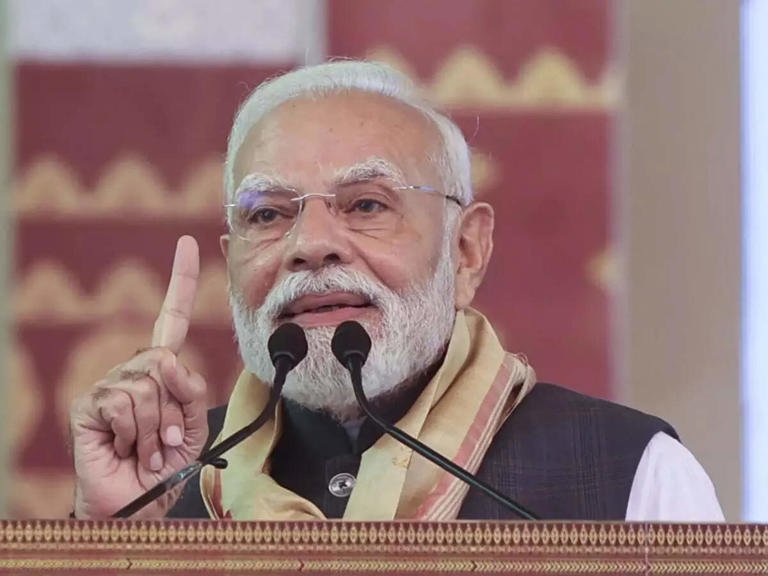
Prime Minister Narendra Modi has once again stressed the importance of self-reliance in India’s strategic sectors. Speaking at a recent shipping industry event, he pointed out that India’s shipping bill, which stands at an enormous ₹6 lakh crore annually, is nearly equivalent to the country’s defence expenditure. He called this situation unsustainable and urged a strong Atmanirbhar push in shipping to curb outflows and strengthen national capacity.
The Prime Minister’s remarks come at a time when India is focusing on reducing dependence on imports and enhancing domestic capabilities in key industries. His comparison with defence spending highlighted the critical importance of shipping to the country’s economy and security.
Read More: Tripura Assembly Hails Armed Forces for Operation Sindoor
India’s growing shipping bill raises alarm
PM Modi explained that India pays around ₹6 lakh crore every year to foreign shipping companies for transporting goods and cargo. This cost, he noted, is almost equal to the defence budget, which funds the nation’s military readiness. He said the shipping sector cannot remain ignored when it has such a massive financial impact.
By drawing attention to this figure, the Prime Minister emphasized that investing in domestic shipping infrastructure would not only save resources but also generate employment, build skills, and improve competitiveness. A strong Atmanirbhar push in shipping could, therefore, transform the sector into a pillar of India’s economic independence.
The need for self-reliance in shipping
Shipping is the backbone of international trade, and India, with its long coastline and strategic location, has significant potential to become a global hub. However, the country still relies heavily on foreign vessels for trade transport. This dependence makes India vulnerable to fluctuations in global freight costs and foreign market pressures.
The Prime Minister argued that by promoting indigenous shipbuilding, strengthening ports, and modernizing logistics, India could cut its shipping bill while simultaneously boosting exports. He added that the government’s focus on an Atmanirbhar push in shipping aligns with the broader national goal of self-reliance, already underway in defence, manufacturing, and energy.
Government initiatives to strengthen the sector
Over the past few years, the government has introduced several policies aimed at revitalizing the maritime industry. Schemes under the Sagarmala project, port modernization programs, and investments in inland waterways are some key measures.
PM Modi highlighted that while progress has been made, much more needs to be done to close the gap between India’s shipping potential and its current capacity. He urged private sector players to join hands with the government in this mission, stressing that a united effort is crucial to achieving an Atmanirbhar push in shipping.
Linking shipping to national security
By equating the shipping bill to the defence budget, PM Modi underscored the strategic role of shipping in national security. Just as defence protects the nation’s borders, shipping ensures economic security through trade. Any disruption in global shipping routes could affect supply chains and impact essential imports.
Developing domestic capacity, therefore, is not just an economic necessity but also a matter of national security. With greater control over its shipping infrastructure, India would be better prepared to withstand external shocks and safeguard its trade routes.
Opportunities for Indian industry
The Prime Minister’s call also opens up opportunities for Indian shipbuilders, port operators, and logistics companies. He noted that investment in this sector could lead to the creation of thousands of jobs, both skilled and unskilled. Furthermore, it could stimulate innovation in green shipping technologies and digital solutions.
A robust Atmanirbhar push in shipping could also enhance India’s role in global trade. By developing its own fleet and infrastructure, the country can position itself as a reliable maritime partner in Asia and beyond.
Challenges to overcome
While the vision for self-reliance is clear, several challenges remain. Building ships requires heavy capital investment, advanced technology, and skilled manpower. Indian companies will need to scale up quickly to compete with established international players.
Additionally, port infrastructure must be upgraded to handle increased traffic efficiently. PM Modi acknowledged these hurdles but expressed confidence that with government support and industry collaboration, the sector could overcome them.
Path ahead for a self-reliant future
The Prime Minister concluded his address by urging stakeholders to treat shipping as a priority sector. He said that just as India has made significant strides in defence manufacturing, it must replicate the same determination in shipping. The government, he assured, would provide full support through policy reforms, funding assistance, and incentives.
By reinforcing his vision of self-reliance, PM Modi made it clear that the time has come for India to reclaim its maritime strength. The call for an Atmanirbhar push in shipping is not just about reducing bills but about building a future where India controls its economic destiny.
Conclusion
PM Modi’s remarks on the massive ₹6 lakh crore shipping bill have highlighted an often-overlooked sector that demands urgent attention. By linking it to defence expenditure, he underscored the importance of shipping in both economic and strategic terms. His call for an Atmanirbhar push in shipping reflects a broader national mission of self-reliance, aiming to secure India’s future on land and at sea.
Read More: Daily Benefits of Raw Papaya Juice Explained