


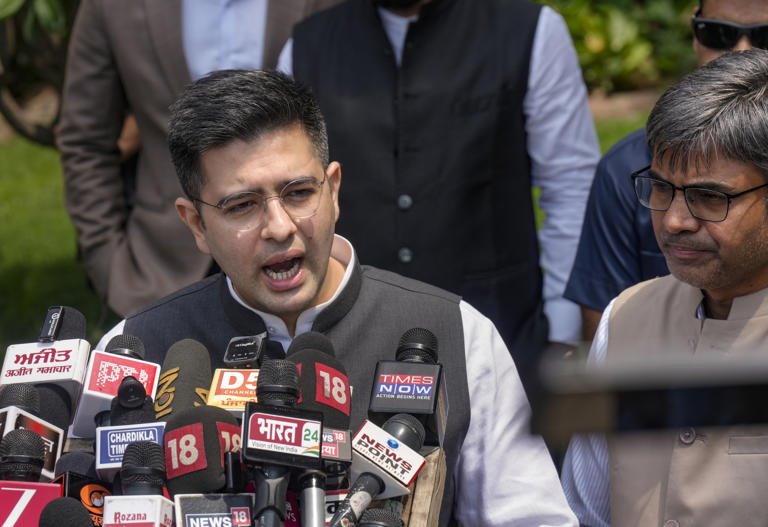
Aam Aadmi Party leader Raghav Chadha met President Droupadi Murmu to raise concerns over what he described as harassment of Members of Parliament who quit the AAP and later joined the Bharatiya Janata Party.
According to Chadha, the issue involves actions taken against certain MPs after their political shift. He alleged that these developments raise questions about fairness and the treatment of elected representatives.
The meeting has drawn attention in political circles, as it brings the matter to the highest constitutional office. Moreover, it highlights ongoing tensions between political parties over defections and their consequences.
Read More: Mamata Banerjee Targets EC, Calls BJP Win ‘Loot’ and ‘Immoral Victory’ in Bengal
Allegations focus on treatment of defecting MPs
During his interaction with the President, Raghav Chadha reportedly outlined specific concerns regarding the treatment of MPs who left the Aam Aadmi Party. He alleged that these individuals faced undue pressure and harassment after joining the BJP.
According to Chadha, such actions could undermine democratic principles. He argued that elected representatives should be free to make political decisions without fear of retaliation.
Furthermore, he emphasised that political competition must remain within the bounds of fairness. Any form of coercion, he said, could weaken trust in the democratic process.
These allegations have added a new dimension to the debate on political defections in India.
Appeal for intervention and safeguarding democratic norms
Raghav Chadha urged President Droupadi Murmu to take note of the situation and ensure that democratic norms are upheld. He highlighted the importance of protecting the rights of MPs regardless of their political affiliations.
He also called for a review of the circumstances surrounding the alleged harassment. According to him, addressing such concerns is essential for maintaining the credibility of institutions.
Moreover, Chadha stressed that the issue goes beyond party politics. He argued that it is a matter of safeguarding democratic values and ensuring that elected representatives can function without undue interference.
This appeal reflects the seriousness with which the AAP views the situation.
BJP responds to allegations
Leaders from the Bharatiya Janata Party have responded to the allegations, rejecting them as baseless. They stated that claims of harassment are politically motivated and lack evidence.
According to BJP representatives, party members operate within the framework of the law. They argued that any actions taken against individuals are based on legal and procedural grounds, not political considerations.
Additionally, BJP leaders accused the Aam Aadmi Party of attempting to create controversy. They suggested that such allegations are part of a broader strategy to gain political attention.
This response has further intensified the debate surrounding the issue.
Political tensions between AAP and BJP escalate
The meeting between Raghav Chadha and the President has highlighted the growing tensions between the Aam Aadmi Party and the BJP. Both parties have been engaged in sharp exchanges on various issues, and this development adds to the ongoing friction.
Political analysts note that defections often lead to disputes over loyalty and accountability. In this case, the allegations have brought these tensions into the national spotlight.
Moreover, the involvement of the President underscores the seriousness of the matter. It reflects the extent to which political disagreements can escalate into institutional concerns.
Debate on political defections and accountability
The issue has also reignited discussions about political defections and their implications. In India, party-switching by elected representatives has been a recurring phenomenon, often leading to controversy.
Supporters of strict measures argue that defections can undermine the mandate given by voters. They believe that accountability mechanisms are necessary to maintain political stability.
On the other hand, critics argue that elected representatives should have the freedom to change affiliations. They emphasise that democracy allows for evolving political choices.
Raghav Chadha’s allegations bring this debate into focus once again, highlighting the complexities involved.
Broader implications for democratic institutions
The controversy has broader implications for democratic institutions and governance. Ensuring that elected representatives can function without undue pressure is essential for maintaining the integrity of the system.
Experts note that institutions must remain neutral and operate within constitutional frameworks. Any perception of bias or misuse can erode public trust.
Furthermore, the issue highlights the need for clear guidelines on handling political transitions. Transparent processes can help prevent disputes and ensure fairness.
The current situation serves as a reminder of the challenges involved in balancing political competition with institutional integrity.
Public reaction and political discourse
Public reaction to the development has been mixed. Some individuals have expressed concern over the allegations, emphasising the importance of protecting democratic values. Others have questioned the claims, calling for evidence before drawing conclusions.
The discussion has gained traction on social media, where users are debating the issue from different perspectives. This engagement reflects the significance of the matter in shaping public discourse.
At the same time, experts caution against jumping to conclusions. They stress the importance of verifying facts and maintaining responsible communication.
Conclusion
Raghav Chadha’s meeting with President Droupadi Murmu and his allegations of harassment against MPs who left the Aam Aadmi Party and joined the BJP have sparked a significant political debate. The issue touches upon key themes such as democratic norms, political defections, and institutional integrity.
While the BJP has dismissed the claims as baseless, the AAP continues to push for intervention and accountability. The involvement of the President highlights the seriousness of the matter.
As the situation develops, the focus will remain on ensuring fairness and transparency. The outcome of this controversy may have lasting implications for political discourse and democratic practices in India.
Read More: Change Needed in Bengal for National Security: Tripura CM Manik Saha