


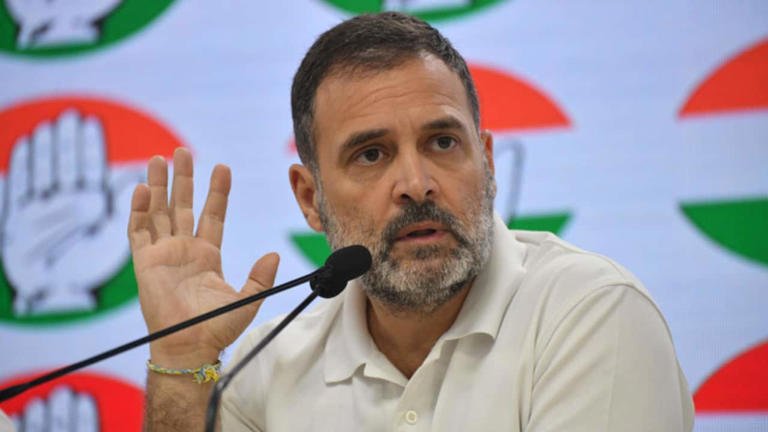
Congress leader Rahul Gandhi has launched a sharp attack on the Rashtriya Swayamsevak Sangh (RSS), alleging that the organisation is attempting to impose its ideological worldview on the country. Speaking about the broader political and ideological environment in India, Gandhi claimed that the RSS believes it has already determined what is right for the nation and is seeking to shape institutions and society according to its own ideas.
His remarks are part of the continuing ideological confrontation between the Congress and the RSS-BJP ecosystem. Gandhi has repeatedly accused the RSS of promoting a centralised ideological vision, while the BJP and its supporters have rejected such allegations and maintained that their politics is rooted in nationalism, cultural values and democratic governance.
The latest statement once again highlights the deep divide between the two sides over questions of diversity, institutions, education and the future direction of the country.
Rahul Gandhi’s Criticism of the RSS
In his remarks, Rahul Gandhi suggested that the RSS has developed a belief that it already possesses the answers to the country’s complex social and political challenges. According to him, the organisation has “decided that they know” what is best and is therefore attempting to promote its ideas across different sections of society.
Gandhi argued that India cannot be governed or understood through a single ideological framework. He has consistently maintained that the country’s strength lies in its diversity of languages, religions, cultures and political opinions.
The Congress leader’s criticism centres on what he describes as an attempt to reduce this diversity by promoting one particular ideological perspective. In his view, a healthy democracy requires disagreement, debate and the freedom to hold different opinions.
His comments are likely to intensify the ongoing political debate over the role of ideology in governance and public institutions.
What Does Gandhi Mean by Ideological Imposition?
The term “ideological imposition” generally refers to attempts to make a particular set of political, cultural or social beliefs dominant within institutions or society.
Rahul Gandhi has often accused the RSS and the BJP of attempting such an approach through their influence on public discourse, education and cultural policy. His argument is that institutions in a democracy should remain open to different perspectives rather than being shaped by a single ideological position.
According to Gandhi, India’s diversity makes ideological uniformity particularly problematic. The country includes numerous languages, communities, cultural traditions and political movements, each contributing to its larger national identity.
He has argued that democracy works best when these differences are accommodated rather than suppressed.
The RSS and BJP, however, have consistently rejected the Congress leader’s accusations. Supporters of the Sangh maintain that its work is aimed at promoting cultural nationalism and national unity rather than imposing a single worldview.
Congress-RSS Ideological Battle Continues
The disagreement between the Congress and the RSS is not new. It represents one of the longest-running ideological conflicts in Indian politics.
The Congress has historically promoted an idea of India based on constitutional democracy, secularism and pluralism, although interpretations of these principles have changed across different periods of its history.
The RSS, on the other hand, has promoted the concept of cultural nationalism and has emphasised India’s civilisational and cultural identity. Its ideological influence is closely associated with the broader Sangh Parivar, which includes the Bharatiya Janata Party.
These competing visions have often produced intense political debate. Issues related to education, history, religion, minority rights, nationalism and the role of the state frequently become areas of disagreement.
Rahul Gandhi’s latest criticism must therefore be seen within this larger historical and ideological context.
Debate Over Institutions and Education
One of the major areas where the Congress and other opposition parties have accused the RSS-BJP ecosystem of ideological influence is education.
Opposition leaders have repeatedly questioned changes in school and university curricula, appointments to educational institutions and the interpretation of Indian history.
Gandhi’s broader argument is that institutions responsible for education and knowledge should encourage questioning and critical thinking. He has warned against any attempt to present a single interpretation of history or culture as the only acceptable viewpoint.
The BJP, however, has argued that changes in education are aimed at correcting what it describes as historical distortions and ensuring that India’s civilisational achievements receive appropriate recognition.
This difference demonstrates how the debate over ideology often extends beyond electoral politics into questions about knowledge, history and national identity.
Diversity and the Idea of India
At the centre of Rahul Gandhi’s criticism is his belief that India cannot be reduced to one language, culture or ideological identity.
He has repeatedly argued that the country’s strength comes from its ability to accommodate differences. According to him, people should have the freedom to express their cultural and political identities without being pressured to conform to a dominant ideological position.
This argument has become an important part of the Congress’ political messaging. The party has sought to present itself as a defender of constitutional values, institutional independence and India’s pluralistic traditions.
The RSS and BJP, however, argue that recognising India’s cultural heritage does not mean rejecting diversity. They maintain that national unity can coexist with linguistic, regional and cultural differences.
The disagreement, therefore, is not simply over whether India is diverse. It is about how that diversity should be understood and incorporated into the national political framework.
BJP and RSS Likely to Reject the Allegations
Rahul Gandhi’s allegations are likely to be strongly rejected by the BJP and the RSS. Both organisations have previously dismissed similar accusations as politically motivated.
The BJP has often accused the Congress of attempting to create divisions by portraying cultural and ideological debates as threats to democracy. It argues that its electoral mandate gives it the right to implement policies based on its political programme.
RSS leaders have also maintained that the organisation is a social and cultural body working to promote national unity, discipline and service.
Supporters of the Sangh argue that the organisation’s ideology is openly debated in public and that its influence comes from voluntary participation rather than coercion.
These opposing narratives ensure that the ideological conflict between the Congress and the RSS-BJP ecosystem remains central to Indian political discourse.
Why Rahul Gandhi’s Remarks Matter
The remarks are significant because ideological issues are increasingly becoming a major part of political competition in India.
Election campaigns are not limited to discussions about infrastructure, welfare and economic policy. Questions about identity, history, nationalism and the role of institutions also influence political debate.
Rahul Gandhi has positioned himself as one of the Congress’ strongest voices against what he describes as the concentration of ideological and institutional power.
By accusing the RSS of believing that it “knows” what is best for everyone, he is attempting to draw a contrast between what the Congress describes as an inclusive democratic framework and what it portrays as ideological centralisation.
Whether this message resonates with voters will depend on how effectively the Congress communicates its alternative vision and how the BJP and RSS respond to the criticism.
Ideology and Democracy
The larger debate raised by Gandhi’s comments concerns the relationship between ideology and democracy. Every political party operates according to certain beliefs and values. In a democratic system, the key question is how different ideologies compete and coexist.
Supporters of pluralism argue that institutions should remain independent and allow different viewpoints to flourish. They believe that democracy becomes stronger when citizens can question those in power and challenge dominant ideas.
Others argue that governments elected with a democratic mandate have the right to pursue their ideological and policy objectives, provided they remain within constitutional limits.
This debate is likely to continue as political parties seek to define their vision for India’s future.
Looking Ahead
Rahul Gandhi’s latest attack on the RSS has once again brought the ideological conflict between the Congress and the Sangh-BJP ecosystem into focus. His allegation of ideological imposition reflects a broader argument that India must protect its diversity and allow multiple perspectives to coexist.
The RSS and BJP are expected to reject the allegation and continue to defend their political and cultural vision. As a result, the exchange is unlikely to remain limited to a single statement.
With political competition continuing across the country, questions about ideology, identity and the role of institutions are expected to remain central to public debate. Rahul Gandhi’s remarks represent another chapter in this long-running confrontation over competing visions of India and the direction in which the country should move.