


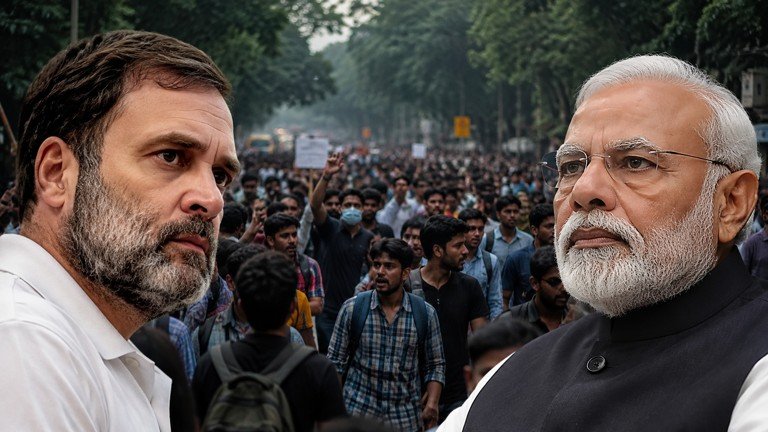
Congress leader and Leader of Opposition in the Lok Sabha Rahul Gandhi has stepped up his attack on the Narendra Modi government over the caste census. He has linked the demand for greater representation of Other Backward Classes (OBCs) with the wider political awakening seen among young people.
Gandhi’s latest warning comes as the caste census remains a major political issue in India. The Congress has consistently demanded detailed caste-based data to determine the population and socio-economic position of different communities.
His remarks also invoke the recent political significance of Gen Z, whose protests and mobilisation have emerged as a powerful force in several parts of the world. Gandhi’s message suggests that a similar mobilisation among OBCs could create significant political pressure if their demands for representation and social justice remain unresolved.
The issue has become increasingly important for both the Congress and the BJP as political parties seek to consolidate support among OBC communities.
Rahul Gandhi Raises ‘Gen Z’ Comparison
Gandhi’s warning draws attention to the possibility of OBC communities adopting a more assertive political approach. His reference to the Gen Z movement is aimed at highlighting the power of organised public mobilisation.
The younger generation has increasingly used social media, digital platforms and street protests to raise political and economic concerns. Gandhi’s argument is that OBCs, too, could become more politically assertive if they believe their concerns are being ignored.
The comparison adds a new dimension to the caste census debate. Instead of treating the issue only as a question of government data, Gandhi has presented it as part of a larger debate over representation and access to power.
The Congress leader has repeatedly argued that India’s OBC population does not receive representation proportionate to its numbers in important institutions.
Caste Census at Centre of Congress Campaign
The Congress has made a nationwide caste census one of its major political demands. Gandhi has argued that the government needs accurate data to understand the population of OBCs, Scheduled Castes and Scheduled Tribes.
He has also linked the census with what he calls the principle of “Jitni Abadi, Utna Haq”, meaning that representation and rights should correspond to population share.
Gandhi had earlier said that a caste census would be among the first major decisions of a Congress-led government. He described the exercise as a historic step towards social justice.
The Congress has also argued that caste data should help policymakers identify inequalities in employment, education, administration and other areas.
Why OBC Representation Matters
OBCs form one of India’s largest social groups, making their political representation significant for national and state elections.
Gandhi has repeatedly pointed to the gap between the population share of OBCs and their representation in powerful institutions. He has particularly highlighted the presence of OBC officials in the higher bureaucracy.
In 2024, he argued that OBCs, SCs, STs and minorities together account for a large share of India’s population but remain underrepresented in several sectors. He cited the composition of the senior bureaucracy as an example of what he described as an imbalance in representation.
His latest remarks continue that argument. The Congress wants caste-based data to provide a clearer picture of representation across different sections of society.
Modi Government Has Already Announced Caste Enumeration
The caste census debate has changed significantly since the Modi government announced that caste enumeration would be included in the upcoming national census.
The decision was welcomed by several parties, although the political debate over credit quickly intensified. Opposition leaders, including Gandhi, have argued that sustained pressure from the Opposition helped push the issue to the forefront.
The government, however, has rejected the suggestion that the decision resulted from Opposition pressure.
Union minister and Apna Dal (S) leader Anupriya Patel said the decision represented a major step towards data-driven social justice. She also argued that previous governments had opportunities to conduct a caste census but did not take the decision.
This disagreement over credit has become an important part of the political debate.
BJP Highlights Its OBC Outreach
The BJP has strongly contested the Congress narrative on OBC representation. The party has highlighted several measures taken under Prime Minister Narendra Modi that it says have benefited backward communities.
BJP leaders have pointed to the constitutional status given to the National Commission for Backward Classes and the extension of OBC reservation to NEET postgraduate admissions.
The party has also highlighted the Bharat Ratna awarded to former Bihar Chief Minister Karpoori Thakur, a prominent OBC leader, as evidence of its commitment to social justice.
The BJP has also invested heavily in its organisational outreach among OBC communities. Its OBC Morcha has been tasked with communicating government schemes and policies to members of backward communities.
Political Battle Over Caste Data
The caste census has therefore developed into a political contest between the Congress and BJP.
For the Congress, the issue provides a way to challenge the BJP on questions of representation and social justice. Gandhi has used the subject repeatedly in Parliament, rallies and public speeches.
For the BJP, the challenge is to demonstrate that its policies already address the concerns of OBC communities. The party has also argued that it has taken several steps to strengthen OBC representation.
The coming caste enumeration could provide both sides with new political arguments once detailed data becomes available.
Gandhi Wants Data to Drive Policy
Gandhi’s argument is not limited to counting the number of OBCs. He wants caste data to be used to understand inequalities across different sectors.
He has called for information about representation in government institutions, private companies, education and other areas.
The Congress has argued that policymakers cannot effectively address inequality without knowing which communities remain underrepresented.
The data could potentially influence welfare programmes and policy planning. However, the government will also have to determine how the information is collected, categorised and eventually used.
Concerns Over Political Mobilisation
Gandhi’s Gen Z comparison also raises questions about how caste politics could evolve in the digital age.
Young people increasingly use social media to organise campaigns and communicate political messages. OBC organisations and activists could similarly use digital platforms to highlight demands for representation.
If caste data shows significant disparities, political pressure for changes in welfare and reservation policies could increase.
At the same time, the government will need to manage the process carefully to prevent misinformation and social tensions.
Reservation Could Become Next Major Debate
One of the biggest questions surrounding the caste census is whether its findings could influence the reservation system.
Congress leaders have argued that representation should reflect population figures. However, changes to reservation policy involve constitutional, legal and political considerations.
The government has not said that caste enumeration will automatically result in changes to existing reservation arrangements.
The data could nevertheless become an important reference point for future policy discussions.
OBC Politics Could Shape Future Elections
OBC voters are politically important across several major states, including Uttar Pradesh, Bihar, Maharashtra, Karnataka and Madhya Pradesh.
Political parties therefore have strong incentives to address their concerns. The BJP has built a substantial support base among OBC communities, while the Congress is trying to expand its appeal through the social justice agenda.
Regional parties such as the Samajwadi Party, Rashtriya Janata Dal and Janata Dal (United) have also historically made OBC representation a central part of their political campaigns.
The caste census could consequently reshape political narratives across several states.
What Rahul Gandhi’s Warning Means
Gandhi’s reference to the Gen Z path is essentially a warning about what could happen if large sections of OBC communities feel that their demands are not being addressed.
His message is that demographic strength can translate into political mobilisation. The Congress wants the government to recognise this growing demand and ensure that caste enumeration produces meaningful information.
However, the Modi government has already committed to caste enumeration. The political debate has therefore shifted from whether caste should be counted to what the government will do with the resulting data.
That could become the next major battleground.
Caste Census Debate Enters New Phase
Rahul Gandhi’s latest remarks show that the caste census remains a central part of the Congress’s social justice campaign. By comparing potential OBC mobilisation with Gen Z protests, he has sought to underline the political power of communities demanding greater representation.
The BJP, meanwhile, continues to argue that its record on OBC welfare and representation demonstrates its commitment to social justice. The government has also maintained that the decision to include caste enumeration is part of its own policy agenda rather than a response to Opposition pressure.
The eventual publication of caste data could therefore have consequences far beyond statistics. It could influence debates over representation, welfare policies and reservations.
For now, Gandhi’s warning has added another layer to the political conversation. His central argument is that communities that feel underrepresented may increasingly demand a greater share in India’s institutions and decision-making.
As the caste enumeration process moves forward, the question will be whether the data leads to concrete policy changes—and whether India’s political parties can respond to demands for social justice without deepening social divisions.