


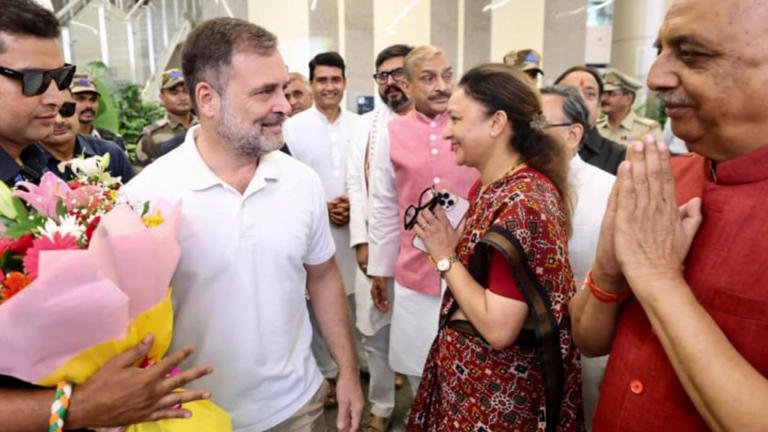
Rahul Gandhi launched a sharp attack on Prime Minister Narendra Modi while warning that the country could soon face a major economic shock. The Congress leader claimed that serious economic challenges are approaching and urged citizens to prepare for difficult times ahead.
Using the phrase “a storm is coming,” Rahul Gandhi accused the central government of failing to address key economic issues such as unemployment, inflation, rising inequality, and pressure on small businesses. His remarks quickly triggered political reactions from the ruling BJP, which rejected the criticism and defended the government’s economic policies.
The Congress leader’s comments came during a political interaction where he questioned the government’s handling of the economy and alleged that ordinary citizens were bearing the burden of economic mismanagement.
The BJP, however, dismissed the allegations and accused Rahul Gandhi of spreading unnecessary fear and negative narratives regarding the Indian economy.
Rahul Gandhi raises concerns over economy
Rahul Gandhi said the country is moving towards economic uncertainty and warned that the situation could worsen if corrective measures are not taken quickly. He claimed that several sectors of the economy continue facing pressure despite government claims of growth and stability.
The Congress leader pointed to issues such as unemployment, rising prices of essential commodities, and economic pressure on middle-class and lower-income families. According to him, many small traders and businesses still struggle due to economic disruptions over the past few years.
Rahul Gandhi also questioned the benefits of economic growth for ordinary citizens. He argued that wealth concentration and rising inequality remain major concerns under the current government.
During his remarks, he alleged that the government focuses more on publicity than addressing structural economic problems. He further claimed that young people continue facing difficulties in securing stable employment opportunities.
The Congress leader urged citizens to remain alert and prepare for what he described as an approaching economic crisis.
BJP rejects criticism, defends economy
The Bharatiya Janata Party strongly rejected Rahul Gandhi’s statements and accused him of making politically motivated remarks aimed at creating panic.
BJP leaders defended the Modi government’s economic record and highlighted India’s growth rate, infrastructure expansion, digital economy, and global investment potential. Party spokespersons argued that India remains among the world’s fastest-growing major economies.
The ruling party also pointed to improvements in road infrastructure, manufacturing, startup growth, and digital governance as evidence of economic progress under Prime Minister Narendra Modi’s leadership.
Several BJP leaders accused Rahul Gandhi of repeatedly presenting negative narratives despite positive economic indicators and international recognition of India’s economic growth.
According to BJP representatives, the government has implemented major welfare schemes and development programmes aimed at supporting poor and middle-class families.
The political exchange quickly intensified as leaders from both parties continued attacking each other over economic management and public welfare.
Economic issues remain major political topic
Economic conditions continue to remain one of the central political issues in India. Opposition parties have repeatedly criticised the government over unemployment, inflation, and pressure on small businesses.
At the same time, the BJP government maintains that India’s economy remains strong and resilient despite global economic uncertainty and geopolitical challenges.
Experts noted that economic narratives often play a major role in political campaigns and public debates. Political parties therefore continue highlighting issues such as job creation, investment, inflation, and income growth to strengthen their positions.
Rahul Gandhi has consistently focused on economic concerns during speeches and public interactions. He has frequently criticised the government over unemployment levels and alleged inequality in economic growth.
Meanwhile, the BJP continues emphasising infrastructure development, welfare schemes, and India’s global economic standing as key achievements of the Modi government.
Opposition sharpens attack before future elections
Political observers believe Rahul Gandhi’s remarks reflect the Congress party’s broader strategy of focusing on economic concerns ahead of future elections. Opposition parties increasingly aim to connect issues like inflation and unemployment with public dissatisfaction.
The Congress leadership has repeatedly accused the government of failing to generate enough employment opportunities for youth. Rahul Gandhi has also raised concerns regarding farmers, small businesses, and rising living costs in several recent speeches.
Analysts believe the opposition hopes economic issues may resonate strongly with sections of voters facing financial pressure and employment uncertainty.
At the same time, BJP leaders remain confident about the government’s development record and economic policies. The ruling party believes infrastructure projects, welfare initiatives, and investment growth continue strengthening public support.
Political commentators noted that economic debates are likely to intensify further as parties prepare for upcoming electoral battles.
Experts divided on economic outlook
Economic experts continue offering mixed opinions regarding India’s economic future. Some analysts highlight strong GDP growth, digital expansion, and infrastructure investment as positive indicators for long-term development.
Others, however, express concern regarding unemployment, inflationary pressure, and uneven distribution of economic benefits. Rising costs of living and financial stress among lower-income groups remain significant public concerns in many regions.
Several experts also pointed out that global economic conditions continue affecting domestic markets and investment trends. Geopolitical tensions, supply chain disruptions, and international financial uncertainty remain important external factors.
Despite differing opinions, economists generally agree that employment generation and balanced growth remain key priorities for India’s long-term economic stability.
The ongoing political debate between the Congress and BJP reflects these broader discussions regarding the direction of the economy and policy priorities.
Congress and BJP continue political confrontation
Rahul Gandhi’s latest remarks have once again intensified the political confrontation between the Congress and the BJP. Leaders from both parties continue presenting contrasting narratives regarding the country’s economic condition.
The Congress argues that ordinary citizens continue facing economic hardship despite government claims of progress. Meanwhile, the BJP insists that India’s economy remains on a strong growth path under Prime Minister Narendra Modi’s leadership.
Political observers believe the issue is likely to remain central in public discourse as parties continue engaging in aggressive political messaging and policy debates.
Rahul Gandhi’s warning about an “economic storm” has therefore become both a political statement and a broader criticism of the government’s economic approach.
Economic debate expected to continue
The sharp exchange between Rahul Gandhi and the BJP highlights how economic issues remain deeply connected to India’s political landscape. Concerns regarding inflation, employment, and economic opportunity continue shaping public discussions across the country.
While the Congress attempts to portray the economy as vulnerable and uneven, the BJP continues presenting India as a rapidly growing global power with strong development momentum.
As political campaigns and parliamentary debates continue, economic issues are expected to remain among the most discussed topics in national politics.
Rahul Gandhi’s remarks have once again brought attention to the broader debate surrounding economic growth, public welfare, and governance under the Modi government.