


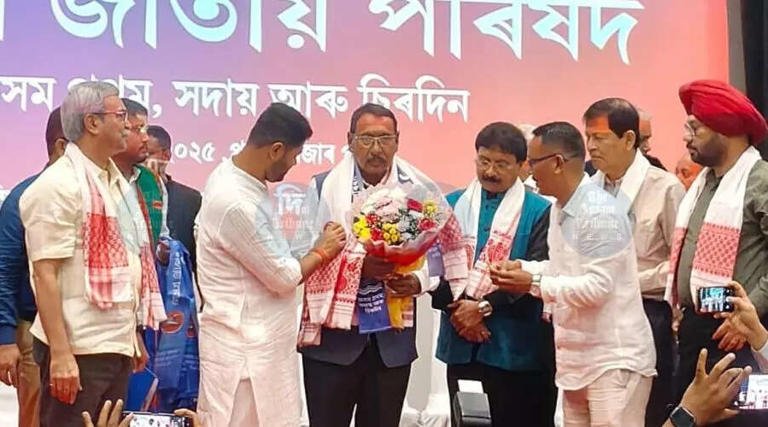
The political landscape of Assam witnessed a major shift as former Union Minister Rajen Gohain joins Assam Jatiya Parishad (AJP), marking a significant development ahead of the 2026 Assembly elections. The veteran leader, who had been a long-time member of the Bharatiya Janata Party (BJP), announced his decision at a public event in Nagaon. His move reflects growing discontent among senior leaders who feel that the BJP’s central leadership has overlooked regional voices and Assamese identity.
Read More: Adil Hussain Named Festival Ambassador for Arunachal Rang Mahotsav 2025
Addressing supporters and journalists, Gohain said his decision stemmed from what he called the BJP’s “drift away from the people’s issues.” He accused the party leadership of ignoring the sentiments of Assam’s indigenous population and prioritizing power politics over welfare and cultural preservation. “The BJP I joined decades ago was committed to the land and people of Assam. Today, it has become a machine driven by outsiders and corporate interests,” Gohain remarked.
The 73-year-old leader’s move to the AJP is expected to strengthen the regional party’s standing in central Assam, where Gohain maintains a loyal voter base. His decision also signals shifting political alliances as parties prepare for a closely contested election.
A Break from BJP After Decades
The Rajen Gohain joins Assam Jatiya Parishad announcement ends a long association that began in the early 1990s. Gohain, a four-time Member of Parliament from Nagaon, served as Minister of State for Railways in Prime Minister Narendra Modi’s first term. Known for his straightforward nature and grassroots connect, he was among the early faces of BJP’s rise in Assam.
However, differences reportedly began to surface between Gohain and the state BJP leadership over policy priorities and candidate selections. The former minister had voiced dissatisfaction with the party’s handling of regional issues like land rights, employment, and implementation of the National Register of Citizens (NRC).
“I tried to raise concerns internally, but the leadership no longer listens. The party has lost touch with its original ideals,” Gohain said. He added that regional voices within the BJP had been marginalized and that decision-making had become overly centralized.
According to sources, the turning point came during recent discussions on the upcoming local polls, where Gohain was allegedly sidelined. His shift to AJP, therefore, comes as both a personal and political statement against the current direction of the BJP in Assam.
Gohain’s Vision for a Regional Renaissance
The Rajen Gohain joins Assam Jatiya Parishad move aligns him with a party that has positioned itself as a defender of Assamese identity and regional autonomy. Founded in 2020 by members of the All Assam Students’ Union (AASU) and Asom Jatiyatabadi Yuba Chatra Parishad (AJYCP), the AJP emerged as a response to growing central dominance in state politics.
Gohain said his decision was guided by the need to restore people’s trust in regional representation. “Assam needs a political force that speaks for its people, not one that takes instructions from Delhi. The AJP embodies that spirit,” he declared.
Party president Lurinjyoti Gogoi welcomed Gohain’s entry, calling it a major boost for the AJP. “Rajen Gohain’s experience and credibility will strengthen our movement for a self-reliant Assam. His decision sends a strong message that regional unity is the way forward,” Gogoi said.
Gohain emphasized that his immediate goal is to rebuild public faith in regional politics. He announced plans to work on issues such as unemployment, erosion control, and safeguarding the Assamese language. “Our people need leaders who stay rooted in their struggles. I want to dedicate my remaining years to that cause,” he added.
Critique of BJP’s Governance and Policies
The Rajen Gohain joins Assam Jatiya Parishad development also carries a strong critique of the BJP’s current leadership in Assam. Gohain accused the ruling party of failing to address rising unemployment, economic inequality, and ethnic tensions.
He argued that despite promises of development, many rural and semi-urban areas remain neglected. “Projects are launched with fanfare, but implementation is weak. The government talks about growth while ordinary citizens struggle for basic facilities,” he said.
The former minister also criticized the BJP’s approach to cultural and linguistic identity. He alleged that the party’s national agenda often overshadows regional concerns, leading to a loss of confidence among the Assamese population. “Cultural preservation is not about slogans; it requires empathy and policy. The BJP has failed to understand that,” Gohain said.
His comments drew sharp responses from BJP leaders, who dismissed his allegations as “politically motivated.” Party spokespersons claimed that Gohain’s exit would not impact the BJP’s prospects in Assam, as the party remains “deeply connected with the people.”
Political Reactions and Implications
The Rajen Gohain joins Assam Jatiya Parishad announcement sparked widespread debate in political circles. Opposition parties, including the Congress and Raijor Dal, welcomed the move as a sign of BJP’s internal divisions. Congress leader Debabrata Saikia said Gohain’s decision “exposes the growing dissatisfaction among BJP veterans.”
Political analysts believe Gohain’s shift could reshape voter dynamics in central Assam. As a respected leader with decades of experience, he could attract traditional BJP voters who are disillusioned with the current government. His move may also encourage other regional leaders to align with the AJP, giving the party a broader base ahead of the 2026 polls.
Analyst Dr. Bhaskarjyoti Goswami said, “While Gohain may not bring large numbers, he adds legitimacy to AJP’s regional narrative. His presence will help the party connect with older voters and rural communities.”
Toward a New Political Chapter
For Gohain, joining the AJP represents both a return to his regional roots and a call for political reform. “Assam’s people deserve leadership that listens and delivers. I have made this decision for the future of our state, not for personal gain,” he said during his speech.
The Rajen Gohain joins Assam Jatiya Parishad moment underscores a growing sentiment among many in Assam—that regional identity and self-determination need renewed political expression. With elections on the horizon, this shift could redefine alliances and challenge national parties’ dominance in the state.
As AJP leaders prepare for their next phase of outreach, they believe that experienced figures like Gohain will lend the party both strategic depth and credibility. Whether this move signals a broader realignment in Assam’s politics or remains a symbolic gesture, it has already reignited the debate on who truly represents Assam’s people.
Read More: Assam Set to Welcome PM Modi and Amit Shah for Major Project Launches