


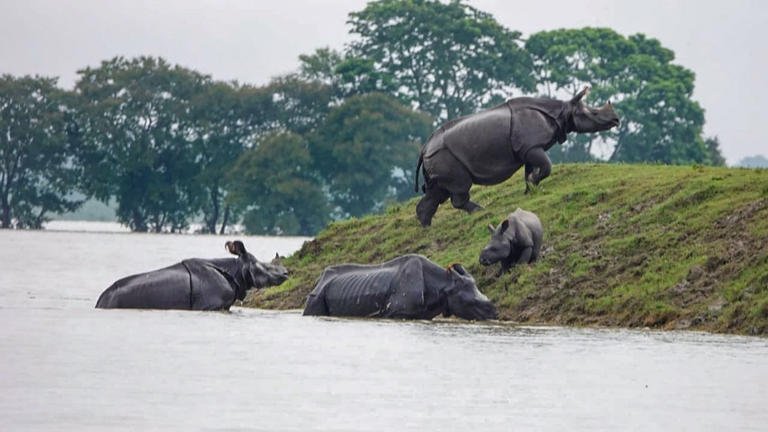
Today, the image of the Indian one-horned rhinoceros is almost inseparable from Assam’s Kaziranga National Park. The world-famous conservation area is home to the largest population of the species and has become a symbol of successful wildlife protection. However, few people realize that around 3,000 years ago, rhinoceroses were not limited to a small corner of northeastern India. They once roamed vast stretches of the Indian subcontinent, including large parts of northern India, the Gangetic plains, and regions that are now heavily populated and urbanized.
The story of how these magnificent animals became confined largely to Kaziranga and a few other protected habitats is one of environmental change, human expansion, habitat destruction, and ultimately, conservation success. Understanding this journey provides valuable insights into both India’s ecological history and the importance of wildlife protection.
A Widespread Presence Across Ancient India
Historical records, archaeological evidence, and ancient texts suggest that the Indian rhinoceros once inhabited a much larger geographical range than it does today. The species thrived in the fertile floodplains, grasslands, wetlands, and riverine forests that stretched across northern India and beyond.
Ancient literature, including references found in historical accounts and regional traditions, indicates the presence of rhinos in areas far beyond present-day Assam. Researchers have found evidence suggesting that rhinos inhabited regions along the Indus and Ganges river systems and parts of present-day Uttar Pradesh, Bihar, West Bengal, and even Pakistan.
The extensive grasslands and wetlands of ancient India provided ideal conditions for rhinos. These herbivorous animals depend on abundant vegetation, access to water, and open landscapes where they can graze and move freely.
At the time, the natural environment offered a continuous habitat network that supported healthy rhino populations across a vast area.
The Importance of Riverine Ecosystems
Rhinos have always been closely associated with river systems. Their preferred habitats include floodplains, marshes, swamps, and grasslands located near rivers. Such environments provide both food and protection.
The rivers of northern India once created enormous stretches of fertile grasslands that supported diverse wildlife populations, including rhinos, elephants, wild buffaloes, deer, and numerous bird species.
Seasonal flooding played a crucial role in maintaining these ecosystems. Floodwaters replenished nutrients, encouraged vegetation growth, and prevented forests from completely overtaking grassland habitats.
For centuries, rhinos flourished within these dynamic landscapes. However, the very river valleys that supported wildlife also attracted growing human populations.
As civilizations expanded, increasing pressure was placed on these habitats, gradually altering the balance between humans and wildlife.
Human Settlement and Habitat Loss
One of the primary reasons for the decline of rhino populations across northern India was the rapid expansion of human settlements. As agriculture became more widespread, large areas of grassland and wetland were converted into farmland.
The fertile floodplains that once supported rhinos were particularly attractive for cultivation because of their rich soils and access to water. Over time, forests were cleared, grasslands were reduced, and wetlands were drained to accommodate growing populations.
As habitats became fragmented, rhinos lost access to the extensive territories they once occupied. Isolated populations became more vulnerable to environmental pressures and human activities.
The expansion of villages, towns, transportation networks, and agricultural fields steadily reduced the space available for wildlife.
By the medieval period, many former rhino habitats had already disappeared or been severely degraded.
Hunting and Royal Sport
Habitat loss alone did not explain the dramatic decline in rhino numbers. Hunting played an equally significant role.
Throughout history, rhinos were often hunted for sport, prestige, and perceived medicinal value. Royal hunting expeditions were common in various parts of the Indian subcontinent, and large animals such as rhinos were considered prized trophies.
As firearms became more accessible, hunting became increasingly efficient and destructive. Rhino populations that had already been weakened by habitat loss faced additional pressure from organized hunting activities.
The belief that rhino horn possessed medicinal properties further increased demand for the species. Although scientific evidence does not support these claims, the illegal trade in rhino horn contributed significantly to population declines.
By the nineteenth century, rhinos had vanished from much of their historical range.
Decline to a Few Isolated Populations
By the late nineteenth and early twentieth centuries, the Indian rhinoceros had become restricted to a handful of isolated populations in northeastern India and Nepal.
Many wildlife experts feared that the species could become extinct. Estimates suggest that the total population may have fallen to just a few hundred individuals.
In Assam, rhinos survived primarily in remote floodplain habitats where human settlement remained relatively limited. Areas such as Kaziranga provided one of the last refuges for the species.
Even within these remaining habitats, however, the animals faced ongoing threats from hunting and habitat encroachment.
Without intervention, the future of the Indian rhinoceros appeared uncertain.
The Birth of Kaziranga’s Conservation Story
The turning point came during the early twentieth century when conservation efforts began to take shape in Assam.
Concerned about the declining rhino population, conservation advocates and administrators pushed for greater protection of wildlife habitats. Kaziranga was initially designated as a protected area to safeguard the remaining rhinos.
Over the years, the protected status of the area was strengthened through various measures, eventually leading to its recognition as a national park and later as a UNESCO World Heritage Site.
Strict anti-poaching measures, habitat management, scientific monitoring, and government support played crucial roles in the recovery of rhino populations.
Kaziranga became a model for wildlife conservation not only in India but around the world.
Why Kaziranga Became the Stronghold
Several factors contributed to Kaziranga emerging as the principal stronghold of the Indian rhinoceros.
The park’s vast grasslands provide ideal feeding grounds for rhinos. The Brahmaputra River and its tributaries create a dynamic ecosystem rich in vegetation and water resources.
Seasonal flooding, although challenging, helps maintain the grassland habitats that rhinos prefer. The park also benefits from strong legal protection and dedicated conservation efforts.
Unlike many other former rhino habitats, Kaziranga retained sufficient ecological integrity to support a growing population. Continuous management and community involvement further strengthened conservation outcomes.
Today, Kaziranga supports the majority of the world’s one-horned rhinoceroses and serves as a symbol of successful species recovery.
Continuing Conservation Challenges
Despite remarkable progress, conservation challenges remain. Rhinos continue to face threats from poaching, habitat fragmentation, climate change, and human-wildlife conflict.
Floods, while ecologically important, can sometimes force animals to move outside protected areas where they become vulnerable. Expanding infrastructure and development projects also require careful planning to avoid disrupting wildlife corridors.
Conservation authorities continue to focus on strengthening habitat protection, enhancing anti-poaching operations, and establishing additional rhino populations in other protected areas to reduce dependence on a single stronghold.
The goal is to ensure the long-term survival of the species while maintaining healthy ecosystems.
From Decline to Recovery
The journey of the Indian rhinoceros from widespread dominance across northern India to near extinction and eventual recovery in Kaziranga is one of the most remarkable wildlife stories in the world. Three thousand years ago, rhinos roamed freely across vast landscapes that stretched far beyond modern Assam. Human expansion, habitat destruction, and hunting gradually pushed them toward extinction, leaving only a few surviving populations.
Yet the story did not end there. Through sustained conservation efforts, strong legal protection, and community support, Kaziranga transformed into a sanctuary where rhinos could recover and thrive. Today, the park stands as a testament to what dedicated conservation can achieve.
The history of the Indian rhinoceros serves as both a warning and an inspiration. It reminds us of the consequences of environmental degradation while demonstrating that with commitment and action, endangered species can be given a second chance at survival.