


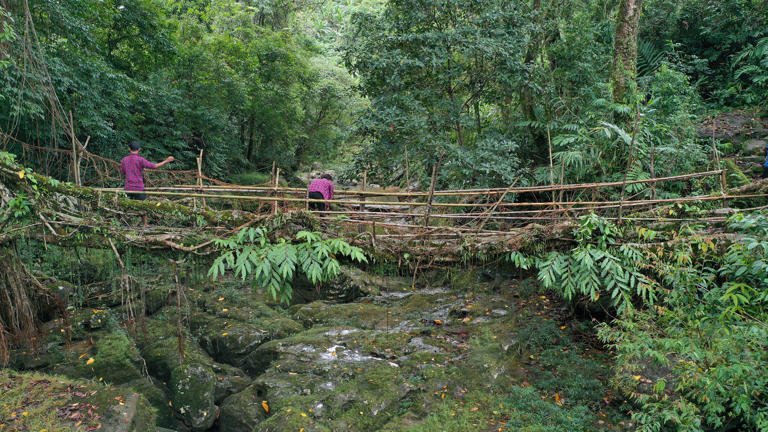
Nestled amidst the lush forests and rolling hills of Meghalaya, the state’s iconic living root bridges have long stood as remarkable examples of harmony between humans and nature. Today, these extraordinary natural structures are drawing global attention not only for their engineering brilliance but also for the unique conservation philosophy they represent. Built over decades by guiding the aerial roots of rubber fig trees across streams and rivers, the living root bridges embody a sustainable partnership between indigenous communities and the environment that continues to inspire conservationists worldwide.
Unlike conventional infrastructure that often replaces natural ecosystems, Meghalaya’s living root bridges evolve alongside nature. They grow stronger with time, require minimal artificial intervention, and reflect generations of traditional ecological knowledge passed down within local communities. As climate change, biodiversity loss, and environmental degradation become pressing global concerns, these living bridges are increasingly being recognised as powerful symbols of sustainable development and community-led conservation.
Experts believe that Meghalaya’s unique model demonstrates how indigenous wisdom can complement modern environmental strategies while preserving both cultural heritage and ecological balance.
Living Root Bridges Showcase Indigenous Innovation
The living root bridges are primarily found in Meghalaya’s Khasi and Jaintia Hills, where indigenous communities have perfected the art of training the aerial roots of the Indian rubber tree (Ficus elastica) over many decades. Instead of constructing conventional bridges from wood or concrete, villagers patiently guide the growing roots across rivers using bamboo scaffolding and natural supports until they form stable walkways.
This remarkable process often takes years before a bridge becomes fully functional, but once mature, the structures can survive for centuries with continuous community care.
The bridges represent a rare combination of engineering, ecology, and cultural tradition, demonstrating how human ingenuity can work in partnership with natural processes rather than against them.
Their continued use today highlights the enduring relevance of indigenous knowledge in addressing modern environmental challenges.
A Model of Sustainable Infrastructure
One of the most distinctive features of Meghalaya’s living root bridges is their sustainability. Unlike conventional infrastructure that deteriorates over time and often requires extensive maintenance or replacement, living root bridges become stronger as the trees continue to grow.
The bridges require very little external material, generate virtually no construction waste, and maintain the surrounding ecosystem instead of disrupting it.
Because they remain living organisms, they continue absorbing carbon dioxide, supporting biodiversity, stabilising soil, and contributing to healthy forest ecosystems throughout their lifespan.
Environmental experts increasingly cite these structures as examples of nature-based solutions that combine infrastructure development with ecological conservation.
The bridges illustrate how sustainable engineering can minimise environmental impact while providing long-term benefits for local communities.
Indigenous Communities Lead Conservation Efforts
The preservation of Meghalaya’s living root bridges depends largely on the active involvement of indigenous communities that have cared for these structures for generations. Local residents continue to maintain the bridges through traditional practices while protecting the surrounding forests that sustain them.
Community stewardship remains central to the long-term survival of these natural landmarks. Villagers understand that healthy forests, clean rivers, and thriving ecosystems are essential for the continued growth of the living bridges.
This strong sense of environmental responsibility has enabled many of the bridges to remain functional for hundreds of years despite changing environmental conditions.
Officials and conservationists acknowledge that meaningful conservation succeeds when local communities are recognised as partners rather than merely beneficiaries.
Balancing Heritage with Modern Development
As Meghalaya continues to expand its infrastructure and tourism sectors, authorities are placing increasing emphasis on balancing development with the preservation of cultural and natural heritage.
The living root bridges have become symbols of this balanced approach by demonstrating that development does not necessarily require replacing traditional practices with modern alternatives.
Instead, they encourage the integration of indigenous knowledge into contemporary planning and sustainable resource management.
Officials believe that protecting these bridges contributes not only to environmental conservation but also to safeguarding Meghalaya’s rich cultural identity for future generations.
Their preservation has therefore become both a heritage priority and an environmental responsibility.
Boosting Eco-Tourism and Local Livelihoods
The growing international recognition of Meghalaya’s living root bridges has significantly contributed to the state’s eco-tourism sector. Visitors from across India and abroad travel to experience these unique natural structures while exploring the region’s forests, waterfalls, caves, and indigenous culture.
Responsible tourism centred around the living root bridges generates income for local communities through homestays, guided tours, handicrafts, transportation, and hospitality services.
The economic benefits have encouraged greater community participation in conservation, as residents recognise that preserving natural heritage also supports sustainable livelihoods.
Officials continue promoting eco-tourism models that prioritise environmental protection while ensuring tourism growth benefits local communities directly.
Such approaches strengthen both conservation and rural economic development.
Living Bridges Offer Lessons for Climate Resilience
Climate change has increased global interest in nature-based solutions capable of improving environmental resilience. Meghalaya’s living root bridges demonstrate how natural systems can provide durable infrastructure while adapting to changing environmental conditions.
Unlike concrete structures that may deteriorate under extreme weather events, living bridges continue growing and strengthening over time, making them remarkably resilient.
Their deep root systems also help prevent soil erosion, stabilise riverbanks, improve water retention, and support surrounding vegetation.
Experts suggest that these traditional engineering techniques offer valuable lessons for climate adaptation, particularly in ecologically sensitive and high-rainfall regions.
As countries seek sustainable infrastructure models, Meghalaya’s living root bridges provide a compelling example of resilience through coexistence with nature.
Global Recognition Strengthens Conservation Efforts
The international profile of Meghalaya’s living root bridges has grown considerably in recent years, attracting the attention of researchers, environmental organisations, architects, and conservation experts.
Their recognition extends beyond tourism, with increasing discussions about their importance as examples of sustainable engineering, biodiversity conservation, and indigenous innovation.
Greater global visibility has also strengthened efforts to preserve these remarkable structures through scientific documentation, community engagement, and responsible tourism management.
Officials continue supporting initiatives that promote awareness while ensuring that increased visitor interest does not compromise the ecological integrity of the surrounding forests.
Responsible conservation remains essential for maintaining the authenticity and environmental value of these living landmarks.
Community Partnership at the Heart of Conservation
Perhaps the greatest lesson offered by Meghalaya’s living root bridges is that successful conservation depends on partnership. Rather than separating people from nature, these bridges demonstrate how communities can actively shape and protect ecosystems through generations of stewardship.
The bridges continue to survive because local people view themselves not as owners of nature but as custodians responsible for preserving it.
This philosophy aligns closely with modern conservation approaches that increasingly recognise the importance of indigenous knowledge, local participation, and community-led resource management.
The partnership between forests, rivers, trees, and communities has created one of the world’s most remarkable examples of sustainable coexistence.
A Global Inspiration Rooted in Nature
Meghalaya’s living root bridges represent far more than architectural marvels—they embody a timeless philosophy of cooperation between humanity and the natural world. By blending indigenous knowledge, environmental stewardship, sustainable engineering, and community participation, these extraordinary structures have emerged as powerful symbols of conservation in an era increasingly defined by climate and ecological challenges.
As nations search for innovative solutions to protect biodiversity while supporting sustainable development, Meghalaya offers an inspiring example rooted in patience, partnership, and respect for nature. The continued preservation of the living root bridges not only safeguards a priceless cultural and ecological heritage but also demonstrates that the most enduring infrastructure is often built not against nature, but alongside it. Through community commitment and responsible conservation, these living bridges will continue connecting people, landscapes, and generations while redefining what sustainable development truly means.