


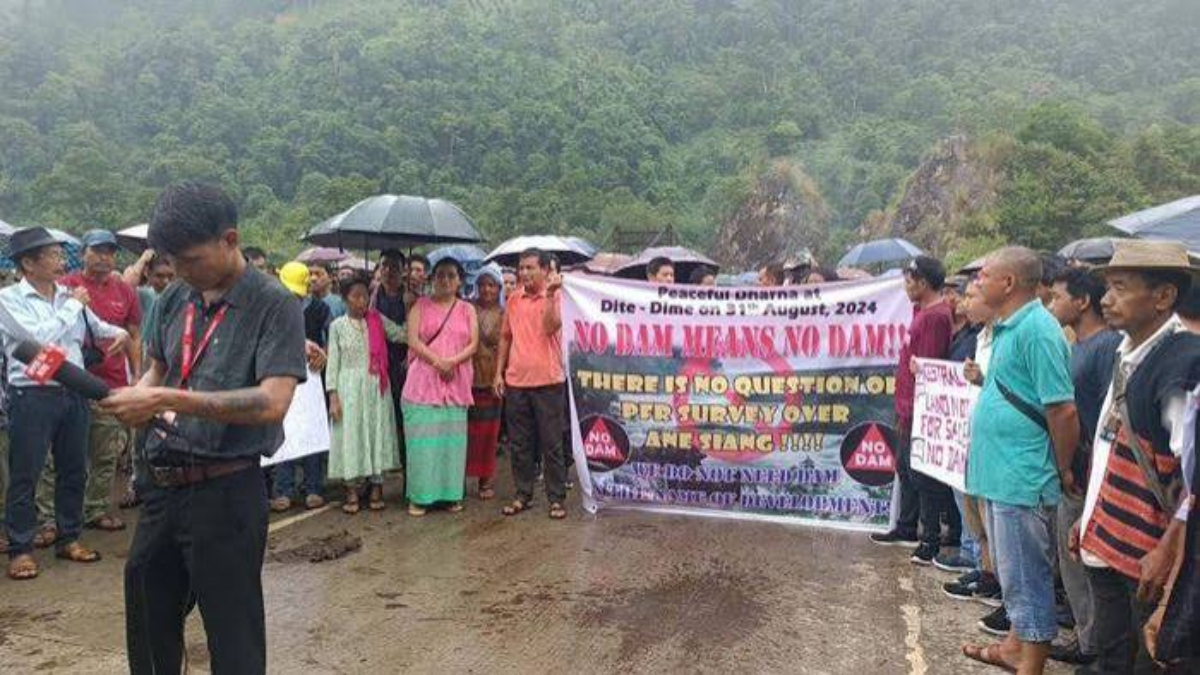
Siang Valley dam opposition has received fresh support from Nagaland, with the Nagaland Community Conserved Areas Forum (NCCAF) expressing solidarity with residents of Arunachal Pradesh opposing the proposed Siang Upper Multipurpose Project (SUMP). In an open letter issued on November 9, 2026, the forum urged the Centre and the Arunachal Pradesh government to respect the decisions of traditional village councils and listen to communities resisting the proposed mega dam. The organisation also highlighted concerns over ancestral land, indigenous rights, traditional livelihoods and the growing tensions in the region. India Today NE+1
Nagaland forum stands with Siang Valley residents
The NCCAF, an organisation representing community-conserved areas across Nagaland, issued the letter to express support for the Indigenous Adi people and other communities living in the Siang Valley.
Signed by forum chairman Heirang Lungalang and secretary Seve R. Vadeo, the letter described the residents’ resistance as a legitimate effort to protect their ancestral territory and natural resources.
The organisation said it had been following developments in the valley with concern. It referred to reports of women keeping watch near riverbanks, elders facing action for supporting their villages and young people being detained amid the continuing protests.
The forum also raised concerns about farmers experiencing difficulties accessing their agricultural fields during the harvest season. It drew attention to reports that residents had faced restrictions while moving to their fields and carrying traditional agricultural tools.
Describing its solidarity with the affected communities, the NCCAF said the people of the Siang Valley were not alone in their struggle to protect their land and river.
Traditional village councils at the centre of the dispute
A major point raised by the NCCAF concerns the role of the kebang, the traditional village council of the Adi community. The forum argued that decisions about ancestral land and natural resources must be made collectively through these customary institutions.
It referred to two important village-level resolutions.
In August 2025, the General Bogum Bokang Kebang at Geku declared the Siang River as Aane Siang, meaning a goddess river. The council adopted a resolution opposing both the proposed mega dam and its pre-feasibility report (PFR) survey.
Similarly, in March 2026, the Ramku village kebang reportedly adopted a resolution declaring collective non-consent to pre-feasibility activities on its customary land. It also maintained that no individual or group could represent the village without authorisation from its village council.
The Nagaland organisation questioned attempts to secure support through individual household signatures, arguing that these cannot replace collective decisions made by traditional institutions.
According to the forum, such practices risk creating divisions among neighbouring families and communities.
Siang Valley dam opposition linked to indigenous rights
The NCCAF also highlighted the conservation efforts undertaken by Adi communities, arguing that their relationship with the environment must be considered before major development projects are pursued.
It referred to traditional restrictions on hunting and fishing using explosives, poison and electric current. Gobuk village was cited as an example of a community that had moved away from hunting towards protecting its natural surroundings.
The forum also noted that several villages in Upper Siang had started setting aside forest areas for community conservation.
Importantly, the organisation clarified that opposition to the proposed mega dam should not be viewed as opposition to development itself.
It pointed out that the Geku traditional council had expressed willingness to consider smaller hydropower projects on the Siang’s tributaries, even while rejecting the proposed large-scale project.
The position, therefore, reflects a demand for development decisions that recognise local priorities, environmental concerns and customary rights.
11,200-MW project faces growing resistance
The proposed Siang Upper Multipurpose Project is an 11,200-MW hydropower and flood-control project planned in Arunachal Pradesh. It is expected to become one of India’s largest hydropower developments.
The Centre and the Arunachal Pradesh government have highlighted its strategic importance, particularly in the context of China’s proposed hydropower development on the Yarlung Tsangpo River, which flows into India as the Siang.
However, Siang Valley dam opposition has intensified over concerns about displacement, submergence of ancestral territories, environmental damage and the possible disruption of traditional livelihoods.
The project is expected to affect 27 villages, making land rights and community consent central issues in the ongoing debate. India Today NE+1
The Siang Indigenous Farmers’ Forum (SIFF) has also questioned the transparency of the consultation process. Its representatives have alleged that affected private and community landowners were not adequately informed about the proposed survey.
However, BJP MLA and Arunachal Pradesh minister Ojing Tasing has denied allegations that memorandums of understanding were signed under duress. The state government has maintained that the pre-feasibility process will continue. India News – The Indian Express
Protests and security deployment deepen tensions
The disagreement has developed into a wider confrontation between residents and authorities. Protests intensified in September 2026 following the deployment of security personnel to facilitate survey-related activities.
Tensions escalated further on October 23, when a protest march turned violent in Pasighat. The NHPC office was set on fire, while other incidents of vandalism and damage were reported. Police subsequently registered cases and arrested several people.
The deployment of additional security personnel and the detention of protesters have remained major concerns for local organisations.
On October 25, Chief Minister Pema Khandu reiterated that no final decision had been taken on constructing the dam. He stressed that public consultation and consent would remain important before any decision on the project.
On November 7, the state government released four protesters detained under the Arunachal Pradesh Unlawful Activities (Prevention) Act as a goodwill measure aimed at facilitating dialogue with the protesting organisations.
The NCCAF’s intervention adds another regional voice to the growing debate over the project. Its appeal places particular emphasis on recognising traditional institutions and ensuring that affected communities are not excluded from decisions concerning their future.
The forum’s message to the Centre and the Arunachal Pradesh government is that development cannot be pursued by overlooking the people whose land, rivers and livelihoods may be affected. It has urged authorities to engage directly with the Siang Valley residents and respect the decisions reached through their customary councils. The coming weeks will be important in determining whether dialogue can help ease tensions and address the concerns surrounding the proposed project.
Northeast Unity: Mizoram Minister Highlights Powerful Path to Regional Growth