


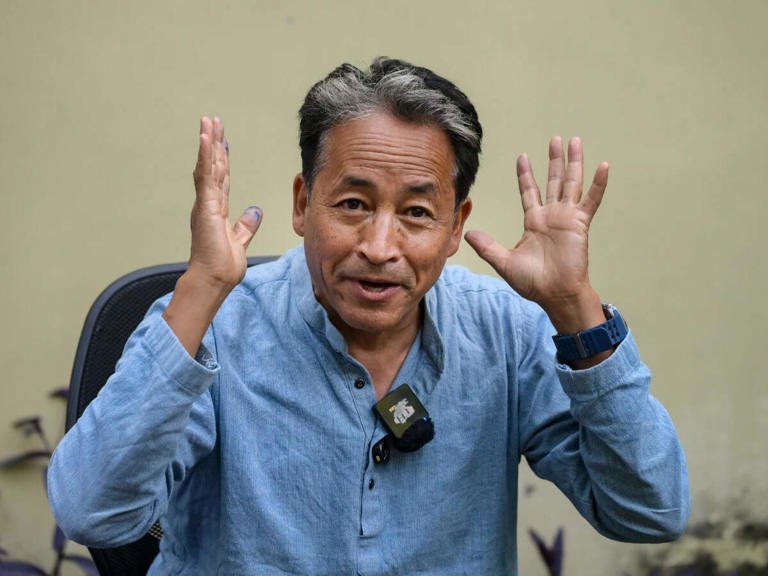
Climate activist Sonam Wangchuk has accused the Centre of moving away from an understanding reached with Ladakh’s representatives in May 2026. He has reiterated the demand for an elected legislature with meaningful powers, saying the people of the Union Territory deserve greater democratic representation.
Wangchuk’s criticism comes amid renewed tensions between Ladakh’s political representatives and the Union Ministry of Home Affairs (MHA). The two sides have held several rounds of discussions on constitutional safeguards and a proposed governance structure for the region. However, recent meetings have failed to produce a consensus.
In a video message released on Thursday, October 22, Wangchuk expressed disappointment over uncertainty surrounding the next round of talks. He said Ladakh’s representatives had expected a meeting in New Delhi on the scheduled date but had not received confirmation that it would take place.
According to Wangchuk, the latest developments have strengthened concerns that the Centre is retreating from assurances given during earlier discussions. He argued that the people of Ladakh were still waiting for concrete steps towards democratic governance.
Disagreement Over the May Understanding
The current dispute follows discussions held on May 22 between officials from the Union Home Ministry and representatives of the Leh Apex Body (LAB) and the Kargil Democratic Alliance (KDA).
After the meeting, Wangchuk had described the outcome as an important step towards restoring democratic governance in Ladakh. He said the two sides had reached an in-principle understanding on a tailor-made legislative body with law-making, executive and financial powers.
The proposed arrangement was intended to address Ladakh’s demand for greater autonomy after the region became a Union Territory in 2019. Representatives also sought safeguards to protect local land, culture, identity and the fragile Himalayan environment.
However, the understanding did not amount to a final agreement. Details of the proposed structure and the extent of its powers remained subject to further discussions.
Subsequent disagreements over the wording of meeting records and the authority of elected representatives over the bureaucracy added to the uncertainty. Wangchuk and other Ladakh leaders have maintained that any final arrangement must reflect the substance of the commitments discussed in May.
Demand for an Empowered Legislative Assembly
At the centre of the dispute is the demand for a legislative body that can exercise meaningful authority over Ladakh’s administration.
Wangchuk and other representatives have argued that an elected assembly must have more than a limited advisory role. They want elected leaders to have substantial control over legislation, public spending and administrative decisions.
The Leh Apex Body and the Kargil Democratic Alliance have also called for constitutional guarantees to protect the region’s interests. Their demands have included safeguards for land ownership, employment opportunities, cultural identity and environmental resources.
Ladakh’s representatives have long sought inclusion under the Sixth Schedule of the Constitution and statehood. During negotiations, however, the Centre proposed exploring safeguards modelled on provisions similar to Article 371, alongside a special legislative arrangement.
The two sides have yet to agree on the precise structure and scope of these protections.
For Wangchuk, the effectiveness of any arrangement will depend on whether it transfers genuine decision-making authority to elected representatives. He has argued that democratic accountability would remain limited if major administrative and financial decisions continued to rest primarily with the centrally appointed administration.
Latest Talks Fail to Bridge the Gap
A meeting between the MHA sub-committee, the LAB and the KDA in Leh on October 15 failed to resolve the differences. Both sides exchanged draft proposals, but Ladakh’s representatives said the government’s proposal did not adequately address their demands.
Wangchuk described the discussions as unsatisfactory and pointed to a significant gap over the proposed democratic structure, the powers of the assembly and constitutional safeguards.
The participants had indicated that another round of talks could take place in New Delhi on October 22. Ladakh’s representatives hoped that a revised draft would address their concerns and provide a basis for further negotiations.
However, uncertainty over the meeting prompted fresh criticism from Wangchuk. He said he had made arrangements to travel based on the earlier understanding that discussions would continue on the scheduled date.
The latest disagreement has added pressure on the Centre to clarify its position and provide a concrete roadmap for resolving Ladakh’s long-standing political demands.
Strategic Importance and Local Concerns
Ladakh’s political demands are closely linked to concerns over its strategic location along India’s borders with China and Pakistan. Local representatives have argued that residents who live in the sensitive border region should have a stronger voice in decisions affecting their land, livelihoods and future.
Wangchuk has also highlighted the challenges faced by communities living in the ecologically fragile Himalayas. He believes greater local participation in governance would help protect the region’s environment and ensure that development decisions reflect local needs.
Since Ladakh’s separation from the former state of Jammu and Kashmir in 2019, demands for constitutional protection, employment safeguards and democratic representation have remained central to public debate.
The ongoing negotiations are therefore significant not only for the region’s administrative structure but also for the relationship between Ladakh’s communities and the Union government.
Centre Faces Pressure to Provide Clarity
The Centre has maintained that it is committed to finding a political solution for Ladakh. However, the failure to reach an agreement in recent meetings has left important questions unresolved.
For Ladakh’s representatives, the next step must be a revised proposal that clearly defines the powers of the proposed assembly and provides credible constitutional safeguards. They have stressed that discussions cannot deliver a lasting solution without addressing these core demands.
Wangchuk’s latest remarks reflect growing frustration over the slow pace of negotiations. His criticism also signals that the leadership of the ongoing campaign is unwilling to accept an arrangement that falls short of meaningful democratic representation.
The immediate challenge is to restore confidence between the two sides and establish a clear path towards an agreement. Whether the next round of talks can narrow the differences will determine the future course of Ladakh’s demand for an empowered legislature and stronger constitutional protection.