


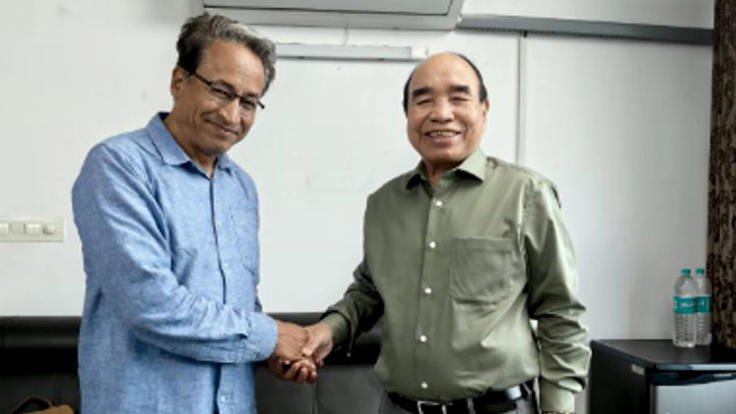
Activist, educator and environmentalist Sonam Wangchuk met former Mizoram Chief Minister and Mizo National Front (MNF) president Zoramthanga in New Delhi to learn more about Mizoram’s peace process and its historic peace settlement.
The meeting took place at Mizoram House on September 28 and lasted for around one-and-a-half hours. The two discussed political and contemporary issues, as well as the reconciliation process that eventually brought an end to decades of insurgency in Mizoram.
Wangchuk Interested in Mizoram’s Peace Model
During the meeting, Wangchuk expressed his desire to study the Mizo Peace Accord and understand the experiences of those who played key roles in the negotiations.
“I want to study the successful memorandum of settlement of Mizoram and understand more about the experiences of Zoramthanga,” Wangchuk said, according to an MNF release. He also expressed interest in visiting Mizoram with colleagues from Ladakh to learn more about the implementation of the settlement.
The interest comes as Wangchuk examines experiences of conflict resolution and reconciliation that could offer lessons for other regions.
Mizo Peace Accord Ended Two Decades of Insurgency
The Mizo Peace Accord, formally known as the Memorandum of Settlement, was signed in 1986 between the Government of India, the Government of Mizoram and the Mizo National Front.
The agreement brought an end to around two decades of insurgency in Mizoram and paved the way for the state’s transition to full statehood. Mizoram became India’s 23rd state on February 20, 1987.
The accord remains an important part of Mizoram’s modern political history and has attracted interest from researchers and organisations studying conflict resolution.
Zoramthanga Shares Experience of Peace Process
Zoramthanga discussed the circumstances surrounding the peace agreement and the steps involved in bringing different stakeholders into the settlement.
According to reports, he also explained the role played by the Centre in facilitating the peace process and negotiations with the Mizo National Front. Zoramthanga said the accord continues to attract interest from people and organisations seeking to understand reconciliation and negotiated settlements.
He expressed hope that Mizoram’s experience could continue to provide lessons for reconciliation in other regions.
Zoramthanga’s Role in the Mizo Movement
Zoramthanga was associated with the Mizo National Front during the insurgency period and later served as the party’s president and Chief Minister of Mizoram.
His experience in the Mizo national movement and subsequent political career made him one of the figures Wangchuk wanted to speak with while studying the peace settlement.
The discussion therefore focused not only on the text of the agreement but also on the political experiences surrounding its negotiation and implementation.
Wangchuk Invites Zoramthanga to Ladakh
During the meeting, Wangchuk also invited Zoramthanga to visit Ladakh.
The invitation came amid Wangchuk’s continuing involvement in issues concerning Ladakh and his interest in understanding different approaches to political dialogue, reconciliation and conflict resolution.
The two sides also exchanged views on contemporary issues during their meeting in New Delhi.
Mizoram’s Experience Draws Wider Interest
Mizoram’s peace process has attracted attention because the 1986 settlement brought an extended period of insurgency to an end and was followed by the state’s transition to full statehood.
The process involved negotiations between the Centre and the Mizo National Front and the participation of different stakeholders. Its implementation subsequently shaped Mizoram’s political development.
For Wangchuk, studying the experience provides an opportunity to understand how political negotiations and reconciliation contributed to the settlement.
Focus on Conflict Resolution and Reconciliation
The meeting between Sonam Wangchuk and Zoramthanga has brought renewed attention to Mizoram’s peace accord and the experiences behind it.
Wangchuk has indicated that he wants to continue studying the agreement and its implementation. His proposed visit to Mizoram could provide an opportunity to interact with people who were directly involved in the peace process and examine how the settlement evolved over time.
The discussion also highlights the continuing interest in Mizoram’s peace process as an example of negotiated conflict resolution in India’s Northeast.