


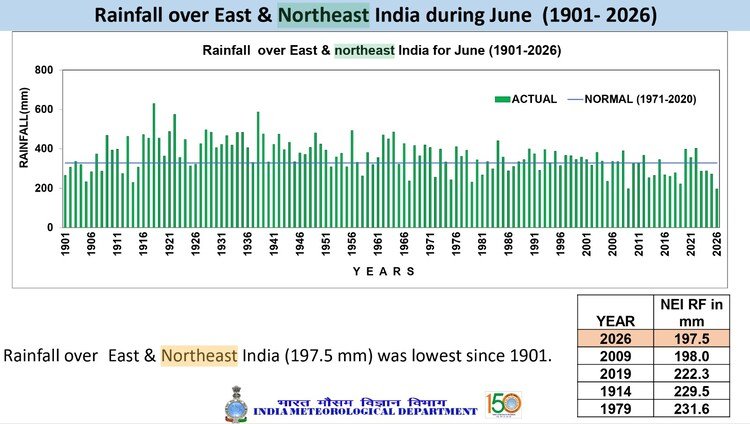
The Northeast monsoon rainfall deficit has remained a major concern as India’s southwest monsoon season draws to a close. The country recorded rainfall 12.6% below normal between June and September, while East and Northeast India faced a much larger shortfall.
The India Meteorological Department reported that East and Northeast India received about 74% of their normal seasonal rainfall. A separate IMD-linked report put the regional deficit at around 26%.
Meanwhile, the southwest monsoon has begun its withdrawal from parts of India. However, the IMD had not formally declared the monsoon withdrawn from the Northeast as of October 3.
Mizoram Water Bodies Plunge 63% in Second Central Water Census
Northeast Monsoon Rainfall Deficit Remains Significant
The Northeast monsoon rainfall deficit was considerably higher than the national shortfall during the 2026 southwest monsoon season. East and Northeast India recorded about 1,017.1 mm of rainfall, equivalent to only 74% of the region’s long-period average.
That translates into a deficit of roughly 26%. The figure makes the Northeast one of the worst-affected regions during the four-month monsoon season.
Nationally, India received 759.4 mm of rainfall from June through September. The normal figure stands at about 868.6 mm, leaving the country with a 12.6% shortfall. The IMD described 2026 as the fourth-lowest southwest monsoon season since 2001.
Therefore, the 13% figure in the headline should be understood as the approximate all-India monsoon deficit, rather than the rainfall deficit specifically recorded across the Northeast.
The regional situation was more severe. Assam, Meghalaya and Arunachal Pradesh were among the states that experienced deficient rainfall throughout all four monsoon months.
Southwest Monsoon Withdrawal Progresses
The Northeast monsoon rainfall deficit comes as the southwest monsoon enters its withdrawal phase across India. The IMD’s withdrawal criteria require several indicators, including five consecutive days without significant rainfall, establishment of an anticyclone in the lower atmosphere and a noticeable reduction in atmospheric moisture.
These conditions determine when the department can officially declare further withdrawal. Consequently, the end of the national monsoon season does not automatically mean that the monsoon has withdrawn from every region.
As of October 3, the formal withdrawal of the southwest monsoon from the Northeast had not yet been declared. The IMD requires the specified atmospheric and rainfall conditions before announcing the withdrawal.
The previous year provides a useful comparison. In 2025, the southwest monsoon officially withdrew from the Northeast on October 14. Therefore, the timing can vary considerably from one year to another.
Meanwhile, rainfall continued in parts of the region even as the broader monsoon season ended nationally. This illustrates why withdrawal remains a region-specific process rather than a single nationwide event.
Assam, Meghalaya and Arunachal Pradesh Face Larger Deficits
The Northeast monsoon rainfall deficit was particularly pronounced in several northeastern states. IMD data cited in recent reports showed that Arunachal Pradesh recorded a 44% seasonal rainfall shortfall.
Assam and Meghalaya each recorded a deficit of around 39%. These states remained rainfall-deficient through June, July, August and September.
Such a persistent deficit differs from a situation in which rainfall falls below normal only during one or two months. Instead, the shortage continued through the full southwest monsoon period.
The regional pattern was also uneven. While some areas received significant rainfall during individual weather systems, those episodes did not compensate for the accumulated shortfall.
For example, the national rainfall pattern showed substantial weekly variations. Rainfall briefly surged above normal during parts of the season before returning to deficit conditions. Consequently, the seasonal average does not fully capture the uneven distribution of rainfall across time and location.
The shortfall also matters because the Northeast depends heavily on seasonal rainfall for agriculture, local water supplies and other activities. However, the consequences will vary from one state and district to another.
2026 Monsoon Ranks Among Weakest in Decades
The Northeast monsoon rainfall deficit formed part of an unusually weak national monsoon. India ended the June-September season with rainfall at 87% of its long-period average.
The 12.6% national deficit makes 2026 the driest southwest monsoon in 11 years. It also ranks as the fourth-lowest monsoon since 2001 and the 13th-lowest since 1901.
June was particularly weak, with national rainfall reaching only about 65% of normal. July provided some recovery and reached 101% of the long-period average. However, rainfall again slipped below normal in August and September.
East and Northeast India experienced the most severe regional deficit. The region’s seasonal rainfall was the lowest recorded since 1901, according to the reported IMD assessment.
El Niño conditions also influenced the broader weather pattern. The IMD has linked the weak monsoon to the developing El Niño, which is expected to strengthen further before reaching a peak later in 2026.
Nevertheless, weather patterns involve multiple interacting factors. Therefore, the regional rainfall deficit should not be attributed to one factor alone without considering the wider atmospheric conditions.
Rainfall Outlook Remains Important After Monsoon
The Northeast monsoon rainfall deficit will remain relevant even after the southwest monsoon season ends. The IMD’s post-monsoon outlook indicates that rainfall conditions during October could remain below normal across much of India.
The national October forecast calls for rainfall below 85% of the long-period average. Most parts of the country are also expected to receive below-normal rainfall during the October-December period, although some areas of northwest India and southern peninsular India may receive normal or above-normal rainfall.
For the Northeast, however, short-term rainfall can continue after the formal withdrawal of the southwest monsoon. Local weather systems can produce showers and thunderstorms even during the transition into the post-monsoon period.
The IMD therefore continues to monitor rainfall activity across the region. Updated forecasts will help clarify whether individual states receive further rain that could reduce accumulated deficits.
At the same time, a few days of heavy rain would not necessarily eliminate a seasonal deficit. The impact depends on the amount, distribution and timing of rainfall.
Consequently, authorities and communities must assess local conditions rather than relying only on the regional or national average.
Water and Agriculture Concerns Remain
The Northeast monsoon rainfall deficit could have implications for agriculture and water availability in affected areas. Rain-fed farming is particularly sensitive to prolonged variations in seasonal rainfall.
Assam, Meghalaya and Arunachal Pradesh recorded deficits throughout the monsoon season. Therefore, local soil moisture and water conditions may require closer monitoring in areas where rainfall remained consistently below normal.
However, the effect will not be uniform. Some districts may have received adequate rainfall during individual periods, while others may have experienced longer dry spells.
Moreover, rainfall totals alone cannot determine the complete water situation. Reservoir levels, groundwater availability, soil moisture and local water-management practices also influence the impact of a weak monsoon.
The transition away from the southwest monsoon therefore brings a new phase of weather monitoring. Officials must track both the withdrawal process and any subsequent rainfall systems affecting the Northeast.
For now, the regional deficit remains a clear feature of the 2026 monsoon record. Further rainfall could provide some relief, but it would take sustained and well-distributed rain to significantly change the seasonal picture.
Conclusion
The Northeast monsoon rainfall deficit is substantially larger than the 13% shortfall recorded nationally during the 2026 southwest monsoon. East and Northeast India received around 74% of normal seasonal rainfall, translating into a deficit of about 26%.
The southwest monsoon has ended nationally, but its formal withdrawal from the Northeast had not yet been declared as of October 3. The IMD requires specific rainfall and atmospheric conditions before announcing withdrawal from the region.
Meanwhile, Assam, Meghalaya and Arunachal Pradesh remain among the most rainfall-deficient areas. Continued monitoring will be important as the region moves into the post-monsoon period.
FAQs
What is the Northeast monsoon rainfall deficit in 2026?
The Northeast monsoon rainfall deficit during the southwest monsoon season was around 26%, with East and Northeast India receiving about 74% of normal rainfall.
Is the 13% rainfall deficit specific to Northeast India?
No. The approximately 13% figure refers to India’s overall southwest monsoon deficit. The East and Northeast region recorded a much larger shortfall of about 26%.
Which Northeast states recorded major rainfall deficits?
Arunachal Pradesh recorded a 44% deficit, while Assam and Meghalaya recorded deficits of about 39% during the June-September season.
Has the southwest monsoon completely withdrawn from Northeast India?
Not as of October 3. The IMD had not formally declared withdrawal from the Northeast because the required meteorological conditions had not yet been met.
Why is the 2026 monsoon significant?
India’s 2026 southwest monsoon ended with rainfall 12.6% below normal, making it the fourth-lowest monsoon since 2001 and the lowest in 11 years.