


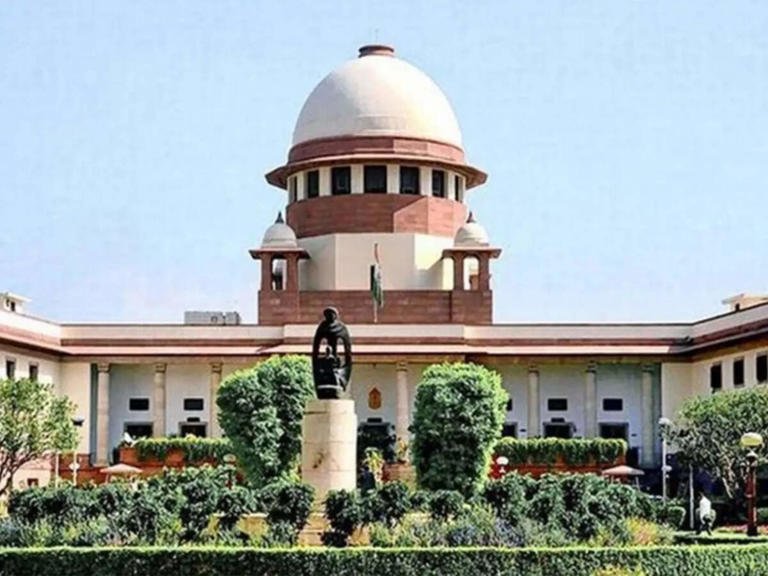
The Supreme Court has refused to interfere with the Election Commission of India’s (ECI) decision to use the 2002 electoral roll as the base year for the ongoing Special Intensive Revision (SIR) of electoral rolls in Sikkim. A three-judge bench dismissed a public interest litigation that sought the use of an earlier year as the reference point for the exercise.
The decision allows the ECI to continue with its ongoing revision process in Sikkim using the 2002 electoral roll. The petitioner had argued that Sikkim’s distinctive demographic and constitutional history justified a different approach.
The case has drawn attention because Sikkim has a unique political and constitutional history. The petitioner argued that the state should not necessarily follow the same reference year as other states.
Supreme Court Rejects Plea for Different Base Year
The petition was filed by the Sikkimese Mulniwasi Surakcha Sangh (SMSS), a registered public trust. The organisation wanted the ECI to consider 1993 instead of 2002 as the base year for the SIR exercise.
The petitioners argued that Sikkim had undergone earlier intensive revisions of electoral rolls, including exercises in 1979, 1983, 1988 and 1993. They questioned why the Commission had selected 2002 as the reference point when Sikkim’s electoral history provided earlier options.
The Supreme Court, however, found no sufficient reason to intervene in the ECI’s decision.
Bench Examines ECI’s Uniform Approach
The case came before a bench comprising Chief Justice of India Surya Kant, Justice Joymalya Bagchi and Justice V. Mohana.
During the hearing, the bench considered the ECI’s argument that it had adopted 2002 as a common reference point because that was the year of the last SIR in Sikkim. The Commission has followed a uniform approach while conducting the current revision exercise across states.
The court questioned why Sikkim should have a different reference year when the Commission had adopted 2002 as part of its broader approach.
The bench also noted that voters included in the 2002 electoral roll had subsequently exercised their voting rights in elections held in Sikkim.
Why 2002 Was Selected
The ECI’s decision rests largely on the fact that a Special Intensive Revision took place in Sikkim in 2002.
The Commission has used the last SIR roll as the reference point for the current exercise. The 2002 roll therefore provides an existing electoral record that officials can use while updating and verifying the present voter list.
The ECI has also maintained that changing the reference year after the current process has already begun could disrupt the exercise.
The Supreme Court accepted the basic reasoning behind the Commission’s approach and declined to direct it to restart the process using a different year.
Petitioners Wanted 1993 as Reference
The petitioners argued that 1993 could provide a more appropriate reference point for Sikkim.
They pointed to the state’s earlier electoral revisions and argued that its demographic and constitutional circumstances differ from those of other parts of India.
The petition also questioned whether the electoral data added during the 2002 revision accurately corresponded with Sikkim’s demographic data. According to the petitioners, using 2002 could therefore create further discrepancies in the electoral rolls.
The Supreme Court did not accept these arguments as sufficient grounds to interfere with the ECI’s decision.
Sikkim’s Distinct Constitutional History
Sikkim occupies a unique position in India’s political history.
The former kingdom became part of India in 1975, and its transition into a state of the Indian Union created distinctive constitutional and demographic circumstances.
The petitioners relied on this history while seeking a separate approach to the electoral-roll revision.
They argued that the state’s unique circumstances should allow the ECI to consider a different reference point rather than automatically applying the same approach used elsewhere.
The court, however, focused on the existing electoral revision framework and the fact that SIR had already taken place in Sikkim in 2002.
Court Notes 2002 Voters Took Part in Elections
One of the factors that influenced the court was the subsequent participation of voters included in the 2002 electoral roll.
The bench noted that these voters had exercised their franchise in elections conducted after 2002. This provided an electoral history connecting the 2002 roll with subsequent elections in the state.
The observation weakened the argument that the 2002 electoral roll could simply be treated as an unsuitable reference point.
The court therefore found no compelling reason to replace it with the 1993 roll.
SIR Aims to Verify Electoral Rolls
The Special Intensive Revision aims to update electoral rolls and ensure that eligible citizens remain included while ineligible names do not enter the voter list.
The ECI launched the third phase of SIR in Sikkim, Odisha, Mizoram and Manipur in May 2026. The enumeration process began on May 30, with Booth Level Officers conducting house-to-house visits and distributing enumeration forms.
The Commission has emphasised that every eligible Indian citizen aged 18 or above should have the opportunity to remain on the electoral roll, subject to the applicable legal requirements.
Sikkim’s Current SIR Is Already Underway
The SIR process in Sikkim is not merely a future proposal. The exercise has already begun.
According to ECI data, Sikkim had 4,71,077 electors and 572 Booth Level Officers assigned to the process. The state also had 681 Booth Level Agents representing recognised political parties.
BLOs have been conducting house-to-house visits to distribute, collect and verify enumeration forms.
The Commission has also allowed Booth Level Agents of recognised political parties to collect forms from members of the public and submit them to BLOs before publication of the draft electoral rolls.
Supreme Court Avoids Mid-Process Change
The court’s decision also reflects the practical difficulty of changing the reference point once an electoral revision exercise has begun.
Changing the base year could require authorities to reassess the existing process and potentially restart significant parts of the exercise.
The ECI argued that such a change would disrupt the ongoing revision.
The Supreme Court ultimately found no adequate reason to interfere with the Commission’s decision at this stage.
Uniformity Becomes Central Issue
A major element of the case was the ECI’s argument for maintaining a uniform approach.
The Commission has used 2002 as the reference year because that was the last SIR year in Sikkim. The court considered this approach reasonable in the context of the ongoing nationwide electoral-roll revision.
The bench questioned the basis for asking Sikkim to follow a different reference year when the ECI had adopted a common framework.
This emphasis on uniformity became one of the key reasons behind the court’s refusal to interfere.
What the Decision Means for Sikkim
The Supreme Court’s decision means that the 2002 electoral roll will remain the reference point for the ongoing SIR in Sikkim.
The ECI can therefore continue its verification and revision process without changing the base year to 1993.
For voters, the immediate focus will remain on completing enumeration forms and cooperating with Booth Level Officers.
Eligible citizens who face difficulties during the process can use the procedures provided by the Election Commission to raise claims or objections during the relevant stages of the revision.
Electoral Roll Revision Moves Ahead
The Sikkim SIR 2002 base year dispute has now reached an important legal conclusion, with the Supreme Court declining to alter the ECI’s decision.
The petitioners had argued that Sikkim’s unique history and earlier electoral revisions justified using 1993 as the reference year. The ECI defended 2002 because it was the year of the last SIR conducted in the state.
The Supreme Court accepted the broader reasoning behind the Commission’s approach and found no sufficient basis for judicial intervention.
The ruling allows the ongoing SIR to continue without interruption. With Booth Level Officers already conducting field verification, the next stage will focus on completing the revision and preparing updated electoral rolls.
For Sikkim, the decision settles the immediate question over the reference year. For the Election Commission, it provides judicial backing for continuing the current exercise under the 2002 base year, while the larger objective remains to ensure accurate, inclusive and legally compliant electoral rolls.