


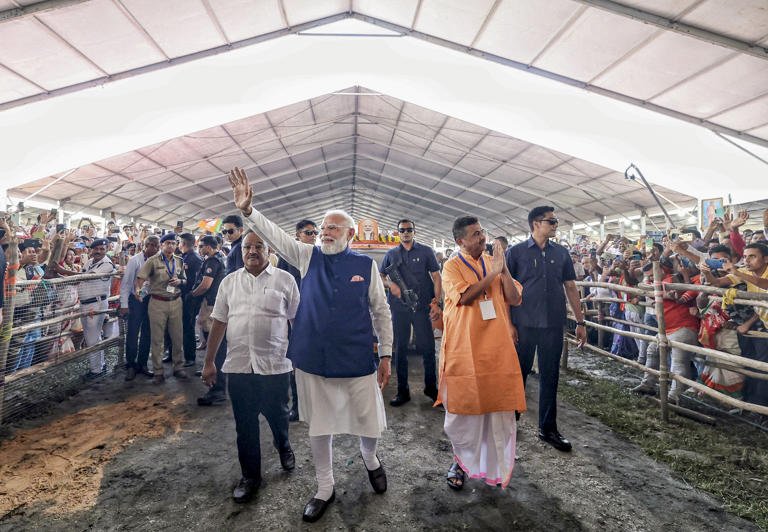
The newly formed cabinet under Suvendu Adhikari reflects a carefully planned political and social balancing strategy by the Bharatiya Janata Party in West Bengal. From north Bengal to Junglemahal and from Matua to Rajbanshi communities, the ministry line-up showcases representation across the state’s geographical and ethnic spectrum.
Political observers believe the BJP designed the cabinet to strengthen its long-term social coalition after ending the 15-year rule of the Trinamool Congress in Bengal.
The swearing-in ceremony at Kolkata’s Brigade Parade Grounds witnessed the participation of senior national BJP leaders, NDA chief ministers, and thousands of party supporters.
The ministry composition has already sparked discussions regarding the BJP’s broader political strategy in Bengal.
Read More: From Giant Slayer To Bengal CM: Why Suvendu Adhikari Chose Celibacy
BJP Attempts Regional And Social Balance
Political analysts say the BJP carefully structured the cabinet to ensure representation from multiple regions and communities across Bengal.
The new government includes leaders from north Bengal, south Bengal, border districts, urban centres, and tribal regions. At the same time, the ministry also accommodates leaders belonging to OBC, Matua, tribal, Kayastha, and Rajbanshi communities.
Experts believe this approach reflects the BJP’s understanding of Bengal’s diverse political and social realities.
The party expanded rapidly in Bengal by building support among groups that traditionally backed regional or Left parties.
The cabinet therefore appears aimed at converting electoral support into long-term political consolidation.
Observers say representation often carries strong symbolic value in Bengal politics.
Suvendu Adhikari Leads Historic BJP Government
Suvendu Adhikari took oath as Bengal’s first BJP chief minister after leading the party to a historic victory in the Assembly elections.
Once a senior Trinamool Congress leader and close aide of Mamata Banerjee, Adhikari later emerged as the BJP’s strongest political face in the state.
His rise gained momentum after he defeated Mamata Banerjee in Nandigram and expanded the BJP’s grassroots network across multiple districts.
Political analysts believe Adhikari’s appointment symbolises the BJP’s effort to establish a strong regional leadership model in Bengal.
The new chief minister now faces the challenge of balancing governance with social and regional expectations.
Dilip Ghosh Represents OBC Face
Dilip Ghosh became one of the key ministers in the cabinet after winning the Kharagpur Assembly seat.
Political observers describe him as one of the BJP’s strongest OBC leaders in Bengal. Ghosh played a major role in expanding the BJP’s organisational structure across the state over the past several years.
His inclusion in the ministry highlights the party’s continued outreach toward backward communities.
Experts say Ghosh’s grassroots image and organisational experience make him an influential figure within the government.
The BJP’s focus on OBC representation reflects broader national political trends where social coalitions increasingly influence electoral outcomes.
Agnimitra Paul Strengthens Urban And Women Representation
Agnimitra Paul also joined the cabinet and strengthened both women’s and urban representation within the ministry.
Paul, a second-time MLA and former fashion designer, represents the Kayastha community. She joined the BJP in 2019 and rapidly emerged as one of the party’s prominent women leaders in Bengal.
Political analysts believe her inclusion reflects the BJP’s attempt to increase women’s participation in governance.
The party has increasingly focused on women-centric political messaging and welfare issues in recent years.
Her presence in the cabinet also highlights the BJP’s outreach in industrial and urban regions such as Asansol.
Matua Community Gets Representation
The inclusion of Ashok Kirtania in the ministry reflects the BJP’s continued focus on the influential Matua community.
The Matua population plays a major role in the politics of districts such as North 24 Parganas and Nadia. Citizenship and refugee-related issues have remained politically significant among Matua voters.
Political experts believe the BJP successfully expanded its support base among the community over the past several years.
Kirtania’s elevation therefore carries both symbolic and electoral significance.
Observers say representation in the cabinet may help the BJP strengthen its relationship with Matua voters further.
The party has consistently highlighted citizenship-related promises while engaging with the community.
Tribal Representation Through Kshudiram Tudu
Kshudiram Tudu emerged as one of the prominent tribal faces in the new Bengal government.
Tudu won his first Assembly election from Ranibandh and previously worked as a government school teacher.
Political analysts say his inclusion reflects the BJP’s growing focus on tribal regions such as Junglemahal and western Bengal.
The BJP made major electoral gains in tribal belts during recent elections through aggressive grassroots campaigns.
Experts believe representation in the cabinet may strengthen the party’s political influence in these regions.
The inclusion also reflects the BJP’s strategy of accommodating historically underrepresented communities within governance structures.
Rajbanshi Representation Strengthens North Bengal Focus
Nisith Pramanik became another important inclusion in the ministry.
A former Union minister of state and ex-MP from Cooch Behar, Pramanik represents the Rajbanshi community in north Bengal.
The Rajbanshi population remains politically influential in districts such as Cooch Behar and Jalpaiguri.
Political observers believe Pramanik’s inclusion reflects the BJP’s strong focus on north Bengal’s regional aspirations and identity politics.
The BJP expanded rapidly in north Bengal during recent elections, and analysts say community outreach played a major role in that success.
Representation of Rajbanshi leaders in the cabinet therefore carries strategic importance for the party.
Cabinet Reflects Bengal’s Regional Diversity
The ministry composition also showcases geographical diversity across Bengal.
Leaders from Kharagpur, Asansol, Bongaon Uttar, Ranibandh, and Mathabhanga received cabinet representation.
Political analysts believe the BJP deliberately avoided concentrating power in one specific region.
North Bengal, border districts, tribal belts, urban industrial zones, and south Bengal all found representation within the ministry structure.
Experts say regional balancing remains essential in Bengal politics because development priorities differ significantly across districts.
The BJP appears keen on projecting the government as representative of the entire state rather than specific political strongholds.
BJP Focuses On Long-Term Political Expansion
Political observers believe the cabinet formation reflects the BJP’s larger goal of establishing durable political roots in Bengal.
The party’s electoral rise depended heavily on support from socially and regionally diverse groups.
By giving representation to multiple communities, the BJP aims to convert electoral momentum into stable political support.
However, experts warn that symbolic representation alone may not guarantee long-term success.
The government must also address employment, infrastructure, governance, and welfare expectations across regions.
Bengal Politics Enters New Era
The formation of Suvendu Adhikari’s cabinet marks a major turning point in Bengal politics.
For decades, regional and Left parties shaped the state’s social coalitions and political narratives. Now, the BJP has attempted to create its own broad-based coalition through carefully balanced representation.
Political analysts believe the cabinet reflects both electoral strategy and governance planning.
From Matua to Rajbanshi and from tribal belts to industrial regions, the ministry line-up highlights the BJP’s effort to accommodate Bengal’s geographical and ethnic diversity.
As the new government begins functioning, attention will remain focused on whether this balancing strategy helps the BJP build lasting political stability in the state.
Read More: Manipur Congress Condemns Reported Attacks On Border Villages, Demands Action