


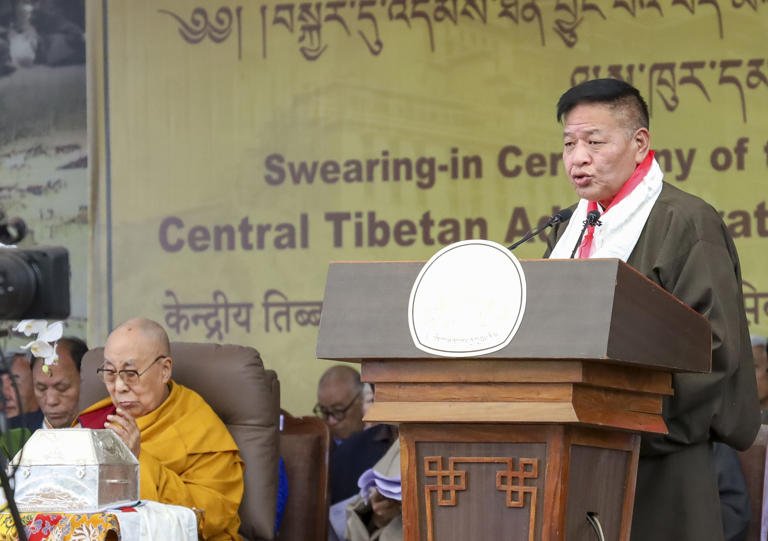
The newly sworn-in Tibetan political head reaffirmed commitment to the “Middle Way Policy,” describing it as the guiding framework for the Tibetan movement and reiterating continued adherence to the approach outlined by Dalai Lama.
The oath-taking ceremony marked an important moment for Tibetan political leadership and renewed attention on the long-standing policy framework that seeks a peaceful and negotiated approach to addressing Tibetan aspirations.
During the ceremony and subsequent remarks, the leadership stressed continuity, democratic governance, and commitment to preserving Tibetan identity, culture, and long-term objectives through dialogue and non-violent engagement.
New Tibetan Political Leadership Takes Oath
The swearing-in ceremony formally marked the beginning of a new phase in Tibetan political leadership.
During the event, the political head outlined broad priorities and emphasised continuity in governance and policy direction.
The leadership reaffirmed commitment to democratic institutions and highlighted the importance of maintaining public trust and institutional stability.
Observers noted that transitions in Tibetan political leadership often attract international attention because of their symbolic and political significance.
The ceremony also reflected continued emphasis on preserving established institutional traditions.
Officials and representatives highlighted unity and collective responsibility during the transition.
The event reinforced continuity within the Tibetan political framework.
Commitment Reiterated To Middle Way Policy
A central theme of the address was renewed commitment to the Middle Way Policy developed under the guidance of the Dalai Lama.
The policy broadly advocates pursuing a peaceful and negotiated path while emphasising dialogue and non-violent engagement.
The newly sworn-in political leadership stated that the approach continues to remain relevant and represents the preferred framework moving forward.
According to the leadership, maintaining consistency in policy remains important for long-term objectives and institutional continuity.
Representatives also emphasised that peaceful engagement remains central to their position.
The remarks highlighted continuity rather than policy change.
The Middle Way approach therefore remained at the centre of the message.
Dalai Lama’s Vision Continues To Shape Direction
During the event, the leadership acknowledged the continued influence of the Dalai Lama’s guidance in shaping political direction and institutional values.
Officials highlighted the importance of preserving principles associated with peaceful dialogue, cultural identity, and democratic engagement.
The address reflected recognition of the Dalai Lama’s long-standing role in defining the broader framework followed by Tibetan institutions.
Observers noted that references to the Middle Way Policy often carry both symbolic and strategic significance.
The leadership reiterated support for continuity and long-term institutional stability.
The ceremony therefore reinforced existing policy foundations.
Public messaging focused on consistency and peaceful engagement.
Focus On Democratic Governance And Institutional Continuity
Alongside reaffirming policy commitments, the new political leadership emphasised governance priorities and institutional development.
Officials stated that strengthening democratic structures remains an important objective.
The leadership highlighted the need to maintain public engagement and support institutional processes.
Observers noted that leadership transitions often provide opportunities to outline administrative goals and governance priorities.
The latest remarks indicated an intention to maintain continuity while strengthening institutional functioning.
Representatives also stressed cooperation and collective responsibility.
The focus remained on stability and long-term planning.
Tibetan Leadership Signals Continuity Rather Than Change
Political observers interpreted the address as a message of continuity rather than major policy adjustment.
The reaffirmation of the Middle Way Policy suggested that the leadership intends to maintain established approaches and priorities.
Observers stated that continuity can provide institutional stability and reinforce public confidence.
The leadership’s remarks reflected emphasis on gradual progress and sustained engagement.
Supporters viewed the speech as reaffirming long-standing principles.
The ceremony therefore became an occasion to communicate both continuity and commitment.
Attention remained focused on the direction outlined during the event.
Focus Turns To Future Engagement And Governance
Following the swearing-in ceremony, attention now shifts to how the new leadership advances governance priorities while maintaining commitment to existing policy positions.
Observers expect continued emphasis on institutional development, public engagement, and adherence to the Middle Way framework.
The reaffirmation of the policy underscored continuity with the approach associated with the Dalai Lama.
As the new political leadership begins its term, the focus remains on governance, institutional stability, and maintaining the principles outlined during the oath-taking ceremony.