


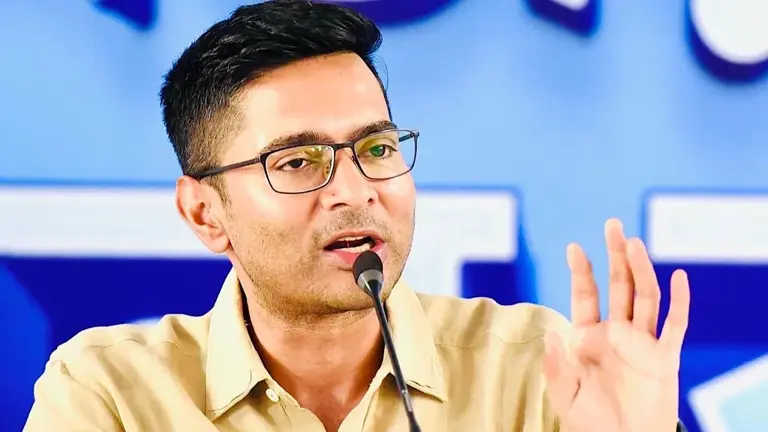
The Trinamool Congress (TMC) alleged political vendetta after police visited the residence of party leader Abhishek Banerjee, triggering a fresh political confrontation in West Bengal.
The development quickly drew reactions from TMC leaders, who questioned the timing and purpose of the visit and accused authorities of using administrative actions for political reasons. The incident has once again intensified political exchanges between rival camps and renewed debate over the use of investigative and administrative processes in political contexts.
Party representatives described the visit as unnecessary and argued that democratic institutions should function independently of political competition.
TMC Alleges Political Motivation Behind Police Visit
Reacting to the development, TMC leaders claimed that the police visit formed part of what they described as a broader pattern of political targeting.
Party representatives questioned the circumstances surrounding the visit and argued that public institutions should remain impartial.
According to TMC leaders, administrative processes should not create perceptions of political pressure or selective attention.
The party maintained that political disagreements should remain separate from institutional functioning.
Leaders also stated that opposition figures and political representatives should receive fair treatment under established procedures.
The remarks added fresh political intensity to an already competitive political environment in West Bengal.
Police Visit Triggers Political Reactions
The visit to Abhishek Banerjee’s residence quickly became a political issue and generated responses across party lines.
Political observers noted that actions involving prominent political figures often attract greater public attention because of their symbolic significance.
The incident prompted debate over the relationship between politics and institutional action.
Supporters of TMC argued that the development raised broader questions regarding administrative neutrality.
At the same time, others maintained that official processes should proceed according to applicable procedures.
The development therefore moved beyond an individual event and became part of a wider political discussion.
Public attention remained focused on explanations and political reactions.
Abhishek Banerjee Continues To Remain Central Figure In TMC
Abhishek Banerjee remains one of the most visible leaders within the Trinamool Congress and continues to play an important role in the party’s political strategy.
His position within the organisation often places developments involving him under greater public and political scrutiny.
Observers noted that actions involving senior political leaders frequently attract stronger reactions from party workers and supporters.
Political events connected to prominent figures also tend to shape broader narratives and influence public discourse.
The latest development therefore received immediate attention across political circles.
Supporters and critics interpreted the incident through different political perspectives.
Political Tensions Continue In West Bengal
West Bengal continues to witness strong political competition and frequent exchanges between rival parties.
Issues involving administration, governance, and institutional functioning often become subjects of political debate.
Observers stated that political parties increasingly frame such developments within larger narratives around governance and accountability.
The latest controversy added to ongoing discussions regarding institutional independence and political rivalry.
Political analysts noted that perceptions surrounding administrative actions often become important in shaping public response.
The issue therefore generated attention beyond immediate procedural questions.
Public debate is expected to continue in the coming days.
TMC Calls For Fair And Transparent Processes
Following the incident, TMC leaders reiterated their demand for transparent and impartial institutional functioning.
Party representatives argued that public confidence depends on maintaining clear separation between politics and official procedures.
They also stated that accountability and fairness remain important principles in democratic governance.
Observers noted that such demands frequently emerge during politically sensitive developments.
At the same time, authorities generally maintain that actions proceed according to legal and procedural frameworks.
The issue has therefore become part of a broader discussion on governance and institutional trust.
Focus Turns To Political Response And Next Developments
Following the police visit and TMC’s reaction, attention is expected to remain on future political responses and any official clarification.
Observers believe the development may continue to shape public and political discussion in West Bengal.
The incident has once again highlighted how administrative actions involving senior political leaders often attract strong reactions and wider debate.
For TMC, the issue has become another point of criticism against what it describes as political targeting.
As discussions continue, the matter is expected to remain in focus within West Bengal’s evolving political landscape.