


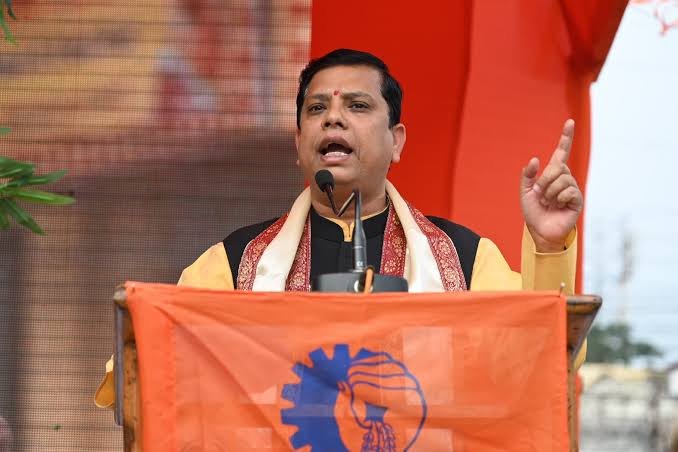
Tripura Labour Minister Tinku Roy has called for stronger systems to protect workers from wage-related disputes and improve labour administration across states. The minister raised the need for a unified national labour database and stricter mechanisms to address cases in which contractors leave projects without clearing workers’ dues. The remarks came during a national conference on Building and Other Construction Workers (BOCW) held in Mumbai on September 11, 2026.
PM Modi Hails 8 Years of Ayushman Bharat, World’s Largest Health Scheme
National Labour Database Proposal Gains Attention
The demand for a National Labour Database reflects a broader effort to improve the availability and coordination of information concerning workers. A unified system could help governments maintain more consistent records across different categories of employment while making it easier to identify workers and connect them with welfare and social-security programmes.
At the Mumbai BOCW conference, labour ministers and senior officials from different states and Union Territories discussed measures concerning construction workers and people employed in the unorganised sector. The discussions focused on worker welfare, social security, workplace safety and labour rights.
Roy’s call for a unified database comes against the background of an increasingly digital labour-administration system. India already operates the e-Shram platform for unorganised workers, while other government systems maintain employment, social-security and enterprise-related information. Bringing relevant databases into better coordination could reduce information gaps and make worker-related administration more efficient.
Moreover, a national system could be particularly useful for workers who move between states for employment. Construction workers often work through contractors and may shift from one project or location to another. Therefore, maintaining reliable employment and wage records can help authorities identify workers and establish their connection with employers or contractors when disputes arise.
However, the creation of any unified database would require clear rules governing data accuracy, access and protection. A database can improve administration only when the information remains current and authorities can use it effectively.
Wage Recovery From Contractors Remains a Concern
A major issue raised in the user’s report concerns contractors who disappear or leave projects without paying workers. Such situations can create significant difficulties for labourers because workers may struggle to identify the responsible contractor or recover wages after the contractor becomes unavailable.
Existing labour rules already contain mechanisms concerning the payment and documentation of wages by contractors. Under the Tripura Contract Labour (Regulation and Abolition) Rules, contractors must maintain wage records, while principal employers have responsibilities connected with wage disbursement and verification. The rules also require contractors to maintain records such as muster rolls and wage registers.
The rules specify that wages generally cannot be carried forward beyond the applicable wage period. They also prescribe deadlines for payment following the end of a wage period and require payment of earned wages when a worker’s employment ends.
Consequently, stronger enforcement could focus not only on recovering unpaid wages but also on ensuring that employment and payment records remain available when a contractor fails to meet obligations.
A unified labour database could potentially support such enforcement by linking information about workers, contractors, establishments and projects. However, that would require coordination between labour authorities, principal employers and other government departments.
The minister’s demand therefore points toward a system in which worker records could remain accessible even when a particular contractor is no longer available. Such a mechanism could make it easier to establish employment relationships and identify outstanding obligations.
BOCW Conference Highlights Worker Welfare
The Mumbai conference focused specifically on Building and Other Construction Workers, a category that includes a large number of workers employed through contractors and subcontracting arrangements. Roy participated in the two-day national conference alongside Union Labour Minister Mansukh Mandaviya, Union Minister of State for Labour Shobha Karandlaje and labour ministers from other states and Union Territories.
The discussions covered welfare measures, social security, workers’ rights and workplace safety. Therefore, the proposed database and stronger wage-recovery mechanisms fit within a wider discussion about improving protection for workers in sectors where employment arrangements can be fragmented.
Construction workers can also face difficulties when they move between projects or states. In such circumstances, fragmented records may make it harder for authorities to establish a worker’s employment history. A coordinated national database could help reduce those gaps if governments implement appropriate data-sharing and verification systems.
Furthermore, stronger records could assist with the administration of welfare benefits. Workers who have moved from one state to another may need access to schemes and protections without repeatedly establishing their employment details. A portable record could potentially simplify that process.
Nevertheless, the effectiveness of such a system would depend on implementation. Authorities would need to ensure that contractors register workers correctly, employment information receives regular updates and workers can report inaccuracies. Without reliable inputs, a large database could still contain gaps.
Tripura’s Labour Administration Faces Broader Challenges
The discussion comes at a time when labour-related payment issues have also received attention within Tripura. Recent reports have highlighted delayed wages among several categories of scheme-based and contractual workers, although those cases concern different employment arrangements from the contractor-related issue raised by Roy.
For example, a recent report said some SSA teachers, Mid-Day Meal workers, NHM employees and Social Welfare Department workers had allegedly experienced salary or honorarium delays. The affected workers reportedly sought timely clearance of outstanding payments and more reliable payment systems.
Separately, Mid-Day Meal workers in Tripura reportedly protested over alleged delays of four months in wage payments. The workers submitted a memorandum seeking action on delayed payments, manpower shortages and remuneration. These allegations come from the workers’ union and should therefore be distinguished from independently established government findings.
These developments illustrate why wage-payment monitoring remains an important labour-governance issue. While scheme-based employment and contract labour operate under different administrative arrangements, both involve the need for accurate records and timely payment.
Tripura has also been moving toward digital labour administration. In August 2026, Labour Minister Tinku Roy launched the Digital Labour Chowk App, reflecting the state’s broader effort to use technology in employment-related services.
Therefore, the proposed National Labour Database could complement existing digital initiatives if it develops into an interoperable system connecting workers, employers, contractors and government authorities.
Conclusion
Tripura Labour Minister Tinku Roy’s call for a National Labour Database places worker records, wage accountability and social-security access at the centre of a wider labour-policy discussion. His participation in the national BOCW conference in Mumbai brought Tripura’s concerns into a forum involving labour ministers and senior officials from across India.
The proposal could become particularly relevant for workers employed through contractors, especially when contractors leave projects without settling wages. Existing Tripura rules already require contractors to maintain wage and employment records and establish requirements for timely wage payments.
A stronger national system could improve coordination, but its success would depend on accurate worker registration, reliable contractor records, effective enforcement and appropriate safeguards for worker information. Consequently, the proposed National Labour Database would need to work alongside stronger legal and administrative mechanisms rather than operate as a database alone.
FAQs
What did Tripura Labour Minister Tinku Roy propose?
Tinku Roy called for a unified National Labour Database and stronger mechanisms to protect workers and address wage-related problems involving contractors during discussions at a national BOCW conference in Mumbai.
Why is a National Labour Database important?
A unified database could help authorities maintain better worker records, coordinate labour-related information and improve access to welfare and social-security programmes.
What problem can arise when contractors disappear?
Workers may face difficulties recovering earned wages when a contractor leaves a project or becomes unavailable. Reliable employment and wage records can help authorities establish responsibilities and pursue outstanding dues.
Do Tripura’s existing rules require contractors to maintain wage records?
Yes. Tripura’s Contract Labour Rules require contractors to maintain employment and wage-related records, while principal employers also have responsibilities concerning wage disbursement and verification.
What was discussed at the national BOCW conference?
The conference addressed welfare and social-security measures for construction and unorganised-sector workers, along with workers’ rights, workplace safety and related labour issues.