

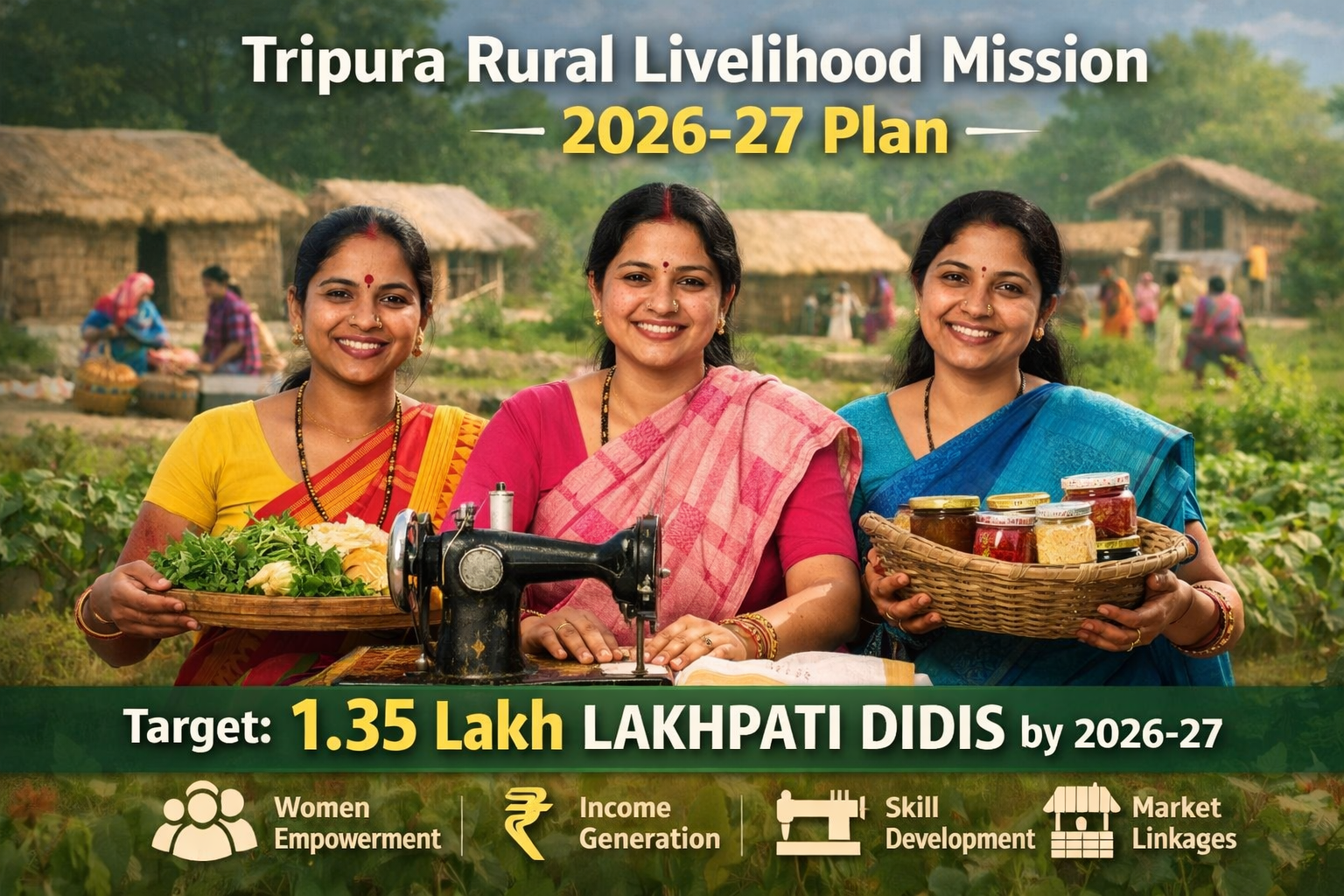
The Tripura Rural Livelihood Mission 2026–27 plan marks a significant step toward strengthening rural economies and empowering women across the state. With an ambitious target of creating 1.35 lakh Lakhpati Didis, the initiative highlights the government’s commitment to financial inclusion and sustainable development. Moreover, this plan is expected to transform the lives of thousands of women by providing them with stable income opportunities and long-term economic security.
Shocking Twist: Siddhartha Bhattacharya Dropped BJP
What is the Tripura Rural Livelihood Mission 2026–27 Plan
The Tripura Rural Livelihood Mission 2026–27 plan focuses on enhancing livelihood opportunities through structured support for self-help groups (SHGs). These groups play a crucial role in rural development by enabling women to come together, access financial resources, and build small-scale enterprises.
Additionally, the mission emphasizes skill development and capacity building. Women are trained in various income-generating activities such as agriculture, handicrafts, and small businesses. As a result, they can diversify their income sources and reduce financial vulnerability.
Furthermore, the plan includes improved access to credit facilities. Financial inclusion is a key component, ensuring that women can invest in their businesses and scale their operations effectively.
Target of 1.35 Lakh Lakhpati Didis
A major highlight of the Tripura Rural Livelihood Mission 2026–27 plan is its goal of creating 1.35 lakh Lakhpati Didis. These are women who earn at least ₹1 lakh annually through sustainable livelihood activities.
This target is not just about achieving a numerical milestone. Instead, it represents a broader vision of empowering women to become financially independent and confident decision-makers. By reaching this goal, the mission aims to uplift entire families and communities.
Moreover, the concept of Lakhpati Didis has gained traction across India as a model for rural transformation. Therefore, Tripura’s initiative aligns with national efforts to boost grassroots entrepreneurship and women-led development.
Himanta Sarma Jalukbari Election: Big BJP Move Ignites Election Battle
Key Strategies Under the Plan
The Tripura Rural Livelihood Mission 2026–27 plan relies on several strategic interventions to achieve its objectives.
Firstly, skill development programs are being expanded. Women receive training in relevant sectors, allowing them to build practical and marketable skills. Secondly, the plan promotes micro-enterprises by encouraging women to start small businesses with local resources.
In addition, access to financial services is being strengthened. SHGs are linked with banks and financial institutions, enabling them to secure loans and manage their finances efficiently. This step is crucial for scaling up income-generating activities.
Another important aspect is market linkage. Without access to markets, even the best products struggle to generate income. Therefore, the mission focuses on connecting rural producers with broader markets, both offline and online.
Dharmanagar By Election BJP Candidate: Big BJP Move
Impact of the Tripura Rural Livelihood Mission 2026–27 Plan
The Tripura Rural Livelihood Mission 2026–27 plan is expected to have a far-reaching impact on the state’s economy and society.
Firstly, it will significantly boost rural incomes. When women earn more, household living standards improve, leading to better access to education, healthcare, and nutrition. Secondly, the initiative promotes gender equality by increasing women’s participation in economic activities.
Additionally, the plan supports local entrepreneurship. By encouraging small businesses, it helps create jobs and reduces migration from rural to urban areas. Consequently, this contributes to balanced regional development.
Moreover, the ripple effect of financial empowerment cannot be ignored. Women who become economically independent often invest back into their communities, creating a cycle of growth and development.
Women Empowerment and Economic Growth
At its core, the Tripura Rural Livelihood Mission 2026–27 plan is about empowerment. When women gain financial independence, they also gain confidence and decision-making power within their families and communities.
This empowerment leads to broader social change. For instance, women are more likely to invest in their children’s education and health. As a result, future generations benefit from improved opportunities.
Furthermore, empowering women contributes directly to economic growth. Studies have consistently shown that increasing women’s participation in the workforce leads to higher GDP growth. Therefore, initiatives like this are not just social programs—they are economic strategies.
Modi Assam Election Rallies: Mega Campaign Blitz Before Poll Showdown
Challenges and Future Outlook
Despite its promise, the Tripura Rural Livelihood Mission 2026–27 plan faces certain challenges. Implementation at the grassroots level requires effective coordination and monitoring. Ensuring that benefits reach the intended recipients is crucial.
In addition, market access remains a key concern. Without consistent demand, income generation can fluctuate. Therefore, building strong and sustainable market linkages is essential for long-term success.
However, the future outlook remains positive. With proper execution, continuous support, and adaptive strategies, the mission has the potential to become a model for other states. It can demonstrate how targeted interventions can drive inclusive growth and empowerment.
Dipankar Sen Assembly Debate: Fiery Questions Rock Tripura House
Conclusion
In conclusion, the Tripura Rural Livelihood Mission 2026–27 plan represents a bold and transformative vision for rural development. By aiming to create 1.35 lakh Lakhpati Didis, the initiative seeks to empower women, strengthen communities, and boost the rural economy.
While challenges exist, the potential benefits far outweigh them. If implemented effectively, this plan could redefine the landscape of rural livelihoods in Tripura and set a benchmark for similar initiatives across the country.
FAQs: Tripura Rural Livelihood Mission 2026–27 Plan
1. What is the Tripura Rural Livelihood Mission 2026–27 plan?
The Tripura Rural Livelihood Mission 2026–27 plan is a government initiative aimed at improving rural livelihoods by empowering women through self-help groups, skill development, and income-generating activities.
2. What is the goal of 1.35 lakh Lakhpati Didis?
Under the Tripura Rural Livelihood Mission 2026–27 plan, the target is to create 1.35 lakh Lakhpati Didis—women who earn at least ₹1 lakh annually through sustainable livelihood sources.
3. Who are Lakhpati Didis?
Lakhpati Didis are women, primarily from rural areas, who achieve an annual income of ₹1 lakh or more through small businesses, agriculture, or other income-generating activities supported by the Tripura Rural Livelihood Mission 2026–27 plan.
4. How will the Tripura Rural Livelihood Mission 2026–27 plan benefit women?
The Tripura Rural Livelihood Mission 2026–27 plan will provide women with access to training, financial support, and market opportunities, helping them become financially independent and self-reliant.
5. What strategies are included in the Tripura Rural Livelihood Mission 2026–27 plan?
Key strategies include skill development, promotion of micro-enterprises, financial inclusion, and strengthening market linkages to ensure sustainable income generation.
6. What impact will the Tripura Rural Livelihood Mission 2026–27 plan have on the rural economy?
The Tripura Rural Livelihood Mission 2026–27 plan is expected to boost rural incomes, reduce poverty, increase women’s workforce participation, and promote local entrepreneurship.
7. Are there any challenges in implementing the plan?
Yes, challenges include effective implementation, ensuring market access, and maintaining consistent income for beneficiaries under the Tripura Rural Livelihood Mission 2026–27 plan.
8. Why is the Tripura Rural Livelihood Mission 2026–27 plan important?
The Tripura Rural Livelihood Mission 2026–27 plan is important because it promotes women’s empowerment, strengthens rural economies, and supports sustainable development at the grassroots level.