


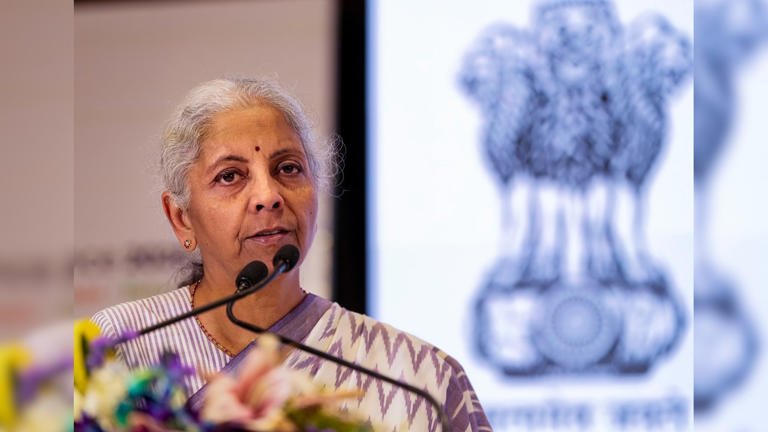
Union Finance Minister Nirmala Sitharaman has clarified the government’s position on the new Merchant Discount Rate (MDR) for UPI payments. She said the charge will not create an additional burden for consumers.
Sitharaman also accused opposition parties of spreading misinformation about the new UPI framework. She said MDR is neither a tax nor a cess and does not go to the government’s Consolidated Fund.
Sitharaman Clarifies UPI MDR
Sitharaman addressed the issue while speaking to ANI. She said MDR applies only to specified merchant transactions above ₹2,000.
She stressed that customers will not pay the charge. According to her, the fee works between payment service providers within the digital payment ecosystem.
“It is neither a tax nor a cess,” Sitharaman said. She added that the funds will not enter the Consolidated Fund of India.
The Finance Minister said service providers will use the charge to support the payment system. She linked the move to better infrastructure and improved digital payment services.
New MDR Framework Starts October 15
The National Payments Corporation of India introduced the new MDR framework on September 15. The framework will take effect from October 15, 2026.
Under the new structure, a 0.4% MDR will apply to specified person-to-merchant UPI transactions above ₹2,000. The charge will have a maximum limit of ₹300 per transaction.
The framework does not apply to person-to-person UPI transfers. Such transactions will remain free regardless of the amount involved.
Payments to merchants up to ₹2,000 will also remain free. Small merchants covered under the existing zero-MDR framework will continue to receive the exemption.
Around 96% of Merchant Transactions Unaffected
The government has said that around 96% of person-to-merchant UPI transactions will remain unaffected.
This means most routine UPI payments will continue without MDR. The new charge targets a specific category of higher-value merchant transactions.
The government has also said that payment ecosystem participants will receive the MDR. These participants include banks and payment application providers.
The Finance Ministry has described the framework as an effort to support the long-term sustainability of the UPI ecosystem.
No Direct Charge on UPI Users
Sitharaman stressed that the new framework does not impose a direct fee on UPI users. She said payment operators will bear the MDR rather than customers.
The clarification comes amid debate over whether businesses could eventually pass higher costs to customers. The government has maintained that the MDR will not be passed on to consumers.
The distinction between MDR and a government tax remains central to the current debate. MDR represents a payment-system charge rather than money collected by the government as revenue.
Opposition Raises Concerns
The new framework has triggered criticism from opposition parties. Critics have questioned the decision to introduce MDR after years of promoting UPI as a free digital payment system.
Some opposition leaders have also raised concerns about possible effects on consumers and merchants. They have questioned whether businesses could eventually factor higher payment costs into prices.
The government has rejected the suggestion that the framework creates a direct consumer charge. Sitharaman described claims suggesting otherwise as misinformation.
Government Explains Purpose of MDR
The government has linked the new MDR system to the sustainability of UPI infrastructure. India’s digital payment network handles billions of transactions every month.
The new revenue mechanism will distribute MDR among participants in the payment ecosystem. These include banks and payment application providers.
According to the government, the framework aims to support continued investment in the UPI system. It also seeks to protect individuals and small merchants from additional charges.
UPI Payments Below ₹2,000 Remain Free
For everyday users, the ₹2,000 threshold remains an important part of the new framework.
UPI payments to merchants below ₹2,000 will not attract the new MDR. Person-to-person payments will also remain free.
The government has also retained exemptions for certain small merchants. These provisions aim to limit the impact of the new framework on smaller businesses.
The changes therefore do not introduce a universal fee on every UPI payment.
Debate Over UPI’s Future
The MDR decision marks a change in India’s approach to financing the UPI ecosystem. The system previously relied heavily on government support and incentives.
The new framework creates a revenue stream for payment ecosystem participants. It also comes as UPI continues to handle a large share of India’s digital payments.
Reuters reported that the 0.4% MDR will apply to merchant transactions above ₹2,000 from October 15. It also noted exemptions for small merchants and other categories.
The government says the framework can help strengthen UPI infrastructure without charging ordinary users directly.
Sitharaman Urges Public to Check Facts
Sitharaman said she had already clarified the issue during the Parliament session. She accused opposition parties of using what she described as misleading claims to criticise the government.
She urged the public to remain vigilant about information surrounding the new UPI rules.
The debate is likely to continue as October 15 approaches. Merchants, payment companies and consumers will closely watch how the new framework operates in practice.
Conclusion
The new UPI MDR framework will introduce a 0.4% charge on specified merchant transactions above ₹2,000 from October 15. The charge will have a ₹300 cap.
The government says customers will not bear the MDR directly. Person-to-person payments and merchant payments up to ₹2,000 will remain free.
Sitharaman has rejected descriptions of MDR as a tax or cess. She has also criticised opposition parties over what she called misinformation.
The impact of the new system will depend on how payment operators and merchants implement the framework. For consumers, the key change is that most everyday UPI transactions will continue without a direct charge.