


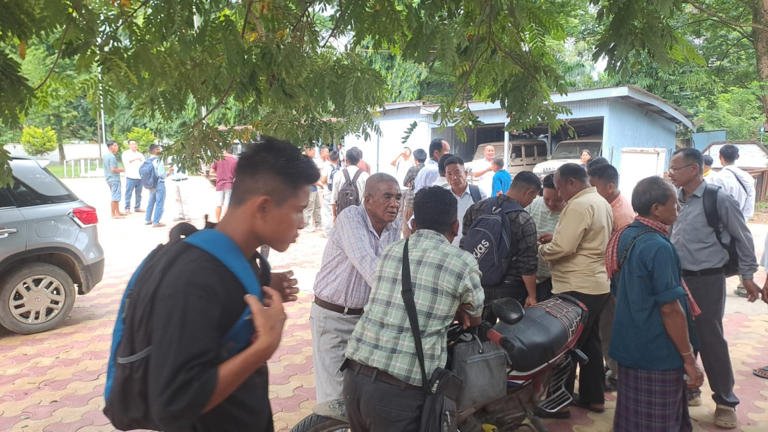
Violence and repeated disruptions have affected Special Intensive Revision (SIR) hearings in parts of Arunachal Pradesh where Chakma and Hajong communities live. The situation became tense in Bordumsa, Changlang district, on September 3 and 4. The hearings focused on claims and objections related to electoral roll entries.
The clashes led the local administration to impose prohibitory orders under Section 163 of the Bharatiya Nagarik Suraksha Sanhita (BNSS). Security forces also intervened to control the situation. Different groups have since made competing claims about what triggered the violence.
SIR Hearing Turns Violent in Bordumsa
The controversy began during an SIR hearing for Bijoypur in Bordumsa. Officials initially held the hearing at a panchayat hall on September 3. The session dealt with claims and objections filed through Forms 6 and 7.
Officials later adjourned the hearing after disruptions by some youths. They moved the next hearing to the Additional Deputy Commissioner’s office on September 4.
The situation worsened when the hearing resumed the following day. According to ADC and Electoral Registration Officer Sabadam Tayang, protesters under the banner of the All Arunachal Pradesh Students’ Union (AAPSU) entered the office and disrupted the proceedings.
Tayang alleged that protesters damaged the office and manhandled him. He also said that people threw stones at members of the Chakma and Hajong communities who had gathered for the hearing.
The incident triggered further clashes outside the office.
Competing Accounts of the Clash
The violence has produced different accounts from the groups involved.
AAPSU representatives said their members faced an attack during the confrontation. AAPSU vice-president Nabam Gandhi alleged that Chakma-Hajong community members assaulted protesters after a dispute at the ADC office. The union also reported injuries among its members.
One AAPSU activist, Khoda Lazar, reportedly suffered injuries during the clash. The Arunachal Times reported that he received six stitches after an alleged knife attack.
Representatives of the Chakma community rejected allegations that community members started the violence. All India Chakma Students’ Union president Drishyamuni Chakma said some people tried to provoke the community and that Chakma members did not participate in the violence.
The conflicting accounts have increased calls for an impartial investigation.
Dispute Over Post-2006 Voters
The dispute centres on electoral roll entries involving Chakma and Hajong residents who arrived in Arunachal Pradesh after 2006.
AAPSU and other organisations have raised objections to the inclusion of some such voters. They have sought the deletion of names they believe do not meet the requirements for inclusion in the electoral rolls.
The issue has become particularly sensitive in areas with significant Chakma and Hajong populations. Changlang, Namsai and Papum Pare are among the districts where these communities are concentrated.
The SIR process requires election officials to examine claims and objections individually. The current dispute has raised concerns about whether officials can conduct the hearings without disruption.
Hearing Process Faces Delays
The violence also affected the number of applications that officials could examine.
The Chakma Development Foundation of India (CDFI) said the Electoral Registration Officer could hear only 222 of 252 Form 6 applications during one session. Officials could examine only 150 of 303 applications during another hearing. The violence forced officials to postpone the proceedings.
The disruption has therefore affected both claimants and objectors who need to present documents before election officials.
The CDFI has alleged that some Chakma voters could not appear before the hearing officials. It subsequently sought intervention from the National Human Rights Commission (NHRC).
The organisation has also asked authorities to provide adequate security during future hearings.
CDFI Seeks NHRC Intervention
The CDFI approached the NHRC after the September 4 incident. It referred to the Supreme Court’s 1996 judgment concerning the protection of Chakma residents in Arunachal Pradesh.
The organisation asked the NHRC to ensure that Chakma and Hajong residents can participate in the SIR process without intimidation or coercion. It also sought security arrangements for upcoming hearings.
The CDFI had earlier approached the Election Commission of India with similar concerns. In August, it sought independent observers and additional security for SIR hearings in areas with large Chakma populations.
The organisation said it wanted election officials to examine every objection according to the applicable rules.
AAPSU Demands Suspension of SIR
AAPSU has also placed demands before the state government following the violence.
The students’ organisation called for the suspension of the SIR exercise in areas inhabited by Chakmas and Hajongs. It also demanded action against those it held responsible for the clashes.
AAPSU has argued that the electoral roll revision must address entries that it considers ineligible. The organisation has maintained that its objections relate to voter eligibility rather than the Chakma and Hajong communities as a whole.
The union has also sought an investigation into the violence and the injuries suffered by its members.
Chakma-Hajong Groups Call for Investigation
The Joint Action Committee (JAC) of Chakma and Hajong community-based organisations has called for a prompt and impartial investigation into the incidents of September 3 and 4.
The JAC said responsibility for individual acts should emerge from evidence gathered through a fair investigation. It also condemned disruption of a lawful electoral hearing, attacks on public officials, damage to government property, communal provocation and violence.
The group has urged the Changlang district administration to conduct a transparent inquiry and take action according to law.
Its position reflects the growing demand for authorities to establish the facts behind the clashes rather than rely on competing allegations.
Security Measures Tightened
Following the violence, the administration imposed prohibitory restrictions in Bordumsa. Security forces also stepped up their presence in the area.
Police reportedly used tear gas to disperse the crowd. There were also allegations of firing during the confrontation. Reports noted conflicting accounts about who fired first, and authorities began investigating the incident.
The increased security aims to prevent further disruptions as officials continue the electoral revision process.
The administration now faces the task of allowing claimants and objectors to participate while maintaining order at hearing venues.
Electoral Roll Revision Underway
The SIR process covers the verification and revision of electoral rolls. Officials examine claims, objections and supporting documents before making decisions on individual entries.
The draft electoral roll was published on July 21. According to reports, the state had 8,87,505 registered electors, while 7,18,046 people submitted their enumeration forms. Officials could not collect 1,69,459 forms due to reasons such as death, migration, absence or duplicate enrolment.
The final electoral rolls were scheduled for publication on September 22.
The hearings therefore play an important role in deciding which claims and objections officials accept before finalisation.
Need for Peaceful Hearings
The incidents in Bordumsa have highlighted the importance of maintaining order during the SIR process. Electoral officials need to hear claims and objections based on documents and applicable rules.
Community organisations and student groups have raised concerns from different perspectives. However, the final decisions on electoral roll entries rest with the designated election authorities.
An impartial and secure hearing process can allow every concerned voter and objector to present their case. It can also help prevent further confrontations.
Conclusion
Violence and disruptions have affected SIR hearings in Arunachal Pradesh’s Chakma and Hajong-inhabited areas, with Bordumsa emerging as the main flashpoint. The September 3 and 4 incidents led to clashes, injuries, damage to government property and the imposition of prohibitory restrictions.
AAPSU has called for the suspension of the SIR process in Chakma-Hajong areas, while community organisations have sought an impartial investigation and stronger protection during hearings. The CDFI has also approached the NHRC over concerns about participation and security.
The controversy centres on objections to certain electoral roll entries, including those involving post-2006 Chakma and Hajong arrivals. Election officials must now complete the revision process while ensuring that claims and objections receive due consideration under the applicable rules.
With the final electoral roll scheduled for publication on September 22, the focus remains on the completion of the process, restoration of order and the protection of participants during electoral proceedings.