


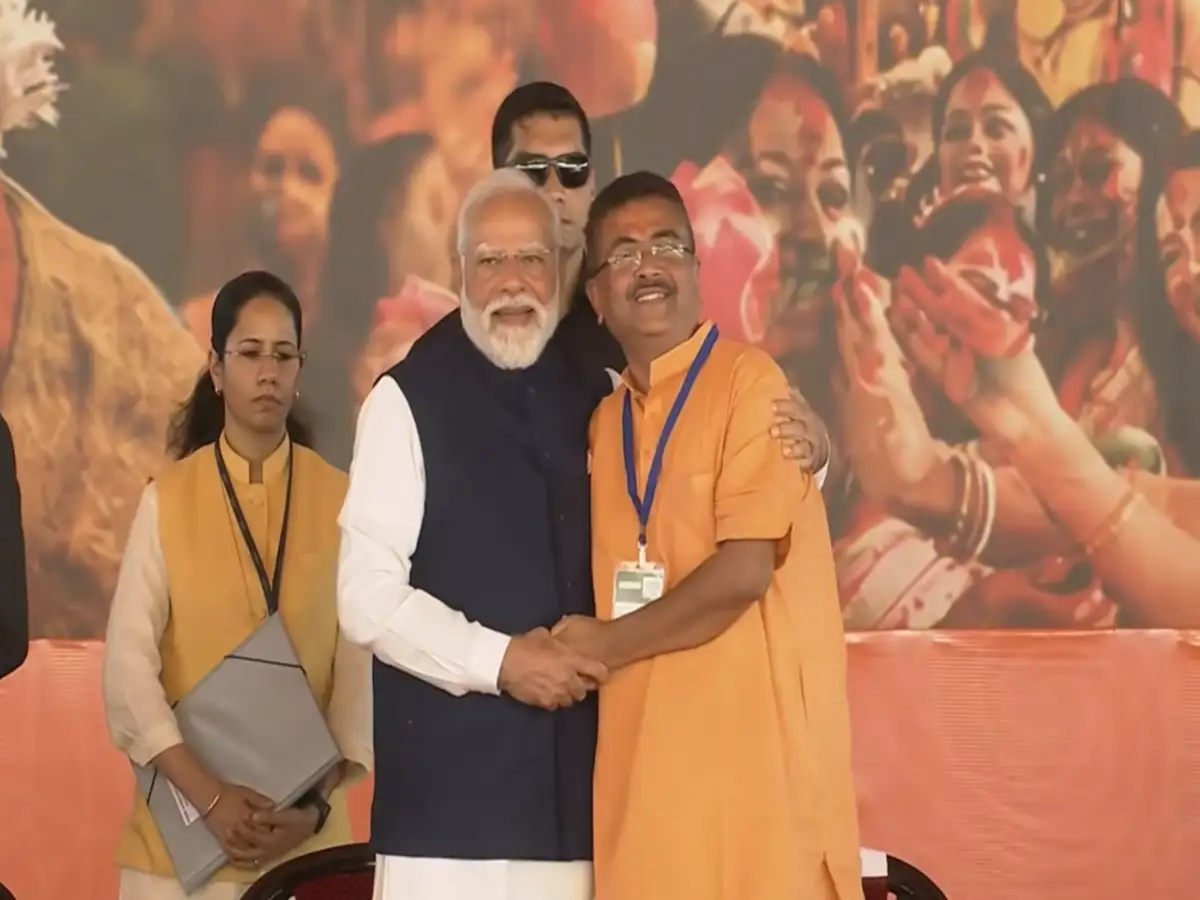
Bharatiya Janata Party scripted a historic political breakthrough in West Bengal on Saturday as Suvendu Adhikari took oath as the state’s first BJP chief minister, ending the 15-year rule of the All India Trinamool Congress.
The swearing-in ceremony took place at Kolkata’s Brigade Parade Grounds in the presence of Narendra Modi, senior Union ministers, NDA chief ministers, BJP leaders, and thousands of party supporters.
RN Ravi administered the oath of office and secrecy to Suvendu Adhikari and members of his cabinet.
The event marked a dramatic political shift in Bengal, where the Trinamool Congress under Mamata Banerjee had dominated politics since 2011.
Read More: Manipur Deputy CM Stresses Honesty In Healthcare
Historic Victory For BJP In Bengal
The BJP’s rise to power in Bengal represents one of the party’s most significant political achievements in eastern India. For years, Bengal politics remained centred around the Left Front and later the Trinamool Congress.
However, the BJP steadily expanded its presence in the state through aggressive grassroots campaigns, organisational growth, and community outreach.
Political analysts believe anti-incumbency, corruption allegations, and growing voter dissatisfaction contributed to the BJP’s victory.
The party also focused heavily on regional identity, welfare schemes, citizenship issues, and law-and-order concerns during the election campaign.
Observers say the victory has reshaped Bengal’s political landscape permanently.
Suvendu Adhikari’s Rise To Power
Suvendu Adhikari’s elevation as chief minister marks the climax of one of Bengal’s most dramatic political journeys.
Once considered a close associate of Mamata Banerjee in the Trinamool Congress, Adhikari later emerged as the BJP’s strongest face in Bengal politics.
His role during the Nandigram movement earlier helped build his political image across the state. After joining the BJP, he rapidly became the party’s key strategist and mass leader in Bengal.
Political observers say his organisational strength and grassroots influence played a major role in the BJP’s electoral success.
Adhikari’s repeated victories against Mamata Banerjee in her political stronghold further strengthened his position within the party.
His oath-taking ceremony therefore carried both symbolic and political significance.
Grand Ceremony At Brigade Parade Grounds
The Brigade Parade Grounds in Kolkata witnessed heavy security and massive crowds during the swearing-in ceremony.
Prime Minister Narendra Modi attended the programme alongside several senior BJP leaders and NDA chief ministers. The event showcased the BJP’s growing confidence after its historic breakthrough in Bengal.
Party supporters waved flags, raised slogans, and celebrated outside the venue throughout the ceremony.
Political analysts described the event as more than a formal oath-taking programme. According to them, the BJP used the occasion to signal the beginning of a new political era in Bengal.
The presence of national leaders also highlighted the importance the BJP attaches to its Bengal victory.
Cabinet Reflects Social And Regional Balance
Along with Suvendu Adhikari, several senior BJP leaders took oath as ministers in the new Bengal government.
Dilip Ghosh, Agnimitra Paul, Ashok Kirtania, Kshudiram Tudu and Nisith Pramanik also joined the cabinet.
The ministry composition reflected the BJP’s effort to balance caste, community, and regional representation.
Political observers noted that the cabinet included OBC, Kayastha, Matua, tribal, and Rajbanshi faces.
Leaders from north Bengal, Junglemahal, border districts, and urban regions received representation in the ministry.
Experts believe the BJP designed the cabinet carefully to strengthen its long-term social coalition in Bengal.
TMC Rule Comes To An End
The BJP victory officially ended the Trinamool Congress government’s 15-year rule in Bengal.
Mamata Banerjee came to power in 2011 after defeating the Left Front government that ruled Bengal for more than three decades.
Under her leadership, the TMC remained the dominant political force in the state for years.
However, political tensions, corruption allegations, and anti-incumbency gradually weakened the party’s position.
The BJP aggressively challenged the TMC through district-level campaigns and strong organisational expansion.
Analysts believe the elections reflected changing political preferences among voters across rural and urban Bengal.
BJP Focuses On Governance And Development
Soon after taking oath, BJP leaders stated that governance and development would remain the top priorities for the new government.
Party leaders promised to focus on infrastructure, industrial investment, employment generation, and law and order.
The BJP has repeatedly claimed that Bengal requires administrative reforms and faster economic growth.
Political experts say the government will face strong public expectations in the coming months.
Issues related to unemployment, healthcare, education, and investment will likely dominate the administration’s agenda.
Observers believe the BJP’s performance in governance will shape its long-term future in Bengal politics.
Opposition Reacts To Political Shift
The Trinamool Congress and opposition parties criticised the BJP after the election outcome. TMC leaders alleged that the BJP used aggressive political strategies during the campaign.
However, BJP leaders rejected the allegations and described the victory as a democratic mandate for change.
Political analysts expect the opposition to remain active and aggressive inside and outside the Assembly.
Bengal politics has historically witnessed intense political competition, and observers believe confrontations between the ruling BJP and opposition parties may continue.
At the same time, experts stress the importance of maintaining democratic stability and administrative focus during the political transition.
Bengal Enters New Political Era
The formation of the BJP government marks the beginning of a new political phase in West Bengal.
For decades, regional and Left parties shaped the state’s political identity. Now, the BJP has emerged as the dominant governing force.
Political analysts believe the Bengal result could influence future political strategies across eastern India.
The BJP leadership also views the victory as a major milestone in its national expansion efforts.
Meanwhile, citizens across Bengal will closely watch how the new government handles governance challenges and development promises.
Focus Now Shifts To Governance
With the swearing-in ceremony completed, attention has now shifted toward the functioning of the new government under Suvendu Adhikari.
The BJP administration faces the challenge of balancing political expectations with effective governance and administrative delivery.
Supporters view the new government as a symbol of political change, while critics remain cautious about the transition.
For now, the BJP’s victory and Suvendu Adhikari’s oath-taking have permanently altered Bengal’s political narrative and opened a new chapter in the state’s history.
Read More: From Matua To Rajbanshi, BJP’s Bengal Cabinet Signals Social Balancing Strategy