


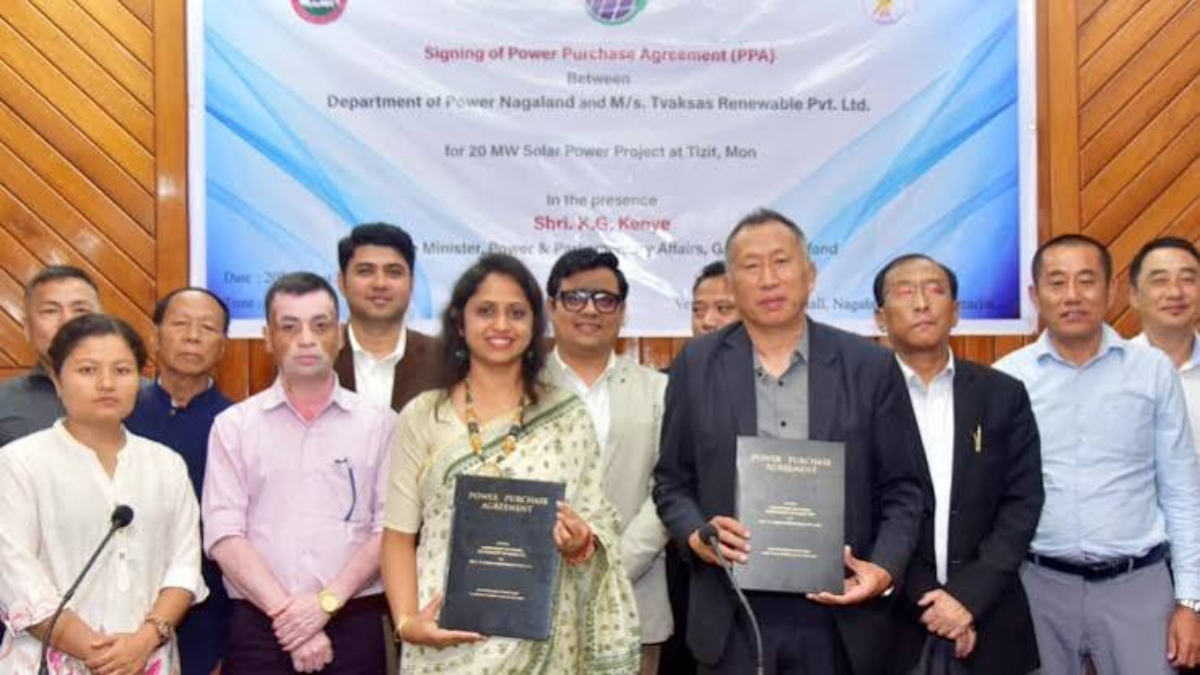
20 MW solar project in Nagaland’s Mon district has received a major boost with the state government signing a 25-year Power Purchase Agreement (PPA) with Tvaksas Renewable Pvt Ltd. The agreement, signed on August 20, 2026, marks a significant step in Nagaland’s efforts to expand local renewable power generation and reduce its dependence on electricity purchased from outside the state.
The project will be developed at Lapa Lampong village in Tizit in Mon district. According to officials, the private solar power plant is expected to be commissioned within 20 months. Once operational, it is projected to generate around 35 million units of electricity every year.
20 MW solar project to strengthen Nagaland’s power supply
The agreement is notable because it represents Nagaland’s first private solar independent power producer initiative, according to the report on the signing. The state government is seeking to increase its own generation capacity as electricity demand continues to rise.
Nagaland’s peak power demand currently stands at around 203 MW. Officials have projected that demand could reach 482 MW by 2034-35. The widening gap between demand and available local generation has increased the importance of developing new power projects within the state.
Under the PPA, electricity from the plant will be supplied to the state grid at a fixed tariff of ₹4.12 per unit. The tariff has received approval from the Nagaland Electricity Regulatory Commission, providing a long-term framework for power procurement from the project.
Project expected to generate 35 million units annually
The proposed 20 MW solar project is expected to generate approximately 35 million units of electricity each year. This additional renewable capacity could help Nagaland meet part of its growing electricity requirement while improving the share of clean energy in its power mix.
Officials have also estimated that the plant could help avoid about 25,000 tonnes of carbon emissions annually. The environmental benefit adds significance to the project as India continues to expand renewable energy capacity and pursue long-term clean energy targets.
The project is expected to contribute to greater energy security for Nagaland. Greater reliance on locally generated electricity could reduce the state’s exposure to external power supplies and provide an additional source of power during periods of high demand.
Local employment among expected benefits
Beyond electricity generation, the project is expected to create employment opportunities in and around Mon district. The state government has urged the developer to complete the project ahead of schedule and make use of local workers wherever possible.
Tvaksas Renewable director Bhakti Dave said the development could create new opportunities for local employment and youth while encouraging further investment in Nagaland. The company is also expected to work with the Department of Power on the project’s long-term maintenance.
For communities in the project area, construction and operation of the plant could create demand for workers involved in civil works, electrical installation, security, maintenance, transportation and other support services.
Private investment could expand renewable capacity
The agreement also signals a greater role for private investment in Nagaland’s renewable energy sector. The developer has indicated plans to eventually scale its programme to 100 MW, suggesting that the current project could become part of a wider renewable energy expansion in the state.
The move comes as India continues to push renewable energy development. For Nagaland, increasing solar capacity could be particularly important because it offers another route to diversify the state’s electricity sources while supporting its long-term energy requirements.
Successful completion of the 20 MW solar project will now depend on timely construction, grid connectivity, equipment installation and other project requirements. Meeting the 20-month completion target will be an important test of the state’s ability to deliver large-scale private renewable projects.
The signing of the 25-year PPA gives Nagaland a long-term framework for purchasing electricity from the plant. With demand expected to rise sharply over the coming years, the project could become an important addition to the state’s power infrastructure.
For Mon district, the development also brings the prospect of new economic activity linked to renewable energy. If the project is completed as planned, it could demonstrate how private investment can support both local employment and Nagaland’s transition towards cleaner and more reliable power generation.
Manipur Polo Heritage Takes the Spotlight in a Powerful Miss Universe India 2026 Costume