


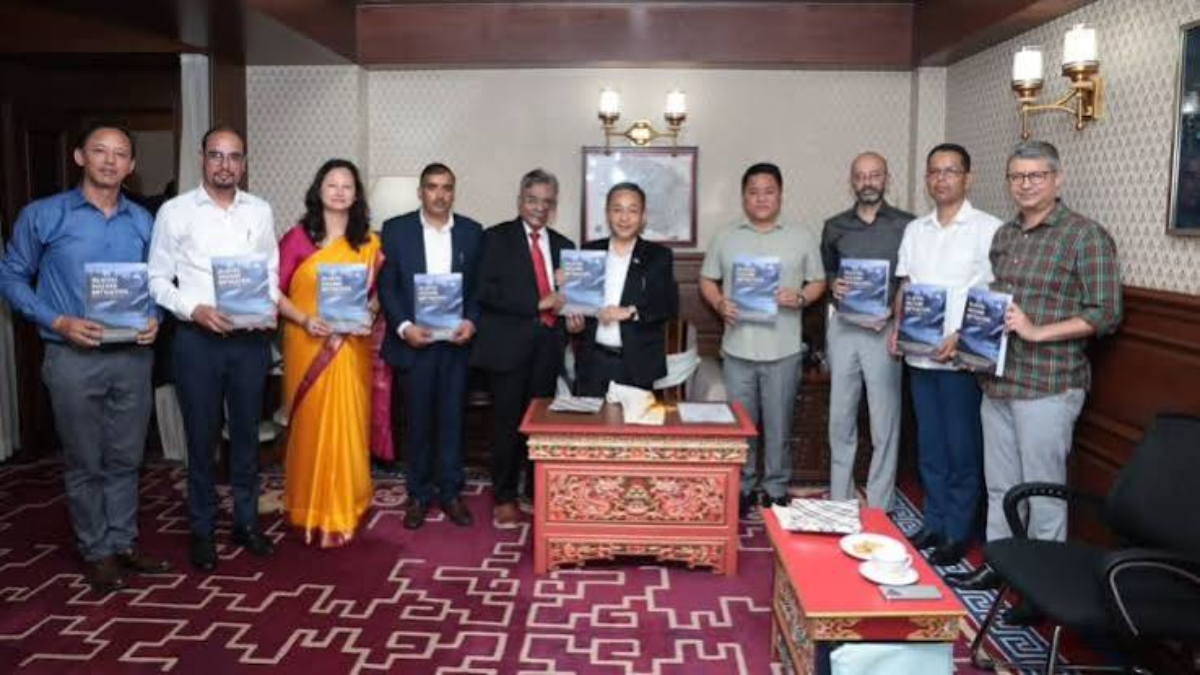
Glacial hazard mitigation has received a major boost in Sikkim with the state government receiving a report from the Commission on Glacial Hazards, which has proposed eight recommendations to strengthen preparedness, resilience and response mechanisms against future glacial disasters. The report was submitted to Chief Minister Prem Singh Tamang by commission chairperson Dr Akhilesh Gupta in the presence of Minister Pintso Namgyal Lepcha on September 12.
The development comes nearly three years after the devastating South Lhonak Glacial Lake Outburst Flood (GLOF) of 2023, which caused extensive destruction in the Teesta river basin. The latest report is expected to provide a broader roadmap for strengthening Sikkim’s ability to manage risks from rapidly changing high-altitude glacial environments.
Commission submits eight-point roadmap
The Sikkim government constituted the Commission on Glacial Hazards on September 11, 2024, following the South Lhonak disaster. Its mandate was to prepare a comprehensive strategy for mitigating glacial hazards and improving the state’s resilience to future disasters.
The commission’s report contains eight major recommendations. While the government has not publicly detailed each recommendation individually, the proposals are focused broadly on improving disaster preparedness, resilience and response.
Chief Minister Tamang said the government would take forward the recommendations with determination and collective responsibility. He also expressed the aim of building a safer, more resilient and climate-conscious Sikkim.
The report therefore marks an important transition from assessing glacial risks to developing a stronger long-term framework for glacial hazard mitigation.
Sikkim strengthens GLOF preparedness
The latest move follows several scientific and administrative initiatives undertaken by the state after the 2023 disaster. On September 10, Chief Secretary R. Telang chaired a high-level coordination meeting in Gangtok to review preparedness and ongoing measures against potential GLOFs.
The meeting brought together state departments, central agencies, defence organisations, technical institutions and project developers. Discussions covered scientific assessments, early-warning mechanisms, mitigation measures and coordination between agencies.
The Department of Science and Technology highlighted the significant losses caused by the South Lhonak GLOF and outlined priorities for protecting people and critical infrastructure from future glacial flood events.
Focus shifts to high-risk glacial lakes
Scientific assessment remains central to Sikkim’s glacial hazard mitigation strategy. In August, the state government announced the completion of a multidisciplinary expedition to high-risk glacial lakes in Mangan district.
Conducted from July 23 to August 8, the expedition collected bathymetric, geological, geophysical, hydrological, geomorphological and meteorological data. Scientists used techniques including Electrical Resistivity Tomography, bathymetric surveys and DGPS measurements to improve understanding of vulnerable lake systems.
The findings are expected to support hydrodynamic modelling, long-term monitoring, early-warning preparedness and lake-specific mitigation plans.
Sikkim has identified several high-risk glacial lakes where the physical characteristics of the lake, surrounding terrain and natural barriers require detailed study before engineering interventions are considered.
Engineering measures already proposed
Recent assessments have also resulted in specific engineering proposals. The state has proposed a solar-powered pumping system at Shako Chho to lower the lake’s water level, a flood-retention structure at Dolma Sampa in the Lhonak Valley and a safety wall at the outlet of the Gurudongmar lake complex.
Shako Chho has been identified as particularly vulnerable. The proposed pumping system aims to reduce the lake level and create additional freeboard, thereby lowering the volume of water that could potentially be released during a GLOF.
At Dolma Sampa, authorities are examining a natural widening of the valley that helped slow the 2023 flood. A retention structure could potentially reduce flood momentum and allow water and debris to spread more gradually.
For the Gurudongmar complex, officials are examining a structure near the outlet to regulate discharge while avoiding major disturbance to the lake system.
Building stronger monitoring systems
Technology and monitoring are also becoming important components of Sikkim’s glacial hazard mitigation efforts. The state has been carrying out field expeditions, lake-level monitoring, geophysical investigations and other scientific studies to establish detailed baseline information.
Authorities are also examining the potential use of Doppler weather radar to improve weather monitoring. Such systems could support understanding of intense rainfall and weather conditions associated with landslides and other hazards that may affect unstable glacial environments.
However, officials have acknowledged that some hazards, including earthquakes and cloudbursts, cannot currently be predicted with sufficient precision. This makes layered preparedness, monitoring and rapid response particularly important.
A long-term Himalayan resilience model
Sikkim’s approach is increasingly based on combining scientific research, engineering solutions, early-warning systems and institutional coordination. The state has established a High-Level Steering Committee for policy direction and a Multidisciplinary Task Force for field-level implementation, while the Department of Science and Technology serves as the nodal department for GLOF hazard assessment and mitigation.
The new commission report adds another layer to this framework by providing a broader strategic roadmap.
For Sikkim, the challenge now is to translate the recommendations into practical measures on the ground. With vulnerable communities, roads, bridges, dams and other infrastructure located downstream of high-altitude lakes, timely implementation will be critical.
The government’s commitment to the recommendations signals a stronger focus on glacial hazard mitigation as part of long-term disaster preparedness. If implemented effectively, the measures could help Sikkim build greater climate resilience and provide a useful model for other Himalayan regions facing growing risks from glacial lake outburst floods.
Sikkim University Campus Delay Sparks Fresh Concern Over PG Vacancies