

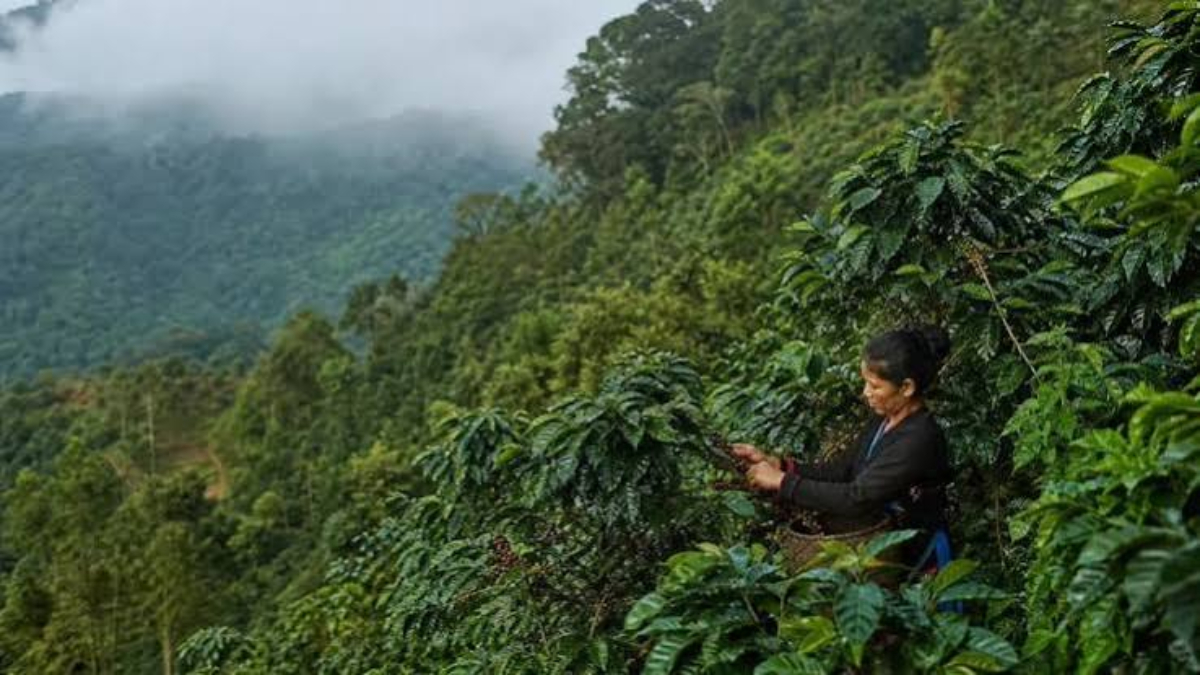
Nagaland coffee needs stronger infrastructure, modern processing, value addition and reliable market linkages to become a commercially viable source of income for farmers, North Eastern Council (NEC) Secretary Satinder Kumar Bhalla said during a visit to Tuophema village in Kohima district.
Bhalla visited Tuophema on October 2 to review coffee cultivation and supporting infrastructure under the Coffee Utilisation of Surplus Potential (USP) Project. He inspected plantation sites and the Hi-Tech Coffee Washing Station and interacted with growers and members of the Tuophema Cluster.
Nagaland coffee needs an integrated approach
Bhalla said coffee development cannot stop at planting trees. For the sector to become commercially viable and competitive, farmers need better road connectivity, modern processing machinery, efficient post-harvest infrastructure, quality assurance, value addition and stronger domestic and export market links.
The NEC secretary described the Coffee USP Project as more than a plantation programme. He said it is intended as an integrated livelihood and economic development initiative that can help villages, societies and farmer clusters gain greater value from local natural and human resources.
According to the state government, the broader objective is to raise farm incomes and create sustainable livelihoods. Bhalla called for coordinated action involving the Centre, Nagaland government, Coffee Board, local administration, technical institutions, farmers and the private sector.
Processing and market access remain crucial
The push for value addition comes as Nagaland is expanding efforts to build a complete coffee value chain. In May, the Centre and Nagaland launched the Cluster-Based Coffee Value Chain Development in Nagaland project with funding of Rs 44.06 crore from the Ministry of DoNER and NEC.
The project has pilot clusters at Tuophema in Kohima district for Arabica coffee and Ghotovi in Niuland district for Robusta. It includes hi-tech nurseries, expansion of cultivation, modern washing stations, roasteries, branding and marketing initiatives. The state government has also proposed positioning “Coffees of Nagaland” as a premium, traceable, single-origin brand.
The initiative is designed to move more of the value chain closer to farms. Better washing, roasting, grinding, packaging and branding can help producers earn more from processed coffee rather than depending mainly on the sale of raw produce.
Farmers highlight labour and water shortages
During the Tuophema interaction, growers pointed to practical challenges affecting cultivation and processing. Village Council Chairman Pfuduolhou Kense said labour shortages and high labour costs for weeding and harvesting were major concerns.
The growers sought support for brush cutters and suitable harvesting equipment to reduce dependence on manual labour and improve efficiency.
Water availability was another key issue. Farmers requested water-harvesting structures, storage tanks and irrigation facilities. Adequate water is particularly important for maintaining productivity and supporting post-harvest processing during dry periods.
Bhalla also encouraged diversification within coffee plantations. He asked the state government and Coffee Board to work with central agricultural institutions to identify suitable intercrops and complementary activities. Black pepper and other crops could provide additional income where technically suitable.
A growing coffee sector in Nagaland
The latest push builds on years of efforts to expand coffee cultivation in the state. According to the Nagaland government, coffee production increased from 21 metric tonnes in 2021–22 to nearly 73 metric tonnes in 2024–25.
The state has also been developing infrastructure to support processing and entrepreneurship. Earlier government data recorded more than 10,000 hectares under coffee plantations, while NEC-supported initiatives included washing stations and training for coffee entrepreneurs in roasting.
The 2026 value-chain project aims to expand this base while creating stronger links between farmers, processors, brands and consumers.
Diversification could strengthen rural incomes
Bhalla said diversification can improve land productivity while creating additional employment opportunities, particularly for local youth. The approach also fits the state’s wider plans to connect agriculture with entrepreneurship and tourism.
The Coffee USP Project includes an emphasis on sustainable livelihoods, while the broader “Coffees of Nagaland” initiative also envisages farm-stay tourism. Visitors could experience coffee production from cherry to cup while generating additional income for rural communities and entrepreneurs.
For Nagaland coffee, the next phase will therefore depend not only on expanding plantations but also on solving field-level constraints and improving what happens after harvesting. Roads, water systems, mechanisation, processing, quality control, branding and market access will determine how much value farmers can retain from the crop.
With NEC, the state government, Coffee Board and private stakeholders working together, the focus is now shifting from cultivation alone towards building a complete and commercially sustainable coffee ecosystem in Nagaland.
Shivaji Park Protest: Complaint Against Abhijeet Dipke, Three Others