


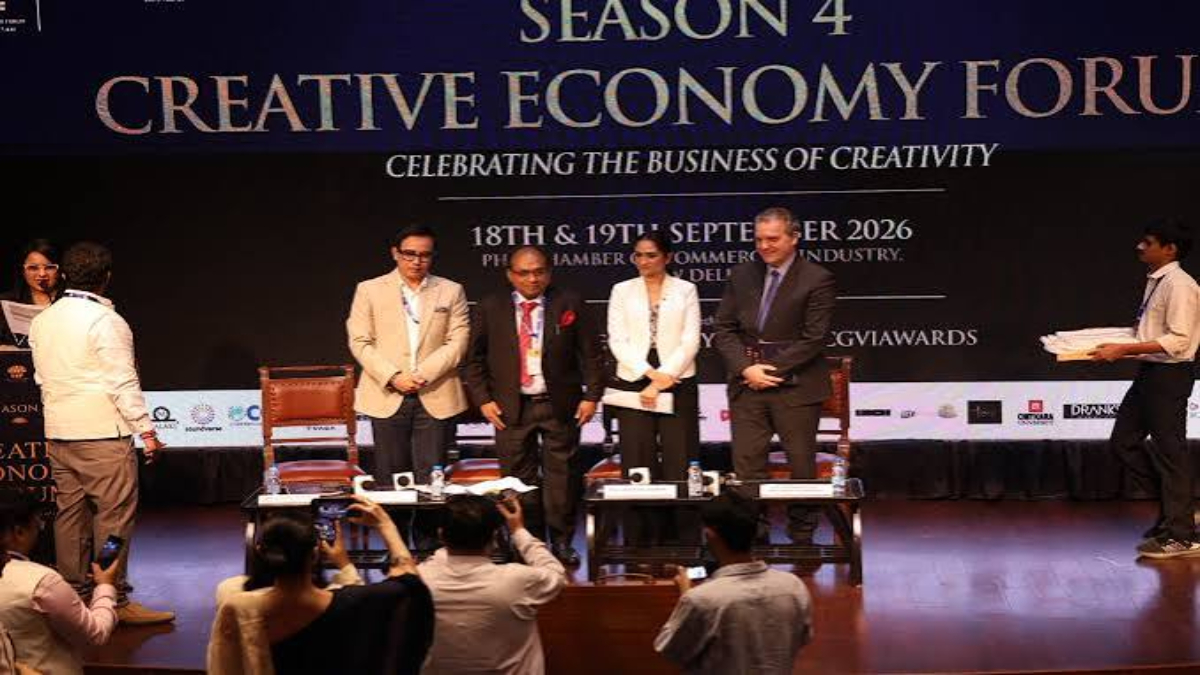
Sikkim creative economy plans are gaining momentum as the state looks to combine its cultural heritage, indigenous knowledge, youth talent and digital entrepreneurship into a sustainable economic model. Chief Minister Prem Singh Tamang’s Press Secretary Yougan Tamang recently said Sikkim could emerge as a pilot state for a “Himalayan creative economy model” rooted in sustainability and the region’s distinct identity.
Tamang made the remarks during the fourth season of the Creative Economy Forum in New Delhi on September 19. The forum, organised by Cinedarbaar under the aegis of the Union ministries of Information and Broadcasting, Electronics and Information Technology, and Culture, brought together policymakers, industry representatives and international voices.
Sikkim creative economy model takes shape
Tamang said the state’s approach under Chief Minister Prem Singh Tamang-Golay focuses on public-private partnerships and the potential of Sikkim’s young population. The proposed model seeks to bring sustainability, indigenous knowledge, cultural heritage and digital-age entrepreneurship into a common framework.
The idea is to turn cultural strengths into sustainable economic opportunities without weakening the ecological and social character of the Himalayan state. According to the state government, creative industries could help young people build livelihoods while keeping local traditions relevant in a changing economy.
The approach also reflects a wider effort to expand the role of creative industries beyond conventional cultural programmes. Art, crafts, music, storytelling, traditions and other forms of creative expression could support entrepreneurship, tourism, digital content and other emerging sectors.
Youth at the centre of the strategy
A major part of the Sikkim creative economy vision is its focus on young people. Tamang said the government wants to use the skills and ideas of Sikkim’s youth to strengthen the state economy and contribute to India’s wider creative sector.
The government has also discussed a proposed Creatorpreneur Policy aimed at supporting young people who combine creativity with entrepreneurship. Such an approach could create space for creators, designers, artists, digital professionals and cultural entrepreneurs to develop businesses around local knowledge and identity.
This could also provide new opportunities for people who want to remain in Sikkim while building careers in creative and digital industries. Better links between creators, private companies, investors and government programmes would be important for turning the concept into long-term enterprises.
Culture as an economic asset
Tamang argued that the Northeast’s cultural diversity should not only be celebrated but also treated as an economic asset. For Sikkim, that means exploring ways to generate income from indigenous art, crafts, music, storytelling and cultural traditions while supporting their preservation.
The concept places cultural preservation alongside economic development rather than treating them as separate goals. This is particularly significant for a Himalayan state where ecological sensitivity and cultural identity remain closely connected.
Sikkim looks beyond traditional industries
The Sikkim creative economy agenda also comes as the state explores newer areas such as animation, digital heritage, design and cultural enterprises. Recent government material has highlighted discussions around animation, archive digitisation, design entrepreneurship and new routes for creative monetisation.
The state has already seen initiatives linked to digital and creative sectors. The Digital Nomad Village model at Yaktan in Pakyong and work involving animation and manga were highlighted during creative economy engagements. Officials have also discussed attracting investment and building partnerships with industry players.
These developments suggest that the creative economy strategy could extend beyond traditional handicrafts and cultural tourism into digital-first businesses.
Northeast gets wider creative economy focus
Tamang also placed Sikkim’s plans within the broader economic potential of Northeast India. He referred to the region’s cultural diversity and its potential to contribute more prominently to India’s creative industries.
The discussion took place alongside international participants, including Brazil’s Ambassador Kenneth Felix Haczynski da Nobrega and Suriname’s Ambassador Hanisha Jairam, during a panel titled “Orange is the New Currency: Creative Capital Uniting Nations.” Tamang also joined a roundtable on cultural diplomacy and soft power.
For Sikkim, the immediate challenge will be translating this vision into policies, investment, infrastructure and market access. If those elements develop together, the state could offer a framework for other Himalayan regions seeking to connect cultural preservation with modern entrepreneurship.
The government’s latest pitch places creativity at the heart of Sikkim’s future economic planning. The Sikkim creative economy vision now faces the task of moving from a promising policy concept to sustainable businesses, stronger youth opportunities and measurable economic outcomes while protecting the cultural and ecological foundations that make the state distinctive.