

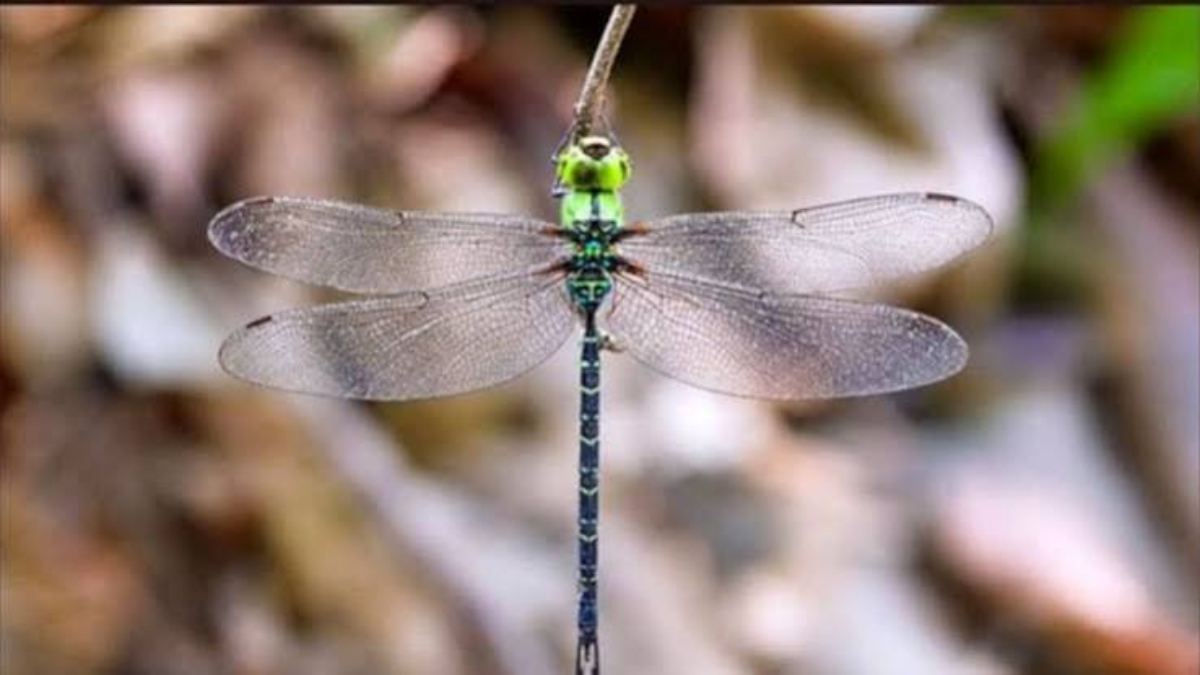
Spoon-tailed Duskhawker has been photographed for the first time in Arunachal Pradesh, providing verifiable photographic evidence of the rare dragonfly from the state. The record was made inside Namdapha National Park and Tiger Reserve in Changlang district and has added an important entry to India’s Odonata documentation.
The discovery is significant because the species, scientifically known as Gynacantha basiguttata, had previously been mentioned in older literature from India. However, those records were considered doubtful because they were based on female specimens. The species was later excluded from recent Indian and South Asian Odonata checklists.
Rare dragonfly recorded at Namdapha
The dragonfly was photographed in October 2024 along the Miao-Vijaynagar Road inside the Namdapha landscape. A single male was observed hanging vertically from vegetation in a densely shaded area on a cloudy day.
At first, researchers identified the insect as Gynacantha khasiaca. A subsequent taxonomic examination of the photographs, however, established that it was Gynacantha basiguttata, commonly known as the Spoon-tailed Duskhawker.
The research was carried out by a five-member team comprising R. Mahesh, Rajesh Gopinath, Dattaprasad Sawant, Gaurav Joshi and Roshan Upadhaya. Their findings were published in the Journal of Threatened Taxa.
How the Spoon-tailed Duskhawker was identified
Researchers relied on visible morphological features in the photographs to confirm the species. These included a distinctive black T-shaped mark on the frons, the front portion of the head, along with an olive-green thorax without a stripe.
The dragonfly also showed characteristic wing pigmentation. Another important feature was its narrow but expanded cerci, the paired appendages at the end of the abdomen. Their shape gives the species its distinctive “spoon-tailed” name.
The species belongs to the family Aeshnidae, which includes large dragonflies commonly known as hawkers or darners. It is part of the order Odonata, which covers dragonflies and damselflies.
Why the record matters for India
The new photographic evidence has wider scientific importance. Researchers recommended that the Spoon-tailed Duskhawker be included in India’s Odonata checklist following the taxonomic verification. The finding therefore helps strengthen documentation of the country’s dragonfly diversity.
The species was originally described from the Philippines and is known from parts of Southeast Asia. Its confirmation in Namdapha expands the documented range of the species and provides stronger evidence of its presence in northeastern India.
Importantly, researchers did not collect a physical specimen. They said this was in accordance with forest regulations and the Wildlife (Protection) Amendment Act, 2022. The identification was instead based on photographic evidence and morphological characteristics visible in the images.
Namdapha highlights Arunachal’s biodiversity
Namdapha National Park and Tiger Reserve is located in Changlang district and is widely recognised for its exceptional biological diversity. The protected landscape continues to produce significant wildlife and biodiversity records, making it an important area for scientific surveys and species documentation.
The latest discovery also underlines how much remains to be documented in Arunachal Pradesh’s forest ecosystems. Dense tropical forests can provide habitats for species that are difficult to observe because of their behaviour, limited visibility and preference for shaded environments.
The Spoon-tailed Duskhawker record is therefore more than a new entry on a checklist. It demonstrates the value of sustained field surveys, careful photographic documentation and taxonomic verification in understanding the region’s biodiversity.
Deputy Chief Minister Chowna Mein welcomed the discovery, describing it as another notable addition to Arunachal Pradesh’s biodiversity profile. He also highlighted the state’s rich forest ecosystems and the range of species they support.
As researchers continue documenting Namdapha and other protected landscapes, further discoveries could add to the understanding of Arunachal Pradesh’s insect diversity. The latest record reinforces the importance of protecting these habitats while encouraging continued scientific research and biodiversity monitoring across the state.