

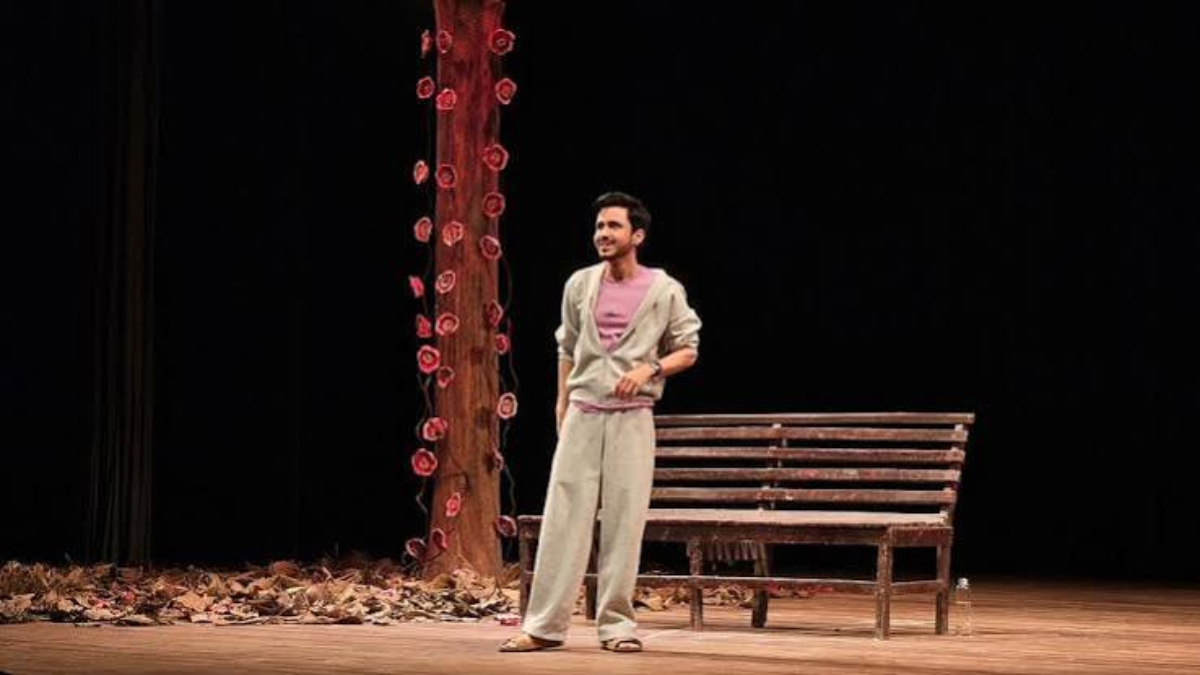
Besharam Aadmi brought actor Amol Parashar to Guwahati on September 26, with the 75-minute solo play at the ITA Centre, Machkhowa, turning an everyday domestic moment into a sharp exploration of masculinity, marriage, family and social conditioning. Written and directed by Vijay Ashok Sharma, the play uses humour and introspection to examine the gap between progressive beliefs and deeply rooted ideas about gender roles.
The play centres on a married man who sees himself as modern and believes in sharing household responsibilities with his wife. However, a seemingly small moment unsettles that confidence: he becomes conscious of handling his wife’s lingerie when his parents are around. What follows is an extended examination of why an ordinary household task can suddenly feel uncomfortable when viewed through the eyes of family and society.
Besharam Aadmi turns hesitation into a story
The central situation in Besharam Aadmi grew from Sharma’s own experience. In interviews, the writer-director has explained that he once felt hesitant while doing laundry in front of his parents, despite regularly handling household chores. That moment became the starting point for a story about the conditioning people carry even when their conscious beliefs have changed.
Rather than presenting the issue through a conventional social drama, Sharma builds the narrative around humour, awkwardness and self-questioning. The result is a performance that moves between comedy and more personal observations about marriage and family.
The play also explores the contradictions that can exist within modern relationships. A man may support equality in principle but still hesitate when traditional expectations enter the room. By focusing on that contradiction, the production examines how ideas about masculinity can remain influential in everyday situations.
Amol Parashar carries the entire performance
Parashar performs the play alone, making the format particularly demanding. Earlier discussions around the production have highlighted the challenge of carrying roughly 75 minutes of material without another actor, prompter or co-performer to share the stage. The performance depends on his timing, movement, voice and ability to sustain a direct relationship with the audience.
Parashar has described the show as different from conventional stand-up. Its structure combines storytelling, comedy and introspection, while keeping the audience close to the protagonist’s thoughts. The minimal stage design also supports this approach, allowing the story and performer to remain at the centre.
The production’s format has helped it travel across Indian cities. Before its international run, the show had performed in places including Mumbai, Pune, Bengaluru and Delhi NCR. In April 2026, it also reached London for an international performance, marking another stage in its touring journey.
A wider conversation about gender roles
At its heart, Besharam Aadmi is not simply about one household chore. Its larger questions concern how men are taught to understand intimacy, domestic work and emotional vulnerability.
Parashar has previously said the story challenges the kind of shame that can make people uncomfortable about helping their partners while leaving other social attitudes unquestioned. The production therefore uses its comic premise to examine how ideas about masculinity are learned and repeated.
The response from audiences has also shaped the show’s journey. Sharma has said that people from different generations have approached him after performances, while newly married couples have recognised aspects of their own experiences in the play’s treatment of household work and equality.
From Guwahati to a growing theatre journey
The Guwahati performance added another stop to a production that has continued to evolve through live performances. A listing for the September 26 show described it as a 70-minute solo comedy theatre performance at ITA Centre, Machkhowa, while the broader production has generally been presented as a 70- to 75-minute work.
The play’s continuing tour reflects the appeal of using a small domestic situation to open a larger conversation. Its questions are rooted in everyday life: who performs household work, why certain tasks are considered embarrassing, and how family expectations influence behaviour even inside contemporary marriages.
By bringing those questions to the stage through comedy rather than a conventional lecture, Besharam Aadmi keeps its focus on the uncomfortable space between what people believe and how they sometimes behave. The Guwahati staging extended that conversation to another audience, adding a new chapter to Amol Parashar and Vijay Ashok Sharma’s evolving theatre project.
Shivaji Park Protest: Complaint Against Abhijeet Dipke, Three Others