

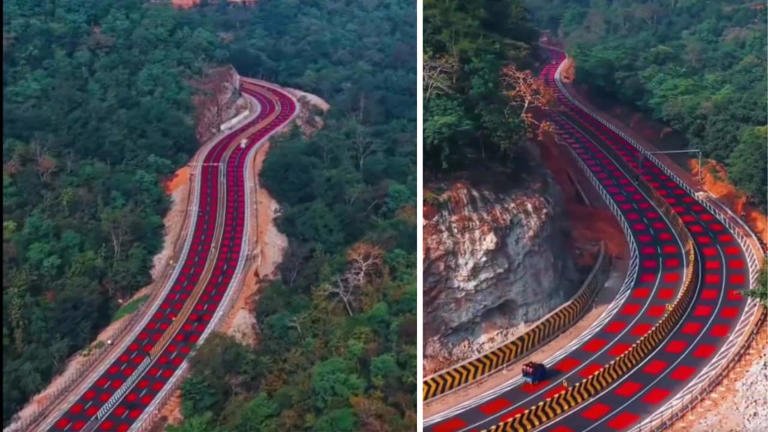
The National Highways Authority of India (NHAI) has introduced a pioneering initiative to enhance road safety for wildlife. Specifically, they have launched India’s first wildlife-safe road stretch. This innovative safety measure involves the use of table-top speed breakers marked distinctly in red on National Highway 45 (NH-45). This critical highway segment passes directly through a vital forest corridor in Madhya Pradesh.
The introduction of this specialized marking system addresses the growing concern over animal-vehicle collisions. These collisions frequently occur when highways cut through established wildlife habitats. The measure aims to slow down traffic significantly within the forest area, thus protecting endangered species and other wildlife that cross the road. This unique design and implementation make it a landmark project in India’s efforts toward Wildlife Safe Road NH-45 Madhya Pradesh.
Read More: BJP Discusses Peace, Power, Progress Strategy for Manipur in Delhi
The Innovation: Table-Top Red Marking
The key innovation lies in the design and color of the speed control structures. Traditionally, roads passing through forest areas relied on standard speed limit signs and occasional rumble strips. The new system is more intrusive and physically compels drivers to reduce speed:
- Table-Top Design: Unlike conventional, curved speed breakers, the table-top design provides a continuous, elevated surface. This forces vehicles to slow down more evenly and ensures that drivers notice the speed regulation.
- Red Marking: The use of a vivid red color for the marking is highly deliberate. It provides maximum visual contrast against the standard black asphalt. Consequently, the bright red surface instantly alerts drivers that they are entering a crucial wildlife zone, prompting immediate speed reduction.
This combination of physical elevation and high-visibility marking creates a dual-action safety mechanism. It enhances driver awareness while simultaneously minimizing the speed differential, thus improving both human and animal safety.
Location: A Critical Forest Corridor on NH-45
The chosen location for this pilot project, NH-45 in Madhya Pradesh, is a critical wildlife corridor. This specific stretch connects key forest reserves, which house diverse fauna, including deer, wild pigs, and even large carnivores. The highway fragmenting this habitat often led to tragic road accidents involving animals, particularly during twilight hours.
By installing the table-top red markings, the NHAI acknowledges the ecological significance of this corridor. The initiative effectively creates a designated ‘slow-moving’ zone, giving animals sufficient time to cross the highway safely. Therefore, this localized intervention is expected to drastically reduce roadkill incidents in the area, offering a tangible solution to a long-standing conservation problem.
Broader Implications for National Highways
The success of the Wildlife Safe Road NH-45 Madhya Pradesh pilot project holds significant implications for infrastructure development across the country. India has several national highways that traverse protected areas and dense forest lands.
If the red-marked table-top system proves effective in significantly reducing animal collisions, the NHAI plans to replicate this model. Furthermore, this standardized approach could become a mandatory feature for all highway segments passing through ecologically sensitive zones. This transition would signal a major policy shift toward integrating conservation priorities directly into road design standards.
This pioneering effort positions India at the forefront of implementing practical, engineering-based solutions for wildlife conservation on national highways. The move demonstrates that large-scale infrastructure development can, and must, coexist with environmental stewardship. The NHAI’s commitment to this project sets a crucial precedent for future road construction across the nation’s diverse landscapes.
Read More: Tripura Ranks 2nd Nationally in Energy Conservation Efforts