

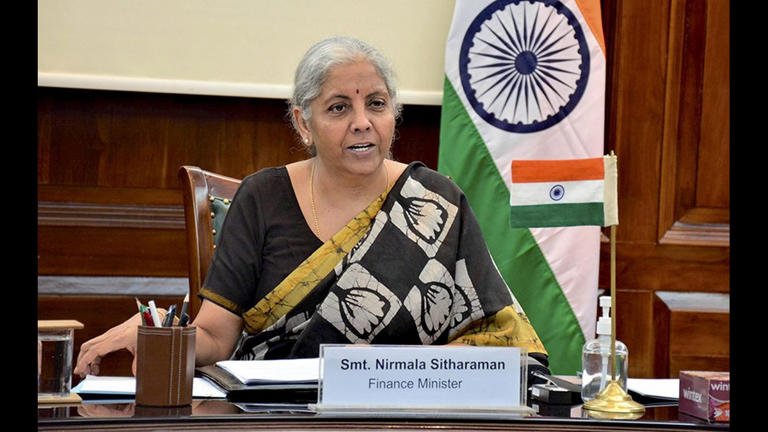
Union Finance Minister Nirmala Sitharaman has described India as a “centre of stability” amid growing geopolitical tensions and global economic uncertainty. She made the remarks while addressing the convocation ceremony of Dr. M.G.R. Educational & Research Institute in Chennai on September 15.
Sitharaman highlighted India’s economic performance during a period marked by several international conflicts. She said the country has continued to grow at 7.8% despite disruptions affecting major economies and global trade.
Her comments came as conflicts and tensions continue to affect energy markets, supply chains and international trade. The Finance Minister pointed to India’s dependence on regions affected by geopolitical tensions for important imports such as crude oil and agricultural fertilisers.
India Faces a Challenging Global Environment
Sitharaman referred to the Russia-Ukraine war, the Israel-Iran conflict and tensions involving Iran, the United States and Gulf countries. She said these developments have created uncertainty across the global economy.
India remains connected to these developments through its trade and energy requirements. Crude oil is a major import for the country. Fertilisers also play an important role in supporting India’s agricultural sector.
The Finance Minister said these external challenges have not prevented India from maintaining economic growth. She presented the 7.8% growth figure as an indication of the economy’s resilience during a period of global uncertainty.
The statement also reflects the wider impact of geopolitical conflicts on economies that depend on international markets. Changes in crude oil prices can affect transport, manufacturing and household expenses. Fertiliser prices can also influence agricultural costs and food production.
Sitharaman Highlights 7.8% Growth
A major part of Sitharaman’s address focused on India’s economic growth. She said India has maintained a 7.8% growth rate despite difficult conditions across the world.
The Finance Minister also referred to her recent visit to North America. According to her, discussions there included questions about how India was able to maintain such growth despite global economic pressures.
Sitharaman said the performance had drawn attention from people in other countries. She linked the growth with the broader economic stability India has maintained during a period of international uncertainty.
The 7.8% figure refers to India’s reported real GDP growth in the first quarter of the 2026-27 financial year. The figure has become an important indicator in discussions about the strength of the Indian economy.
Global Conflicts Create Economic Risks
The Finance Minister’s remarks also underline the economic risks created by international conflicts. India’s large dependence on imported crude oil makes global energy developments particularly important.
West Asian tensions can affect oil supply routes, shipping costs and international prices. The same region also has significance for fertiliser supplies.
These factors can create pressure on India’s import bill and domestic prices. The government therefore faces the challenge of maintaining growth while managing external economic shocks.
Sitharaman said India has continued to protect its economic stability despite these pressures. She described the country as a centre of stability compared with the uncertainty seen in several parts of the world.
Her comments came at a time when businesses and governments around the world are closely watching developments in energy markets and international trade.
Message to Graduating Students
Sitharaman made the remarks while addressing thousands of graduating students. The event was the 36th convocation of Dr. M.G.R. Educational & Research Institute.
Reports said more than 3,500 students attended the convocation. The ceremony also included doctoral degrees and excellence awards for students.
The Finance Minister used the occasion to speak about education, humility and responsibility. She reminded students that graduation should not be viewed as the end of learning.
She quoted the Thirukkural to emphasise the lasting value of education. Her message focused on the idea that material wealth can be lost during difficult times, while education remains a lasting asset.
Sitharaman also referred to scientist Sir Isaac Newton. She said Newton acknowledged the contributions of other scholars to his achievements. She used the example to encourage students to remain humble while building their careers.
Focus on Youth and Future Opportunities
The Finance Minister also spoke about the opportunities emerging for young Indians. She highlighted the growth of Global Capability Centres, particularly in Tamil Nadu.
According to her remarks, Tamil Nadu has around 350 GCCs. She also mentioned developments in cities such as Coimbatore, Madurai and Tiruchi.
Global Capability Centres provide services such as technology, research, finance and business support for multinational companies. Their expansion has created new employment opportunities for skilled workers.
Sitharaman encouraged students to prepare themselves for a changing employment environment. She also highlighted the importance of artificial intelligence and technological development.
India’s Economic Stability in Focus
Sitharaman’s comments place India’s current economic performance within a wider global context. International conflicts continue to affect energy supplies, trade routes and commodity markets.
For India, these developments carry particular significance because of its dependence on imported crude oil and other essential commodities. Any prolonged disruption could create economic challenges.
At the same time, the government has continued to highlight India’s growth performance and domestic economic activity.
The Finance Minister’s remarks therefore focused on two connected themes: managing external uncertainty and maintaining domestic growth.
As geopolitical tensions continue, India’s economic performance will remain closely linked to developments in energy markets, international trade and global supply chains. For businesses and households, the impact of these developments will depend partly on the duration and intensity of international conflicts.
Sitharaman’s Chennai address presented India’s 7.8% growth rate as evidence of economic resilience. She also used the occasion to encourage graduates to approach the country’s changing economic environment with knowledge, humility and responsibility.