

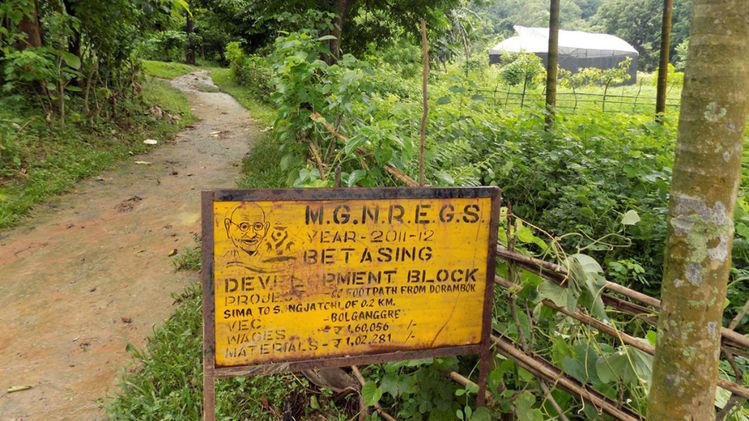
The Meghalaya government has officially replaced the Mahatma Gandhi National Rural Employment Guarantee Act (MGNREGA) with its newly launched flagship programme, the VB-G RAM G initiative. Backed by a substantial financial allocation of Rs 1,100 crore, the ambitious scheme is expected to redefine the state’s approach to rural development by focusing on sustainable livelihoods, infrastructure creation, and community-led growth.
The launch of VB-G RAM G marks one of the most significant policy shifts in Meghalaya’s rural development landscape in recent years. State officials believe the programme will address long-standing challenges associated with conventional employment schemes while offering greater flexibility, accountability, and locally tailored development initiatives.
The announcement has generated widespread attention across the state, with policymakers describing it as a transformative step that aligns with Meghalaya’s vision of achieving inclusive economic growth through community participation.
Why Meghalaya decided to move beyond MGNREGA
For years, MGNREGA served as one of India’s largest rural employment programmes, guaranteeing wage employment to rural households. While the scheme provided employment opportunities across Meghalaya, state authorities argued that its implementation often faced procedural delays, limited flexibility, and challenges in addressing region-specific developmental priorities.
The state government believes that Meghalaya requires a more customized approach considering its unique geographical conditions, tribal governance structures, dispersed settlements, and diverse economic activities. Officials have maintained that a locally designed programme can better respond to the aspirations of rural communities while ensuring faster execution of projects.
The transition to VB-G RAM G is intended to reduce bureaucratic bottlenecks, improve fund utilization, and integrate employment generation with long-term rural asset creation.
Government representatives have also highlighted the importance of creating durable infrastructure instead of merely generating temporary employment, ensuring that every project contributes to lasting economic benefits for villages.
Rs 1,100 crore funding to accelerate implementation
A major highlight of the programme is the allocation of Rs 1,100 crore for its rollout across Meghalaya. The substantial financial support is expected to facilitate large-scale implementation in villages covering infrastructure development, livelihood enhancement, water conservation, agricultural productivity, and rural connectivity.
Officials stated that the funds would be utilized strategically to ensure that every district benefits from the programme while addressing local developmental requirements.
The financial package will support multiple sectors simultaneously, including village road construction, irrigation facilities, watershed development, community infrastructure, renewable energy initiatives, and projects that improve agricultural resilience.
The government expects the investment to stimulate rural economic activity by creating employment opportunities while simultaneously strengthening productive assets that continue benefiting communities for years.
Focus on community-driven planning
One of the defining features of VB-G RAM G is its emphasis on community participation in planning and execution.
Unlike standardized project implementation models, the programme encourages village communities, local institutions, and traditional governance bodies to actively identify development priorities based on local needs.
This decentralized planning model is expected to ensure greater ownership among beneficiaries while improving transparency in project selection and execution.
Village-level consultations will play a crucial role in determining the types of projects undertaken, allowing communities to prioritize works related to agriculture, drinking water, flood management, education infrastructure, sanitation, and rural livelihoods.
Officials believe that empowering local communities will lead to better resource utilization and stronger public accountability.
Creating sustainable employment opportunities
While employment generation remains one of the programme’s primary objectives, VB-G RAM G seeks to move beyond short-term wage employment by promoting sustainable livelihoods.
The initiative is expected to encourage activities that improve agricultural productivity, horticulture, livestock development, fisheries, eco-tourism, and rural entrepreneurship.
Instead of focusing solely on labour-intensive public works, the programme aims to strengthen income-generating opportunities that continue providing economic benefits long after project completion.
The government believes this integrated approach will reduce rural poverty more effectively while encouraging self-reliance among rural households.
Special emphasis will also be placed on skill development and capacity building to equip workers with practical expertise that supports long-term economic growth.
Strengthening rural infrastructure across Meghalaya
Infrastructure development forms another major pillar of the new initiative.
The programme intends to accelerate the construction and maintenance of rural roads, bridges, irrigation channels, water harvesting systems, public buildings, community halls, storage facilities, and other essential infrastructure.
Improved infrastructure is expected to enhance connectivity between villages and markets, enabling farmers and small businesses to access better economic opportunities.
Investments in water conservation and climate-resilient infrastructure are also expected to strengthen Meghalaya’s preparedness against changing weather patterns and environmental challenges.
Officials believe better infrastructure will not only improve the quality of life in rural areas but also attract greater investment into agriculture and allied sectors.
Enhancing transparency and efficient fund utilisation
The Meghalaya government has emphasized that transparency and accountability will remain central to the implementation of VB-G RAM G.
Digital monitoring systems, regular project evaluations, financial audits, and community oversight mechanisms are expected to ensure that funds are utilized efficiently.
Authorities have indicated that technology-enabled monitoring will help track project progress in real time while minimizing delays and improving administrative efficiency.
The government also plans to strengthen coordination between various departments to avoid duplication of projects and ensure optimal resource allocation.
Officials believe these reforms will help improve public confidence while delivering measurable developmental outcomes.
Potential impact on Meghalaya’s rural economy
Economists and development experts believe the successful implementation of VB-G RAM G could significantly reshape Meghalaya’s rural economy.
By integrating employment generation with productive asset creation, the programme has the potential to increase household incomes, strengthen agricultural productivity, improve food security, and create more resilient village economies.
The focus on local planning may also help ensure that developmental interventions remain relevant to specific regional requirements rather than following a one-size-fits-all model.
If effectively implemented, the initiative could contribute to reducing migration from rural areas by creating better livelihood opportunities within villages.
Additionally, investments in infrastructure and natural resource management are expected to support sustainable economic growth while preserving Meghalaya’s rich ecological heritage.
A significant policy shift with long-term ambitions
The replacement of MGNREGA with VB-G RAM G represents one of Meghalaya’s boldest rural policy initiatives in recent years. Supported by Rs 1,100 crore in funding, the programme reflects the state’s ambition to build a more flexible, locally driven, and development-oriented rural governance model.
By combining employment generation, infrastructure development, community participation, livelihood enhancement, and improved transparency under a single framework, the government hopes to create a lasting impact on the state’s rural economy.
While the success of the initiative will ultimately depend on effective implementation, continuous monitoring, and active participation from local communities, the launch of VB-G RAM G signals Meghalaya’s commitment to designing innovative solutions tailored to its unique developmental needs. As the programme expands across the state, it has the potential to become a model for community-centred rural transformation that balances economic growth with sustainable development.