

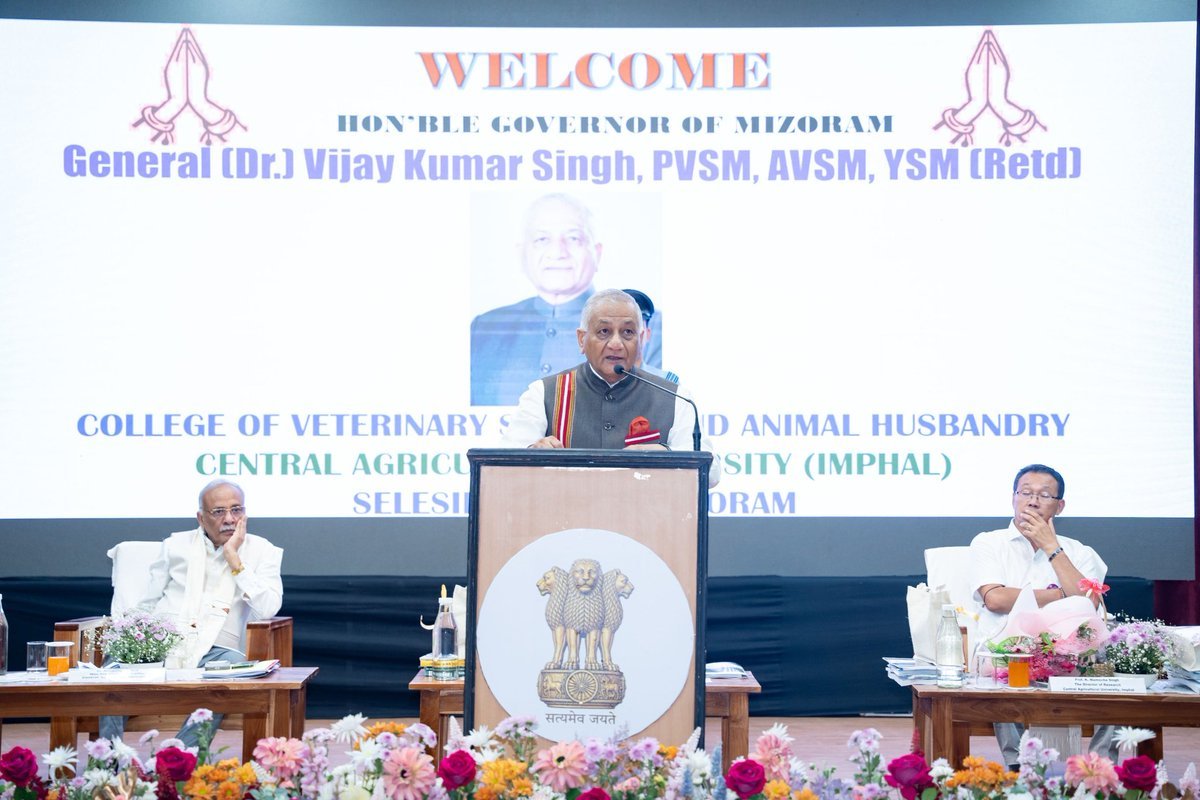
Mizoram Governor Dr. Hari Babu Kambhampati inaugurated the Council Meetings of the Central Agricultural University (CAU), emphasizing the importance of strengthening direct connections between scientific research institutions and farming communities. The initiative aims to bridge the gap between agricultural laboratories and field-level implementation by promoting technology transfer, innovation adoption, and farmer-centric research. Moreover, the discussions highlighted the growing role of science and technology in improving agricultural productivity, sustainability, and rural livelihoods across Northeast India.
Opposition Criticizes BJP Government Over Unfulfilled ‘Flood-Free’ Northeast Commitments
Manipur Strengthens Cross-Border Counter-Militancy Operations to Disrupt Illegal Arms Networks
Central Agricultural University Focuses on Farmer-Centric Innovation
The Council Meetings of the Central Agricultural University brought together academic leaders, researchers, policymakers, and agricultural experts to discuss strategies for strengthening agricultural development and innovation systems. Consequently, the event has attracted significant attention from stakeholders in the agriculture and rural development sectors.
According to officials, one of the primary objectives of the meetings is to improve the transfer of scientific knowledge and technological innovations directly to farmers. Moreover, authorities emphasized that research institutions must increasingly focus on practical solutions that address local agricultural challenges. Therefore, the initiative has been viewed as an important step toward strengthening agricultural ecosystems.
Participants reportedly discussed mechanisms for improving collaboration between universities, research centers, extension agencies, and farming communities. As a result, expectations regarding the practical application of agricultural research have increased.
Meanwhile, academic institutions continue to evaluate new strategies for enhancing farmer engagement.
Strengthening Laboratory-to-Land Connectivity
The initiative places particular emphasis on improving the “lab-to-land” approach, which aims to ensure that scientific advancements benefit agricultural producers directly. Moreover, stronger collaboration between researchers and farmers can accelerate the adoption of modern farming technologies and innovative practices. Therefore, enhancing knowledge transfer remains a major priority.
Agricultural experts noted that bridging the gap between research and field implementation is essential for improving productivity, sustainability, and climate resilience. Consequently, governments and educational institutions increasingly prioritize extension services, demonstration programs, and technology dissemination initiatives. Such efforts contribute to strengthening food security and rural economies.
Furthermore, direct engagement with farming communities can help researchers develop solutions tailored to local conditions and challenges. As a result, farmer-centered innovation models continue to receive growing support.
Meanwhile, stakeholders remain focused on improving institutional coordination and outreach programs.
Agricultural Technology and Innovation Receive Greater Attention
The Council Meetings also highlighted the importance of integrating advanced technologies, scientific research, and sustainable practices into agricultural development strategies. Moreover, technological innovation is increasingly viewed as a critical factor in addressing challenges related to productivity, resource management, and climate change. Therefore, agricultural modernization remains an important policy objective.
Development analysts observed that investments in agricultural research and innovation can generate substantial economic and social benefits. Consequently, governments continue to strengthen research institutions and promote partnerships among academia, industry, and farming communities. Such collaborations contribute to long-term agricultural transformation.
Furthermore, the adoption of modern agricultural technologies can improve efficiency, increase incomes, and enhance market competitiveness. As a result, policymakers remain optimistic about the potential impact of research-driven agricultural development.
Meanwhile, universities and research institutions continue to expand their research and extension activities.
Rural Development and Food Security Remain Central Goals
The initiative reflects the broader objective of promoting sustainable agriculture, strengthening rural livelihoods, and ensuring food security throughout the region. Moreover, policymakers continue to emphasize the importance of science-based solutions in addressing emerging agricultural challenges. Therefore, research and innovation remain central components of development planning.
Experts emphasized that effective agricultural transformation requires continuous investment in education, research, infrastructure, and capacity building. Consequently, institutions such as the Central Agricultural University continue to play a crucial role in shaping future agricultural policy and practice. Such efforts contribute to inclusive and sustainable development.
Furthermore, stronger collaboration between researchers and farmers can support long-term economic growth and resilience. As a result, public and institutional interest in agricultural innovation initiatives remains high.
Conclusion
The inauguration of the Central Agricultural University Council Meetings by Mizoram Governor Dr. Hari Babu Kambhampati underscores the growing importance of connecting scientific research with grassroots agricultural practice. Moreover, the initiative highlights the role of technology transfer, innovation, and farmer-centric policies in promoting sustainable agricultural development.
As efforts to strengthen laboratory-to-land linkages continue, the impact of research-driven agricultural strategies is expected to become increasingly significant. Therefore, initiatives focused on integrating science, education, and farming communities will continue to play a vital role in the future of agriculture in Northeast India.
The latest development reinforces the importance of innovation, collaboration, and knowledge-sharing in achieving long-term agricultural prosperity.
FAQs
1. Who inaugurated the Central Agricultural University Council Meetings?
Mizoram Governor Dr. Hari Babu Kambhampati inaugurated the meetings.
2. What is the main objective of the initiative?
The initiative aims to strengthen direct linkages between agricultural research institutions and farmers.
3. Why is the “lab-to-land” approach important?
It helps ensure that scientific innovations and technologies benefit farmers directly.
4. Who participated in the council meetings?
Researchers, policymakers, academic leaders, and agricultural experts participated.
5. What broader goals does the initiative support?
The initiative supports agricultural modernization, food security, and rural development.