


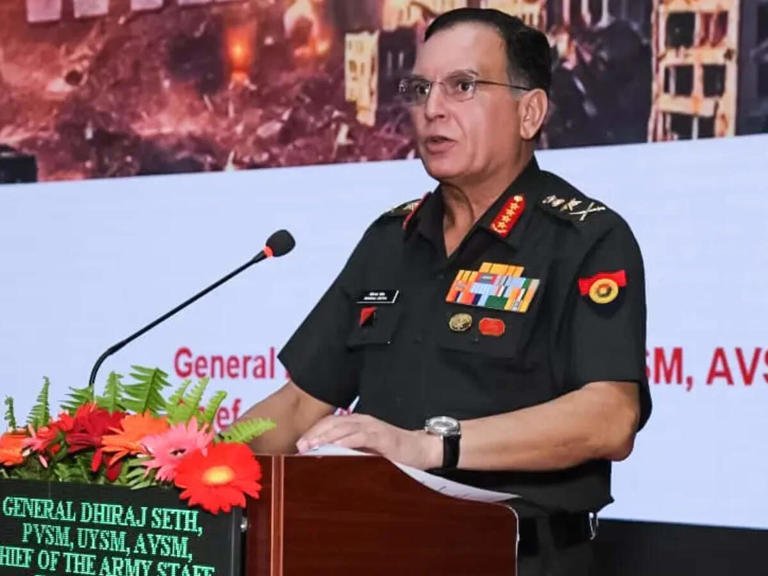
Chief of the Army Staff General Dhiraj Seth began a three-day official visit to Russia on September 16. The visit will continue until September 18.
The trip aims to strengthen India-Russia defence ties and military-to-military cooperation. It comes at a time when both countries continue to discuss training, military technology and defence production.
The Ministry of Defence said the visit reflects the importance India places on sustained military diplomacy with Russia.
During the visit, General Seth will meet senior Russian military and defence officials. He will also visit key defence institutions in Moscow and Saint Petersburg.
Talks With Russian Land Forces Chief
A key engagement will involve Colonel General Andrei Nikolayevich Mordvichev, Commander-in-Chief of the Russian Land Forces.
General Seth and Mordvichev will discuss issues of mutual interest. Their talks will include professional military cooperation and training.
The discussions will provide an opportunity to review existing Army-to-Army cooperation. They will also allow both sides to examine areas where military exchanges and training can expand.
India and Russia have maintained defence cooperation for decades. Their armed forces have also conducted military exercises and professional exchanges.
The current visit aims to maintain this engagement at the senior military level.
Ceremonial Guard of Honour in Moscow
General Seth will receive a ceremonial Guard of Honour during his visit to Moscow.
He will also pay tribute to fallen soldiers at the Tomb of the Unknown Soldier.
The ceremony forms part of the official programme and highlights the military traditions associated with the visit.
The Army Chief will also visit the National Defence Control Centre in Moscow. There, he is expected to interact with senior officials from the Russian Ministry of Defence.
These meetings will cover contemporary military developments and possible areas for stronger defence cooperation.
Defence Industry and Procurement on Agenda
General Seth will meet Russian Deputy Defence Minister Vasily Sergeyevich Osmakov, who handles defence industry and procurement.
The meeting could provide an opportunity to discuss India’s requirements involving Russian-origin military equipment.
The Indian Army continues to operate a significant inventory of Russian-origin platforms. These include armoured vehicles, tanks, air-defence systems and other military equipment.
Recent reports have indicated that the availability of spare parts and supplies remains an important issue in discussions between India and Russia.
The two countries are also examining ways to maintain and upgrade existing systems while expanding domestic production.
Russian-Origin Equipment Remains Important
Russia has historically been one of India’s major defence suppliers.
Several Indian Army formations continue to operate Russian-origin platforms. The country’s armoured and mechanised forces have a long association with Russian-designed equipment.
This makes maintenance and the availability of spare parts important for operational readiness.
Recent discussions have focused on sustaining existing systems while India increases defence diversification and indigenous production.
The Army Chief’s visit provides an opportunity to address these issues directly with senior Russian officials.
The discussions could also examine future cooperation in areas such as upgrades, technology and manufacturing.
New Defence Platforms Also Under Discussion
Apart from existing equipment, Russia has offered several new military systems to India.
Reports have indicated that Russian proposals include air-defence systems, infantry fighting vehicles and possible options for future armoured platforms.
One system reportedly under discussion is the Pantsir-S1M mobile air-defence system. Russia has also offered the latest BMP-3 infantry fighting vehicle as India considers options for modernising its mechanised infantry.
These proposals remain part of ongoing discussions. No new procurement agreement has been announced as part of General Seth’s current visit.
The Army continues to pursue its own modernisation programmes, including indigenous platforms and systems developed in partnership with Indian industry.
Visit to Military Academy in Saint Petersburg
General Seth will travel to Saint Petersburg during the final part of his visit.
There, he will visit the Mikhailovskaya Military Artillery Academy.
He will interact with the academy’s leadership and faculty during the visit.
The engagement will provide an opportunity to discuss professional military education and training.
Military education remains an important element of India-Russia Army-to-Army cooperation. Exchanges between defence institutions can help officers share experiences and understand developments in military doctrine and technology.
The visit to the academy therefore adds an educational dimension to the Army Chief’s Russia programme.
First Army Chief Visit Since 2018
General Seth’s trip is the first visit by a serving Indian Army chief to Russia since General Bipin Rawat visited the country in October 2018.
The gap comes as India has expanded its defence relationships with several other countries.
At the same time, Russia remains an important defence partner for India. The two countries have continued cooperation despite changes in the international security environment.
The latest visit demonstrates that high-level military engagement between New Delhi and Moscow remains active.
It also follows recent senior-level diplomatic engagement between the two countries.
Visit Follows Modi-Putin Talks
General Seth’s Russia visit comes shortly after Prime Minister Narendra Modi met Russian President Vladimir Putin in New Delhi.
The two leaders held talks on the sidelines of the 18th BRICS Summit.
Their discussions covered bilateral cooperation, including defence and other strategic areas.
The Army Chief’s visit now provides a military-level follow-up to the broader India-Russia engagement.
The timing also comes after a meeting of the India-Russia Intergovernmental Commission on Military and Military-Technical Cooperation working group in New Delhi in August.
That meeting reviewed ongoing military cooperation and outlined measures for future engagement.
India Balances Cooperation With Defence Modernisation
India has been working to reduce excessive dependence on any single foreign supplier.
At the same time, the Indian armed forces continue to operate large numbers of Russian-origin systems.
This creates a need for continued cooperation on maintenance, upgrades and spare parts.
India is also promoting domestic defence production through initiatives aimed at increasing indigenous manufacturing.
The Russia relationship has increasingly included joint development and production alongside traditional equipment purchases.
The Army Chief’s visit could therefore support discussions on both existing equipment and future cooperation.
Training Remains a Major Area
Military training is another important part of General Seth’s discussions in Russia.
India and Russia have conducted regular military exercises and professional exchanges.
Such activities allow personnel from both countries to share operational experience and understand different military practices.
The talks between General Seth and General Mordvichev will include professional military cooperation and training.
The discussions could help identify additional areas for Army-to-Army engagement.
A Visit Focused on Long-Term Defence Ties
General Dhiraj Seth’s three-day Russia visit combines military diplomacy, professional training and defence cooperation.
His meetings with senior Russian officials will cover mutual military interests. The programme also includes visits to important defence institutions.
The visit comes as India continues to modernise its armed forces while maintaining established defence partnerships.
For Russia, India remains an important defence partner with decades of military cooperation behind the relationship.
For India, engagement with Moscow remains relevant for the maintenance of existing Russian-origin systems and for discussions on future technologies.
The September 16–18 visit is therefore expected to reinforce Army-to-Army engagement and provide another platform for discussions on training, defence industry and military cooperation.