

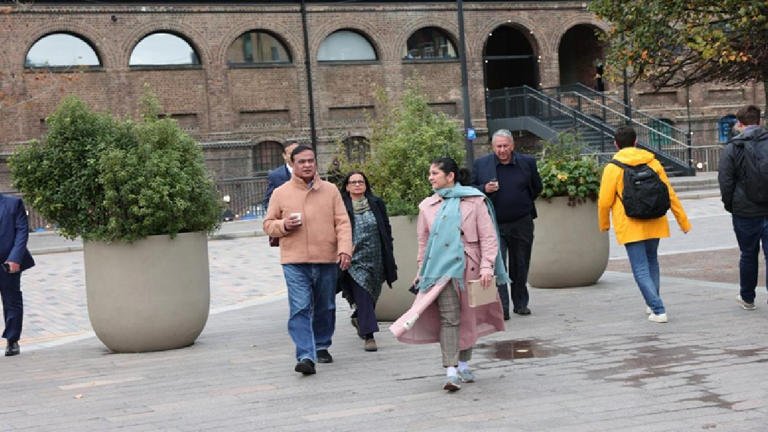
Assam Chief Minister Himanta Biswa Sarma reached London on Sunday to push forward the effort to reclaim the centuries-old ‘Brindabani Bastra’, one of the most significant cultural treasures linked to the Neo-Vaishnavite legacy of Mahapurush Srimanta Sankardeva. The visit marks a major step for Assam, as the state seeks the return of a textile that carries deep cultural, spiritual and historical value. According to officials, the Assam CM Himanta in action to bring back Brindabani Bastra reflects the government’s commitment to preserving heritage that shaped the identity of generations.
Sarma’s London visit includes a series of high-level discussions with museum authorities, cultural institutions and legal experts who handle the repatriation of artefacts. He emphasised that the Bastra is not only a textile but a living symbol of devotion, art and Assamese community identity. Although parts of the cloth have been preserved in museums in London and Paris, he said Assam hopes to bring these pieces home so the people can reconnect with their legacy.
Read More: Janajati Development Priority for Tripura Govt: CM Saha
The Brindabani Bastra holds a revered place in Assamese history. Hand-woven in the 16th century under the guidance of Srimanta Sankardeva and his foremost disciple Madhabdeva, the textile illustrates the childhood stories of Lord Krishna through intricate woven episodes. Each panel represents devotion, artistic brilliance and a unique storytelling tradition rooted in Vaishnavite philosophy. Therefore, its return is seen as an act of restoring dignity to a cultural treasure that belongs to Assam.
Assam CM Himanta in Action to Bring Back Brindabani Bastra, A Masterpiece of Devotional Art
The Chief Minister noted that the Brindabani Bastra is one of the finest examples of medieval Assamese craftsmanship. The textile was created using exceptional weaving techniques that combined creativity, spirituality and attention to detail. Since it narrates divine stories, it served not only as a piece of art but as a visual scripture for followers of Sankardeva’s Neo-Vaishnavite movement. Because of its importance, the Assam CM Himanta in action to bring back Brindabani Bastra aims to ensure future generations can witness the artistry and devotion embedded in each thread.
Historically, sections of this Bastra were transported out of Assam during the British colonial period. Many parts eventually reached museums in the United Kingdom and France, where they remain preserved today. While these institutions recognise the artefact’s value, Assam’s government believes the cultural context makes its rightful place in the state. Sarma highlighted that repatriating the Bastra is not about confrontation but cooperation. He expressed confidence that meaningful dialogue will help both sides work toward a shared agreement.
Experts consider the textile a rare combination of heritage, storytelling and artistic heritage. Because the Bastra illustrates Krishna’s early life, it holds great emotional significance for devotees. It also stands as a remarkable representation of Sankardeva’s inclusive cultural vision, where art, music and literature blended together to guide society spiritually and morally.
The Chief Minister stated that the government wants to display the Brindabani Bastra in a dedicated cultural space where people can learn about its history. Bringing it back will help scholars, artists and young learners explore the Vaishnavite movement deeply. He added that the return will also strengthen global recognition of Assamese cultural heritage.
Assam CM Himanta in Action to Bring Back Brindabani Bastra Marks a Cultural Homecoming
Sarma’s London visit includes consultations with international experts who specialise in artefact repatriation. He believes that legal, historical and diplomatic coordination will speed up the process. The Assam CM Himanta in action to bring back Brindabani Bastra reflects the government’s determination to reclaim artefacts that carry spiritual and cultural ownership.
He said that the Bastra’s return will inspire renewed interest in traditional weaving practices. Since Sankardeva and Madhabdeva’s legacy shaped Assam’s cultural foundation, restoring an artefact created under their direction holds both symbolic and emotional significance. The move also aligns with global discussions on repatriating heritage objects to their place of origin.
Sarma emphasised that Assam’s cultural revival depends on reconnecting with historical treasures. The Brindabani Bastra’s intricate visuals, devotional value and artistic richness represent a chapter of history that must return home. He expressed hope that the discussions in London will lead to a positive outcome and pave the way for cultural reunification.
He concluded by stating that the government will continue its efforts until the Bastra is brought back to Assam. The Assam CM Himanta in action to bring back Brindabani Bastra, he added, is not just an administrative step but an emotional mission that resonates with the people of the state.
Read More: Meghalaya CM Lays Foundation for World War I Memorial Restoration in Tura