

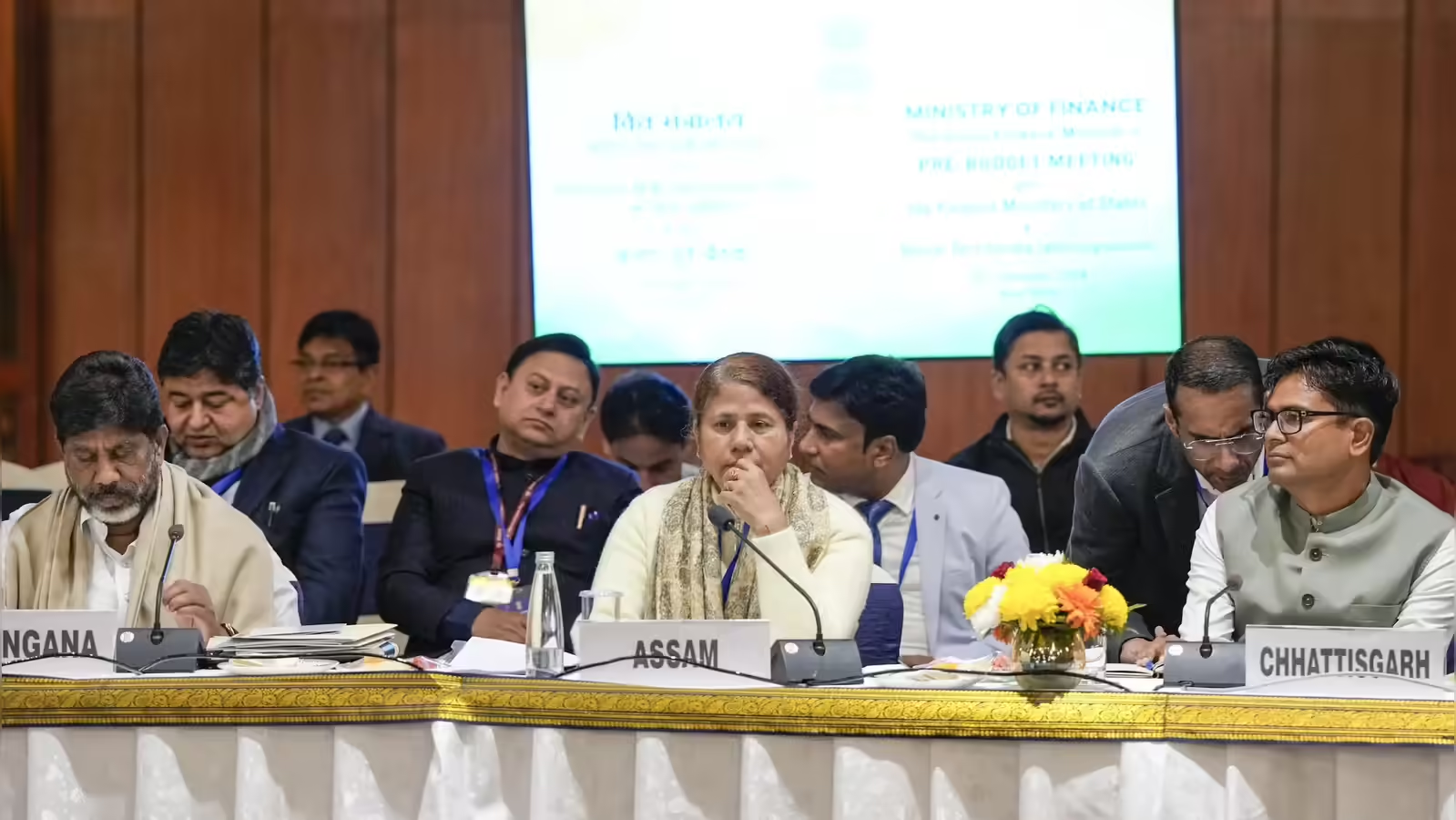
The Assam development roadmap discussion took center stage in New Delhi as Chief Minister Himanta Biswa Sarma met Union Finance Minister Nirmala Sitharaman to review central funding allocations and outline a long-term structural development plan for the state. The Assam development roadmap discussion focused on strengthening infrastructure, improving fiscal support, and accelerating key developmental projects across Assam. Additionally, the meeting reflects continued coordination between the state and central government on strategic economic planning.
CM Manipur peace dialogue UNC meeting
Assam CM promotes peaceful Eid celebrations
High-Level Meeting in New Delhi
The Assam development roadmap discussion was held during a high-level meeting between the Assam Chief Minister and the Union Finance Minister. The Assam development roadmap discussion included detailed deliberations on ongoing central funding schemes and future allocation frameworks. Additionally, both sides reviewed priority sectors requiring accelerated investment. Furthermore, the discussion emphasized improving efficiency in fund utilization. Consequently, the meeting is seen as an important step in aligning state development goals with national financial planning.
Focus on Central Funding Allocation
The Assam development roadmap discussion placed significant emphasis on central funding distribution for ongoing and upcoming projects. The Assam development roadmap discussion highlighted the need for timely release of funds to support infrastructure expansion. Additionally, the state government presented proposals aimed at boosting connectivity and industrial growth. Meanwhile, financial planning mechanisms were discussed to ensure better utilization of resources. Moreover, this coordination aims to reduce delays in project implementation across Assam.
Structural Development Planning for Assam
The Assam development roadmap discussion included drafting a long-term structural development framework for the state. The Assam development roadmap discussion focused on infrastructure modernization, urban development, and rural connectivity. Additionally, emphasis was placed on integrating economic growth with sustainable development goals. However, effective implementation will depend on inter-departmental coordination. Furthermore, the roadmap is expected to guide policy decisions over the coming years.
Strengthening Centre–State Coordination
The Assam development roadmap discussion reflects ongoing efforts to strengthen coordination between the Centre and the state government. The Assam development roadmap discussion underlined the importance of collaborative planning for large-scale development initiatives. Additionally, both sides discussed mechanisms to improve project monitoring and accountability. Meanwhile, streamlined communication channels were identified as essential for faster decision-making. Moreover, such coordination is expected to enhance governance efficiency.
Key Development Priorities
The Assam development roadmap discussion identified several priority sectors including infrastructure, transport, and economic development. The Assam development roadmap discussion also emphasized improving investment inflows and industrial expansion. Additionally, attention was given to enhancing social infrastructure such as health and education systems. However, sustained progress will require consistent policy support and financial backing. Furthermore, these priorities aim to support balanced regional development across Assam.
Future Growth Opportunities and Economic Vision
The Assam development roadmap discussion also explored long-term opportunities that could strengthen the state’s economic position over the coming decade. The Assam development roadmap discussion highlighted the importance of creating growth corridors that connect industrial zones with emerging markets. Additionally, emphasis was placed on improving logistics networks and supporting infrastructure that can increase investment attractiveness. Meanwhile, expanding connectivity through roads, railways, and digital systems was identified as an important enabler of regional development. Moreover, better infrastructure integration is expected to support faster movement of goods and services.
The Assam development roadmap discussion further examined ways to strengthen employment generation and economic diversification. The Assam development roadmap discussion emphasized encouraging industrial expansion while supporting agriculture, tourism, and service sectors. Additionally, discussions considered strategies to attract private sector participation in large-scale development initiatives. However, achieving long-term targets will require policy continuity and effective execution mechanisms. Furthermore, skill development and workforce readiness were identified as important factors for sustaining growth.
Officials also reviewed approaches to improve institutional capacity and governance delivery. Additionally, improving project execution timelines and reducing administrative bottlenecks remained a central focus. As a result, the broader roadmap is expected to support balanced economic growth, enhance public service delivery, and strengthen Assam’s long-term development trajectory.
Conclusion
The Assam development roadmap discussion in New Delhi marks a significant step in shaping the state’s long-term growth strategy. The Assam development roadmap discussion between the Chief Minister and Union Finance Minister focused on funding, infrastructure, and structural planning. Additionally, it reflects stronger Centre–State cooperation in development planning. As a result, the meeting is expected to contribute to more structured and accelerated development outcomes for Assam.
FAQs
1. What was discussed during the meeting?
The meeting focused on central funding, infrastructure development, and Assam’s long-term growth roadmap.
2. Who attended the discussion?
Assam Chief Minister Himanta Biswa Sarma and Union Finance Minister Nirmala Sitharaman attended the meeting.
3. Why is central funding important for Assam?
Central funding supports infrastructure projects, connectivity expansion, and economic development initiatives.
4. Which sectors were prioritized?
Infrastructure, transport, industrial growth, education, and social development received attention.
5. What is the objective of the roadmap?
The objective is to create a structured framework for sustainable and long-term development.
6. How can the roadmap benefit Assam?
It may improve investment opportunities, governance efficiency, and regional economic growth.