


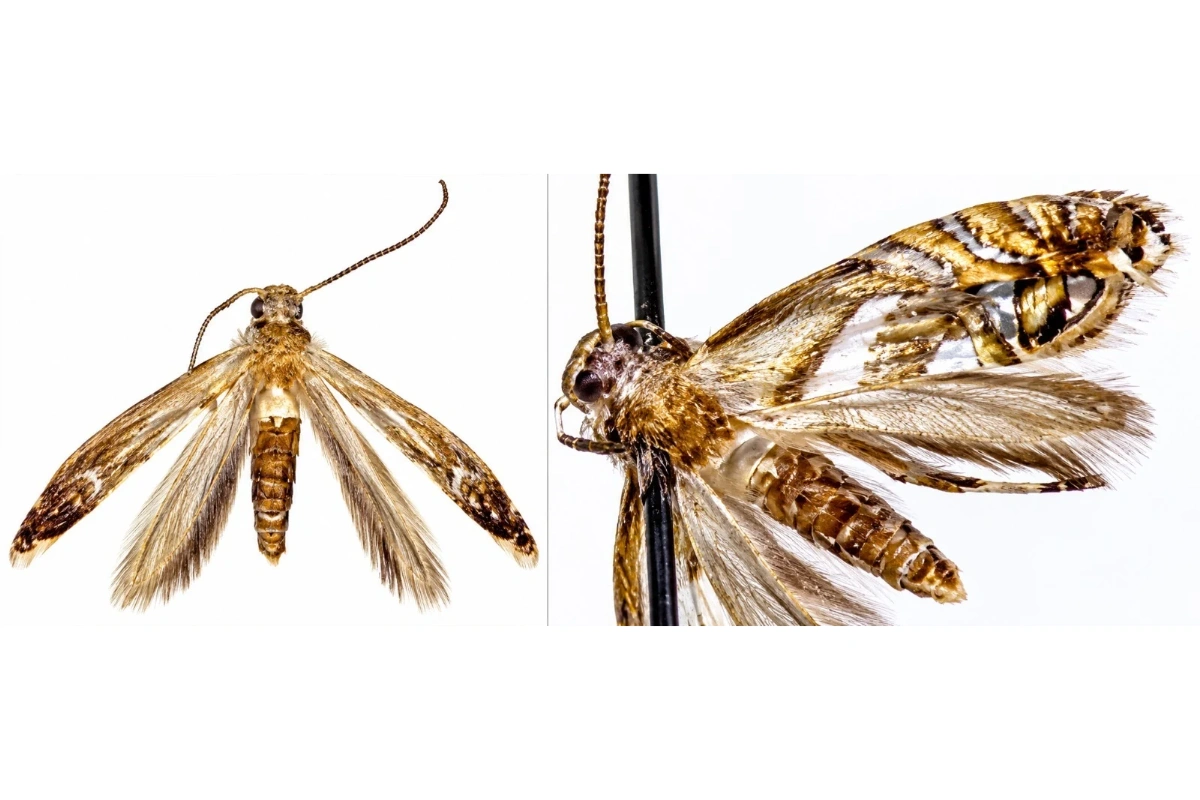
Assam has gained fresh scientific recognition with the identification of a new micro-moth species near Hollongapar Gibbon Sanctuary in Jorhat district. Named Glyphipterix brevimucronata, the tiny insect marks India’s first taxonomic addition to the sedge moth family in nearly a century. Researchers collected the specimen near Mariani during a field survey on October 2, 2025. However, the scientific description appeared in the international journal Zootaxa on November 18, 2026. With a wingspan of just 6.5 millimetres, the species highlights the remarkable insect diversity that remains insufficiently documented across Northeast India.
Tripura: Radhacharan Debbarma Criticises BJP Government Over Civic Issues During AMC Poll Campaign
New Micro-Moth Species Identified Near Hollongapar
The newly described species belongs to the family Glyphipterigidae, commonly known as sedge moths. Researchers found the specimen near Hollongapar Gibbon Sanctuary in Jorhat district, close to Mariani.
The field team collected the male specimen at an elevation of 141 metres above sea level. It was attracted to a mercury vapour lamp during the survey.
Kishore Chandra Sahoo of the ICAR-Indian Agricultural Research Institute (IARI), Assam, documented the discovery. He worked with ICAR-IARI scientist Abhijith K. P. and local guide Jayanta Jyoti Sarmah during the field investigation.
Their findings established the specimen as a previously undescribed species. The research paper formally introduced Glyphipterix brevimucronata to scientific records.
A Tiny Moth With Distinctive Physical Features
The new species measures just 6.5 millimetres in wingspan. Despite its extremely small size, researchers identified several distinctive features.
Its forewings display a brown base colour with a yellowish metallic sheen. The wings also carry characteristic white markings that help distinguish the insect from related species.
Researchers examined its external appearance and male reproductive anatomy to establish its taxonomic identity. The examination of these anatomical structures played an important role in confirming that the specimen represented a separate species.
The scientific name also refers to one of these defining characteristics. The word brevimucronata combines Latin roots meaning “short” and “pointed”. It describes a short, pointed projection on the male’s reproductive structure.
This anatomical feature helped researchers distinguish the species from other members of the genus.
First Addition to India’s Sedge Moth Family in Nearly a Century
The discovery carries particular importance because researchers have documented very few sedge moth species in India.
The family Glyphipterigidae includes more than 530 described species worldwide. However, only around 25 species had previously been recorded in India, according to published research coverage.
The genus Glyphipterix contains more than 400 described species globally. Yet its diversity within India remains inadequately studied.
The latest discovery represents the first taxonomic addition to India’s recorded sedge moth fauna in nearly a century. Earlier descriptions of Indian members of this group largely date from the early twentieth century.
The last Indian species of the genus reported before this discovery was Glyphipterix compastis, described by Edward Meyrick in 1923.
The long gap highlights the need for further surveys and taxonomic research. It also shows how field investigations can reveal species that have remained outside scientific records despite occurring near well-known natural habitats.
What Are Sedge Moths?
Sedge moths are small insects belonging to the family Glyphipterigidae. Their common name comes from the plants associated with many of their larvae.
Depending on the species, larvae feed on or bore into sedges, rushes and grasses. Some also use plant stems, seeds and leaf structures as feeding sites.
These insects form part of wider ecological systems. Their relationships with host plants make them relevant to studies of plant diversity, insect life cycles and habitat conditions.
However, researchers have not yet established the host plant of Glyphipterix brevimucronata. Its larval feeding habits and complete life cycle also remain unknown.
Further field observations will help scientists understand these aspects. Researchers will also need additional specimens to assess its distribution and population status.
Discovery Highlights Assam’s Unexplored Biodiversity
The finding near Hollongapar Gibbon Sanctuary draws attention to the ecological diversity of Assam beyond its widely recognised mammals and birds.
The sanctuary is known for its hoolock gibbons and other wildlife. However, its surrounding landscapes also support numerous smaller organisms that receive less scientific attention.
The discovery of Glyphipterix brevimucronata demonstrates the value of studying these lesser-known groups. Even a moth measuring only a few millimetres can add important information to India’s biodiversity records.
Moreover, the finding reinforces the importance of documenting insects through systematic field surveys. Researchers need detailed taxonomic studies to identify species accurately and understand their ecological roles.
Such work can also provide useful information for future biodiversity assessments and conservation planning.
Scientific Publication Brings National Attention
Kishore Chandra Sahoo published the species description in Zootaxa, an international journal specialising in animal taxonomy.
The paper, titled “A new species of Glyphipterix Hübner (Lepidoptera: Glyphipterigidae) from Assam, India”, appeared in Volume 5909, Issue 1, on November 18, 2026.
Assam Chief Minister Himanta Biswa Sarma also welcomed the discovery and highlighted the state’s biodiversity. Forest Minister Jayanta Malla Baruah also drew attention to the scientific finding.
The publication gives the new species a formal place in scientific classification. It also encourages further investigation into India’s poorly documented sedge moth diversity.
Conclusion
The identification of Glyphipterix brevimucronata near Hollongapar Gibbon Sanctuary marks an important addition to India’s sedge moth records after nearly a century. Collected in October 2025 and formally described in November 2026, the 6.5-millimetre moth highlights the scientific value of biodiversity surveys in Assam. Its distinctive wing markings and male reproductive anatomy helped researchers establish its identity. Meanwhile, its unknown host plant and wider distribution offer fresh opportunities for future research across Northeast India.
FAQs
1. What new moth species has Assam recorded?
Researchers have described a new sedge moth species named Glyphipterix brevimucronata near Hollongapar Gibbon Sanctuary.
2. Where did researchers collect the new moth?
They collected the specimen near Mariani in Jorhat district, close to Hollongapar Gibbon Sanctuary.
3. How large is Glyphipterix brevimucronata?
The male specimen has a wingspan of approximately 6.5 millimetres.
4. Who reported the discovery?
Kishore Chandra Sahoo of ICAR-Indian Agricultural Research Institute, Assam, described the species with assistance from Abhijith K. P. and local guide Jayanta Jyoti Sarmah.
5. Why is this discovery scientifically important?
It represents the first taxonomic addition to India’s sedge moth family, Glyphipterigidae, in nearly a century.
6. When was the research published?
The species description appeared in the journal Zootaxa on November 18, 2026.