


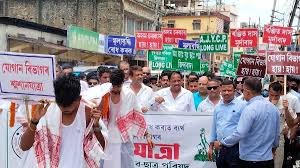
Assam Price Hike Protests intensified after activists from the Asom Jatiyatabadi Yuba Chhatra Parishad launched demonstrations against the government over the increasing cost of essential commodities. Protesters gathered in multiple areas across Assam and raised slogans criticizing rising prices of food items, fuel, cooking gas, and household necessities.
Meanwhile, AJYCP leaders accused the government of failing to control inflation and protect ordinary citizens from mounting financial pressure. Furthermore, the demonstrations attracted public attention as consumers across the state continue facing higher living expenses amid broader economic challenges.
BJP MLA Diganta Kalita Demands Azan Loudspeaker Restrictions in Assam
Bengal Coastal Tourism Expansion Gains Momentum
AJYCP Activists Stage Demonstrations
AJYCP activists organized street protests in several towns and urban centers to highlight concerns regarding rising commodity prices. According to protest organizers, participants carried placards, shouted slogans, and demanded immediate government intervention to reduce the burden on common households.
Meanwhile, demonstrators criticized increasing prices of rice, edible oil, vegetables, fuel, and other essential items affecting daily life. Several activists additionally argued that inflation has created serious difficulties for low-income families, students, and small traders.
The Assam Price Hike Protests therefore became a significant political and public issue across different districts. Consequently, the demonstrations drew attention from local residents and political observers.
Protesters Accuse Government Of Inaction
AJYCP leaders alleged that authorities failed to implement effective measures to control market prices and support consumers. Protesters claimed that ordinary citizens continue struggling with household expenses while prices of basic commodities steadily increase.
Meanwhile, several speakers during the demonstrations argued that inflation has affected both rural and urban populations across Assam. Activists additionally criticized rising fuel prices, stating that transportation and supply costs have further increased the prices of daily essentials.
However, government representatives maintained that economic challenges and market fluctuations influence pricing trends nationwide. Officials also stated that authorities continue monitoring supply chains and market conditions.
Public Frustration Over Rising Costs Grows
The Assam Price Hike Protests reflected broader public concern regarding increasing living costs and inflation-related pressures. Residents in several districts expressed frustration over higher grocery expenses, transportation costs, and utility-related spending.
Meanwhile, consumers stated that repeated price increases are affecting household budgets and reducing purchasing capacity. Several citizens additionally argued that middle-class and lower-income families face growing financial strain due to sustained inflation.
Market observers noted that rising prices of fuel and transportation often impact the overall cost of goods and services. Consequently, inflation remains a major concern for consumers across different sectors of society.
Demonstrations Draw Attention Across Districts
AJYCP workers conducted demonstrations in prominent public areas, attracting attention from commuters, traders, and local residents. Protesters reportedly demanded stronger price-control policies and immediate relief measures for consumers.
Meanwhile, police personnel monitored the demonstrations to maintain law and order during the protest activities. Authorities stated that the gatherings remained largely peaceful despite strong political slogans and criticism directed at the government.
Several local organizations and student groups additionally expressed support for concerns regarding rising commodity prices. As a result, the protests gained wider visibility across social and regional media platforms.
Inflation Debate Intensifies Politically
The Assam Price Hike Protests also intensified political debate regarding inflation, governance, and economic policy. Opposition parties and student organizations increasingly raised concerns about public hardship linked to rising prices.
Meanwhile, ruling party representatives argued that inflationary trends are influenced by national and international economic conditions beyond state-level control. Government supporters additionally highlighted welfare programs and subsidy measures aimed at supporting vulnerable groups.
Political analysts stated that economic issues such as inflation and unemployment frequently become major points of public debate and political mobilization. Therefore, rising prices may continue influencing political discourse in Assam.
Citizens Seek Relief Measures
Consumers and civic groups urged authorities to introduce stronger monitoring mechanisms against unfair price increases and market irregularities. Several citizens called for improved supply chain management and stricter action against hoarding or artificial shortages.
Meanwhile, economists suggested that coordinated policy measures may help stabilize prices of essential commodities over time. Experts additionally emphasized the importance of balancing inflation control with broader economic growth objectives.
Public discussions surrounding food affordability and household expenses continued across markets and community spaces following the demonstrations. Consequently, pressure on authorities to address inflation concerns may increase further.
Economic Pressures Affect Daily Life
Experts stated that inflation directly affects transportation, food consumption, education expenses, and healthcare spending for ordinary families. Rising fuel costs also influence delivery charges and market pricing patterns in urban and rural areas.
Meanwhile, small business owners and vendors reported fluctuating wholesale prices for daily commodities in recent months. Several traders additionally noted that consumers have become more cautious about spending due to financial uncertainty.
The Assam Price Hike Protests therefore highlighted broader economic anxieties among different sections of society, including students, workers, traders, and salaried employees.
Conclusion
Assam Price Hike Protests gained momentum after AJYCP activists organized demonstrations criticizing the government over increasing prices of essential commodities. Furthermore, the protests reflected growing public frustration regarding inflation, household expenses, and economic pressure on ordinary citizens. As political debate over rising costs continues, authorities may face stronger demands for relief measures and market stabilization efforts across Assam.
FAQs
Why did AJYCP organize the protests?
AJYCP organized the demonstrations to protest rising prices of essential commodities and increasing living costs.
What is the focus keyphrase of this topic?
Assam Price Hike Protests is the focus keyphrase connected to the demonstrations.
Which items were highlighted during the protests?
Protesters raised concerns regarding prices of food items, fuel, cooking gas, vegetables, and household essentials.
How did the government respond to the criticism?
Government representatives stated that inflation is influenced by broader economic and market conditions.
Were the demonstrations peaceful?
Authorities reported that the demonstrations remained largely peaceful during the protest activities.
Why are rising fuel prices important in inflation discussions?
Fuel prices affect transportation and supply costs, which can increase prices of goods and services.