

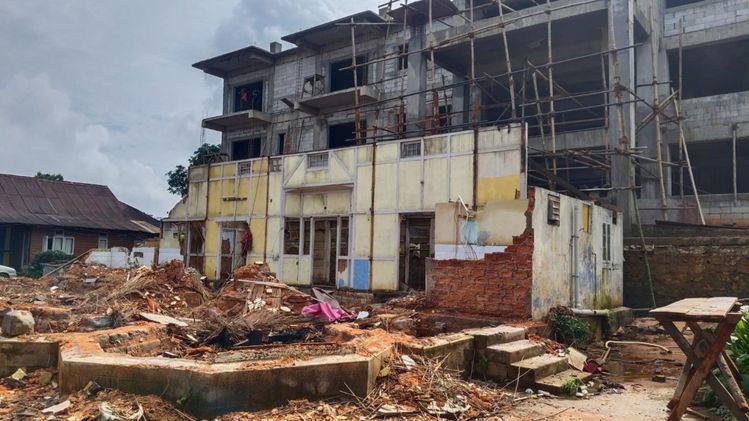
COCOMI, the Coordinating Committee on Manipur Integrity, has strongly demanded the preservation and replica of Manipur Rajbari, following its demolition in Shillong. For many Manipuris, the Rajbari, also known as Redlands Building, represented not just a building but a symbol of political heritage and identity. COCOMI says demolishing it without consent or clear explanation equals erasing a vital piece of the past.
Read More: 100 Flutists to Honour Zubeen Garg in Sonapur Tribute
The Rajbari was where Maharaja Bodhachandra signed the Manipur Merger Agreement with India in September 1949. The building also served as his residence during the princely state days when Shillong was a prominent place for Manipuris. That legacy made the Rajbari more than an architectural landmark: it became a site that connected generations to a defining moment in the state’s history.
COCOMI claims the demolition violates earlier promises by state authorities. In 2022 the government reportedly assured renovation while preserving the original structure. Instead, the Rajbari was taken down, prompting outrage from civil society groups, historians, political leaders, and ordinary citizens alike. Criticism came especially against the planning authorities who approved detailed project reports and then allowed the building’s dismantling. The public questions why no transparent process was followed, and why the decision came without consultations.
COCOMI insists that restoring what is lost requires more than words. They demand a full replica of the demolished Rajbari using the original design and dimensions. They also ask that any materials possible be reused, such as doors, windows, planks, or decorative elements. Such reuse, they argue, would retain emotional resonance and authenticity. As part of their call, COCOMI wants historians and conservation architects involved, to guide reconstruction so it does more than mimic appearance: it honors identity.
Beyond the replica, COCOMI pushes for formal recognition: declare the Rajbari (or its replica) a heritage monument, protected under law. That status, they say, will prevent similar losses in future and ensure sustained maintenance. It will oblige authorities to act openly when dealing with heritage sites, to consult citizens, scholars, and heritage experts before making demolition—or “reconstruction”—decisions.
COCOMI also demands accountability. They want to know who authorised the demolition, on what grounds, and whether heritage committees or preservation guidelines were considered. The group is calling for a public inquiry into the decision process, the role of government departments, and whether the Detailed Project Report (DPR) that approved development over Rajbari contained sufficient heritage safeguard clauses. If not, revisions should follow immediately.
Responses so far from Manipur’s Planning and Development Authority (PDA) assert that the Rajbari was structurally unsound, over 80 years old, with decay in wooden posts, rotting rafters, and leakage. The PDA says parts were dismantled manually and preserved, and that reconstruction would maintain original design, room dimensions, and height. COCOMI says those words need action and visible proof. Until reconstruction begins with fidelity, assurances feel hollow.
Another concern COCOMI raises is time. Big heritage projects often drag on, leaving sites in limbo. COCOMI demands a clear timeline for the replica project. They propose milestones: heritage documentation, architectural survey, using salvaged materials, design finalisation, reconstruction start, and completion. Each phase should have transparent reporting to the public.
The emotional value of the Rajbari for Manipuri people, whether in Imphal or elsewhere, influences COCOMI’s stance. Many recall visits to the building, stories taught in schools, and the pride connected to the Rajbari as the place where Manipur’s merger with India was formalised. Its loss, even as a physical building, has shaken that collective memory. A replica, if built with care, could help heal some of that loss.
COCOMI’s demand intersects with broader issues of heritage preservation in India. Regions with similar colonial‐era or princely state buildings often face conflicts between development and conservation. In Manipur’s case, COCOMI argues that heritage should not be sacrificed, especially when promises were made. The group suggests that heritage preservation must become institutionalised: building laws, preservation boards, clear policies.
In addition, COCOMI’s campaign to preserve and replicate the Manipur Rajbari emphasizes more than reconstructing bricks and wood. It insists on restoring identity, honoring history, and ensuring public agency in preserving sites that belong to the people. The group demands that replica Rajbari stand not merely as a structure but as a symbol: of remembrance, justice, and cultural respect. Authorities must follow through, transforming commitments into actions so that the preservation and replica of Manipur Rajbari becomes a reality and a lesson for future heritage governance.
Read More: Assam CM Sarma reaffirms commitment to equal opportunities for girls