

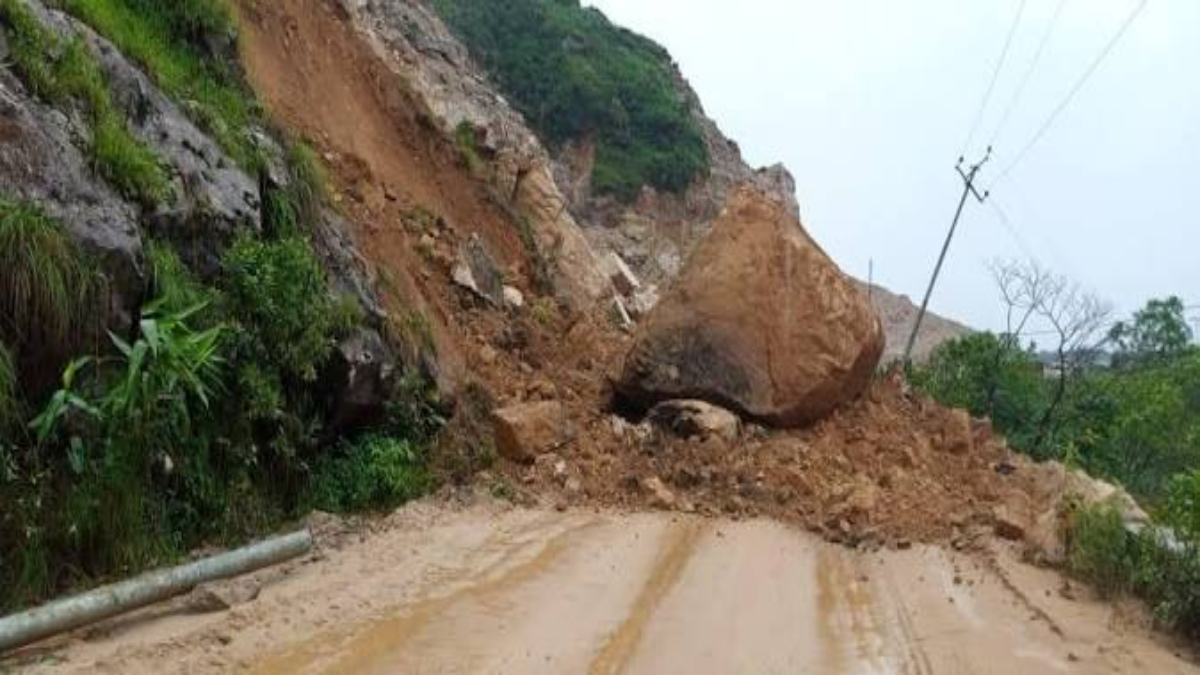
Meghalaya road cave-in has come under renewed scrutiny after experts from IIT Guwahati were tasked with assessing the damaged stretch on the crucial Shillong-Dawki road. The National Highways & Infrastructure Development Corporation Limited (NHIDCL) has also been directed to provide a clear timeline for restoring connectivity following the massive collapse triggered by heavy monsoon rains. The development is expected to help authorities identify long-term engineering solutions while ensuring commuter safety on one of Meghalaya’s busiest highway corridors.
Why the Meghalaya road cave-in is a major concern
The road collapse occurred on the Shillong-Dawki highway after intense rainfall caused a large section near Laitlyngkot village to give way, sending part of the roadway into a deep gorge. The incident completely disrupted vehicular movement and highlighted the vulnerability of the hill road to landslides during the monsoon season.
The Shillong-Dawki route serves as a critical transport corridor connecting Meghalaya’s capital with Dawki on the India-Bangladesh border. Besides local residents, the road is heavily used by tourists, commercial vehicles, traders, students, and emergency services. According to official reports, more than 1,100 vehicles use the route daily, making its restoration a top priority.
IIT Guwahati experts begin scientific assessment
To address the crisis, IIT Guwahati has been engaged to conduct a detailed scientific assessment of vulnerable slopes along the affected highway. The institute’s work will be carried out in two phases.
The first phase involves identifying vulnerable stretches through a comprehensive vulnerability assessment. The second phase will include detailed investigations at the identified locations to recommend permanent engineering solutions for slope stabilization and road safety. NHIDCL has already approved IIT Guwahati’s revised proposal and released the advance payment required for the project registration, allowing the assessment to commence.
The scientific study is expected to provide valuable insights into preventing similar road failures in the future, especially along landslide-prone sections of the highway.
Court asks NHIDCL to provide restoration timeline
During the proceedings, the Meghalaya High Court sought an update from NHIDCL regarding the restoration of the damaged highway. Officials informed the court that an alternative bypass road was being developed with assistance from the state’s Public Works Department (PWD) to restore partial connectivity.
NHIDCL assured the court that work on the temporary diversion would be completed within approximately two weeks. The court also urged IIT Guwahati to expedite its vulnerability assessment so that permanent corrective measures could be implemented without unnecessary delays.
The court further requested NHIDCL to submit a fresh status report detailing the progress of restoration efforts and future safety measures.
Safety measures introduced after the cave-in
Following the Meghalaya road cave-in, NHIDCL has implemented several immediate safety initiatives across the project corridor.
These include:
- Installation of additional road safety signages at vulnerable locations.
- Deployment of trained traffic marshals equipped with communication devices and reflective safety gear.
- Construction of physical barricades and installation of reflective barriers in high-risk areas.
- Regular clearance of landslide debris and mudslides.
- Temporary restoration of damaged carriageway sections using granular material.
- Protective works around nearby schools and other sensitive infrastructure.
Authorities have also instructed engineers not to begin work on any new construction fronts unless prescribed safety standards are fully implemented.
Heavy rains exposed long-standing vulnerabilities
The latest collapse is not an isolated incident. Earlier this year, a massive boulder struck a tourist vehicle on the same highway, although all passengers escaped safely. Days later, continuous rainfall triggered another major landslide that severed road connectivity.
The extreme weather also caused the Umngot River to swell rapidly, flooding labour camps associated with nearby bridge construction projects and washing away heavy equipment. These incidents underscore the increasing impact of intense monsoon conditions on infrastructure across Meghalaya.
Experts believe that scientific slope stabilization, improved drainage systems, and continuous monitoring will be essential to reducing future risks.
Major Boost: Mizoram First Rail Link Gets Final Safety Clearance
Importance of the Shillong-Dawki corridor
The Shillong-Dawki highway is among Meghalaya’s most strategically important roads. Besides supporting tourism to Dawki and nearby attractions, it facilitates cross-border trade, movement of agricultural produce, and access to healthcare, education, and government services.
Any prolonged disruption affects local businesses, transport operators, farmers, and thousands of daily commuters. The restoration project is therefore being closely monitored by both the judiciary and government agencies.
The ongoing engineering assessment by IIT Guwahati is expected to help authorities design long-term solutions rather than relying solely on temporary repairs.
Looking ahead
The inspection by IIT Guwahati experts marks a significant step toward addressing the challenges posed by the Meghalaya road cave-in. While NHIDCL continues work on restoring temporary connectivity, the scientific assessment is expected to guide permanent slope stabilization and infrastructure improvements.
With the High Court seeking regular progress reports and a definite restoration timeline, authorities now face increased pressure to ensure that the Shillong-Dawki highway becomes safer and more resilient against future monsoon-related disasters. Successful implementation of expert recommendations could not only restore normal traffic but also strengthen the long-term reliability of one of Meghalaya’s most vital transport corridors.