

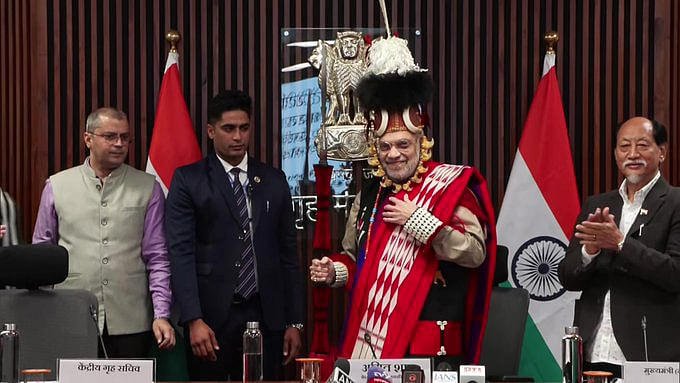
The Centre, the Nagaland government, and the Eastern Nagaland People’s Organisation have signed the Frontier Nagaland Territorial Authority agreement, with leaders declaring that the long-running conflict in eastern Nagaland is “nearing an end.” The tripartite agreement marks a major political breakthrough after years of negotiations, protests, and demands for a separate administrative arrangement.
The Frontier Nagaland Territorial Authority agreement aims to address governance and development concerns in eastern Nagaland through an empowered institutional mechanism, while keeping the region within the constitutional framework of the state. Officials said the pact reflects a consensus-based solution achieved through dialogue rather than confrontation.
The agreement has generated cautious optimism across Nagaland, as it promises administrative empowerment, focused development, and political accommodation for a region that has long felt neglected.
Read More: Tripura CM Lays Foundation Stone of Manu River Bridge
Frontier Nagaland Territorial Authority agreement explained
The Frontier Nagaland Territorial Authority agreement establishes a new territorial authority for eastern Nagaland. This authority is expected to function as a decentralised administrative body with specific powers over development planning, welfare implementation, and local governance.
Unlike demands for full statehood, the agreement does not alter Nagaland’s territorial boundaries. Instead, it creates an empowered structure within the state to address long-standing regional grievances. Officials said this approach balances regional aspirations with constitutional stability.
The authority will work in coordination with both the Centre and the Nagaland government, ensuring smoother policy implementation and targeted development.
Who signed the agreement
The Frontier Nagaland Territorial Authority agreement was signed by representatives of the Government of India, the Nagaland government, and the Eastern Nagaland People’s Organisation. The ENPO has been the principal body articulating demands for eastern Nagaland over the past decade.
Union Home Minister Amit Shah described the agreement as a historic step, saying it demonstrates the Centre’s commitment to resolving regional issues through dialogue. The Nagaland government echoed this view, calling the pact a milestone in internal reconciliation.
ENPO leaders said the agreement reflects recognition of eastern Nagaland’s concerns and opens a new chapter of engagement.
Why eastern Nagaland demanded a separate arrangement
Eastern Nagaland comprises several districts that have historically lagged behind in infrastructure, healthcare, education, and employment. Civil society groups argued that administrative centralisation led to uneven development.
The demand for Frontier Nagaland emerged from frustration over these disparities. Protests, shutdowns, and boycotts highlighted calls for either a separate state or a special administrative unit.
The Frontier Nagaland Territorial Authority agreement represents a negotiated middle path, addressing governance gaps without full political separation.
What powers will the new authority have
While detailed operational guidelines are expected to be notified later, officials indicated that the territorial authority will have financial and administrative powers to plan and execute development programmes.
Key focus areas include road connectivity, health services, education infrastructure, and livelihood generation. The authority is also expected to play a role in local-level administration and coordination with government departments.
Supporters say these powers could reduce bureaucratic delays and ensure that policies reflect local priorities.
Centre’s role and assurance
The Centre has assured full support for implementing the Frontier Nagaland Territorial Authority agreement. Amit Shah said the Union government would provide financial assistance, policy backing, and administrative cooperation to ensure the authority functions effectively.
According to officials, the Centre’s involvement adds credibility and stability to the arrangement. Central oversight may also help resolve coordination challenges between the new authority and state departments.
The assurance from New Delhi has strengthened confidence among stakeholders that the agreement will not remain symbolic.
Nagaland government’s position
The Nagaland government has described the agreement as a pragmatic solution that preserves state unity while addressing internal disparities. State officials said cooperation with the new authority would remain a priority.
By supporting the pact, the state government aims to prevent prolonged unrest and integrate eastern Nagaland more effectively into governance frameworks.
Political analysts say the agreement reflects the state’s willingness to adapt institutional arrangements to regional needs.
‘Conflict nearing end’: what leaders mean
When leaders said the conflict is “nearing an end,” they referred to the possibility of resolving a long-standing political standoff through institutional means. The Frontier Nagaland issue has remained a source of tension, uncertainty, and periodic unrest.
By formalising an agreement acceptable to key stakeholders, the pact reduces the likelihood of future agitations. However, experts caution that true resolution depends on implementation rather than signatures alone.
The phrase signals hope, but also responsibility to deliver results.
Public response and cautious optimism
Public reaction in eastern Nagaland has been mixed but largely hopeful. Many residents welcomed the agreement as a long-awaited recognition of their concerns.
At the same time, community leaders stressed that success will depend on transparency, accountability, and tangible improvements in daily life. Roads, hospitals, schools, and jobs remain key expectations.
Civil society groups urged continued dialogue to address any gaps during implementation.
Challenges ahead
Despite optimism, challenges remain. Defining the authority’s powers, ensuring adequate funding, and managing coordination between multiple levels of government will require careful planning.
Experts warned that unmet expectations could revive discontent. Therefore, timely action and clear communication remain essential.
Institutional capacity-building and local participation will also determine effectiveness.
What it means for the Northeast
The Frontier Nagaland Territorial Authority agreement could influence how similar regional demands are addressed elsewhere in the Northeast. It offers a model of negotiated autonomy within constitutional limits.
Political observers say the pact reinforces the idea that dialogue-driven solutions can address complex regional issues without redrawing boundaries.
However, they also note that each region has unique dynamics, and replication must be cautious.
Conclusion
The signing of the Frontier Nagaland Territorial Authority agreement by the Centre, the Nagaland government, and the ENPO marks a turning point in a long-running political dispute. By choosing dialogue over confrontation, stakeholders have created an opportunity for peace, development, and administrative reform.
While leaders say the conflict is nearing an end, the real test lies ahead. Effective implementation, sustained cooperation, and delivery of tangible benefits will determine whether the agreement fulfils its promise.
If successful, the pact could not only transform eastern Nagaland but also strengthen faith in constitutional solutions across the Northeast.
Read More: Cancer Awareness and Screening Camp Held in Digboi