


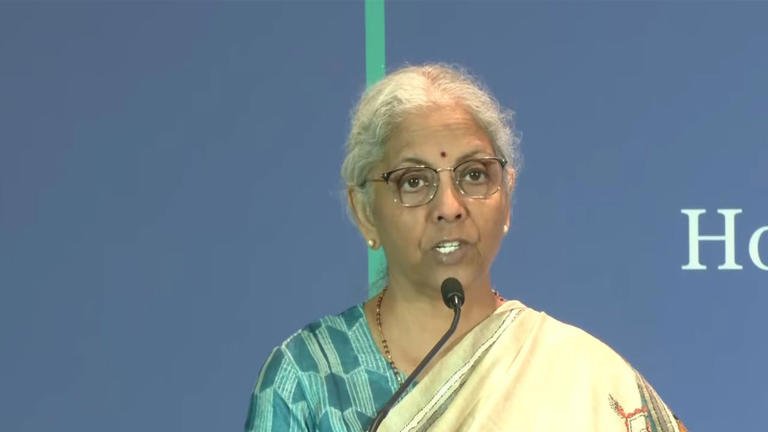
Union Finance Minister Nirmala Sitharaman said the government is focusing on reducing tax litigation rather than simply managing the growing number of disputes.
She made the remarks on Wednesday at the eighth International Tax Conference of the International Tax Research and Analysis Foundation in Bengaluru.
Sitharaman said tax reforms should make voluntary compliance easier. She also stressed that enforcement resources should focus on cases that genuinely require intervention.
According to the minister, the government has introduced several measures to reduce the causes of tax disputes. These include changes in tax rates, dispute resolution schemes and higher monetary thresholds for departmental appeals.
Her comments come amid a broader push to simplify India’s tax system and make compliance more predictable for taxpayers.
Focus on Preventing Disputes
Sitharaman said the government’s approach goes beyond handling tax cases after disputes emerge.
She said policymakers should instead examine why disputes arise in the first place. Clearer laws and simpler compliance procedures can help reduce unnecessary disagreements between taxpayers and authorities.
The Finance Minister linked this approach to the principle of voluntary compliance.
Under this approach, taxpayers should find it easier to understand their obligations and meet them correctly. Enforcement can then focus on cases involving genuine violations or deliberate non-compliance.
Sitharaman said this philosophy has guided several tax reforms introduced by the Centre.
Vivad Se Vishwas Helped Close Old Disputes
The Finance Minister also highlighted the government’s dispute-resolution initiatives.
She referred to the Vivad Se Vishwas schemes, which aimed to help taxpayers and the government settle old tax disputes.
Such schemes allow eligible taxpayers to resolve specified disputes under prescribed conditions. They can reduce the need for prolonged litigation and help authorities clear older cases.
Sitharaman said these initiatives gave taxpayers and the government an opportunity to close disputes instead of allowing them to continue through multiple stages of litigation.
The government has also changed the monetary limits for departmental appeals.
In 2024, it raised the thresholds to Rs 60 lakh for appeals before the Income Tax Appellate Tribunal, Rs 2 crore before High Courts and Rs 5 crore before the Supreme Court.
Higher Appeal Thresholds Aim to Reduce Litigation
The revised thresholds can affect the number of cases that reach higher judicial forums.
Under the new limits, the tax department does not pursue certain appeals below the prescribed monetary thresholds.
This approach can help courts and tribunals focus on cases involving larger disputed amounts or important legal questions.
It can also reduce the administrative resources required to pursue smaller disputes.
However, monetary thresholds do not eliminate litigation altogether. Taxpayers can still challenge assessments through the available legal process when the law permits.
The government’s stated objective is to make the overall dispute-resolution system more focused and efficient.
Tax Reforms Have Changed the Policy Framework
Sitharaman also outlined several major tax reforms undertaken by the Centre.
She pointed to the reduction in the corporate tax rate to 22 per cent in 2019 for eligible domestic companies.
She also referred to the rationalisation of individual income-tax rates in 2025. According to her, the changes meant individuals with income up to Rs 12 lakh would not pay income tax under the relevant provisions.
The Finance Minister also discussed the replacement of the Income Tax Act, 1961, with a new, more concise tax law.
She said the new code uses simpler language and aims to make the legislation easier to understand.
These changes form part of the government’s broader effort to simplify direct taxation.
GST Rationalisation and Classification Disputes
Sitharaman also pointed to changes in the Goods and Services Tax system.
She described the consolidation of GST into essentially two primary rates in 2025 as an important reform.
A simpler rate structure can reduce disputes over classification. Businesses sometimes face disagreements over which GST rate applies to a particular product or service.
Reducing the number of rates can therefore make classification easier in some areas.
Sitharaman presented GST rationalisation as another example of a reform that could help reduce litigation at its source.
The effectiveness of such changes will depend on implementation and how taxpayers and authorities interpret the revised provisions.
Industry Groups Asked to Offer Evidence-Based Proposals
The Finance Minister also called for a change in the way industry groups approach tax policy discussions.
She said industry representations often focus on requests for lower tax rates, exemptions or concessions.
Sitharaman urged industry bodies to look beyond these sector-specific demands.
She asked them to identify provisions that may no longer serve their intended purpose. She also encouraged them to explain the impact of proposed changes using data.
For example, if a provision creates a compliance burden, industry representatives should explain how many taxpayers face the problem.
They should also estimate the time and cost involved. Any proposed alternative should consider its impact on government revenue and the wider tax base.
Need for Independent Tax Research
Sitharaman also called for stronger independent research on taxation.
She urged the International Tax Research and Analysis Foundation to expand its role in public policy discussions.
The minister referred to international institutions such as the UK’s Institute for Fiscal Studies and the Netherlands-based IBFD as examples of organisations that contribute research to tax debates.
She said Indian tax research should similarly provide carefully examined policy choices.
Independent research can help policymakers understand the economic effects of proposed tax changes. It can also bring evidence into debates that may otherwise focus mainly on individual sectoral interests.
International Tax Reforms Also Important
Sitharaman discussed India’s approach to international taxation.
She referred to treaty renegotiations with Mauritius, Singapore and Cyprus. These changes sought to restore India’s source-based taxation rights over certain capital gains.
She also mentioned the implementation of the General Anti-Avoidance Rules, the Multilateral Instrument and the expansion of the Advance Pricing Agreement programme.
The government has also introduced safe-harbour provisions in certain international tax matters.
These measures aim to provide greater clarity while protecting India’s tax base in cross-border transactions.
Balancing Compliance and Enforcement
The Finance Minister’s remarks highlight the government’s stated preference for preventing avoidable disputes.
The approach combines simpler rules, dispute-resolution mechanisms and limits on departmental appeals.
At the same time, enforcement remains part of the tax administration system.
Sitharaman said enforcement resources should focus on cases that genuinely require them. This approach seeks to distinguish routine compliance issues from cases that need stronger action.
For taxpayers, simpler rules could reduce uncertainty. For the government, fewer unnecessary disputes could free administrative resources.
Tax Litigation Reform Remains a Continuing Process
Sitharaman’s comments place tax litigation within India’s wider tax reform agenda.
The government has introduced measures aimed at simplifying laws, rationalising rates and resolving older disputes.
The Finance Minister also wants industry groups and tax professionals to contribute more evidence-based proposals.
Her message was that tax policy should address the causes of disputes rather than simply deal with their consequences.
Reducing litigation will depend on how effectively new rules work in practice. It will also depend on consistent interpretation, taxpayer compliance and administrative implementation.
For now, the government’s stated direction is clear: simplify compliance, resolve old disputes and reduce the number of new tax disputes reaching the courts.