

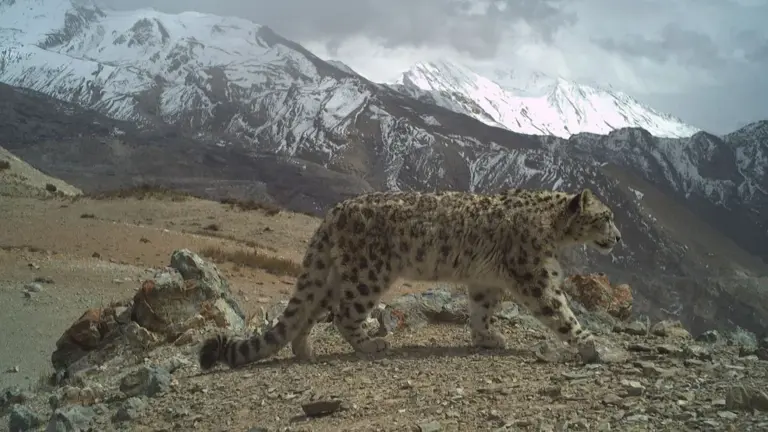
Himachal Pradesh has confirmed a thriving snow leopard population of 83 through the latest census conducted across its high-altitude regions. The finding marks a significant milestone in India’s efforts to protect one of the world’s most elusive and endangered big cats. The survey, led by the Himachal Pradesh Forest Department in collaboration with the Wildlife Institute of India (WII), reveals that the state’s conservation strategies are yielding encouraging results.
The snow leopard, often referred to as the “ghost of the mountains,” is known for its solitary and elusive nature, making population assessment a complex task. The recent study employed advanced camera-trapping techniques, GPS mapping, and DNA analysis to estimate the species’ population across key habitats such as Spiti Valley, Kinnaur, and Lahaul.
Officials confirmed that the data, collected over a two-year period under the Snow Leopard Population Assessment in India (SPAI) project, provides the most accurate estimate to date. The study not only confirms the species’ steady presence but also suggests that their habitat remains largely stable.
Read More: Arunachal Deputy CM Applauds Butterfly Conservation Efforts at Wakro Meet
A Conservation Success for the Himalayas
Wildlife experts have hailed the results as a conservation success story for Himachal Pradesh. The growing snow leopard population highlights the effectiveness of long-term efforts to preserve fragile Himalayan ecosystems. The state has been implementing various projects to safeguard the predator’s habitat while ensuring coexistence with local communities.
Principal Chief Conservator of Forests (Wildlife), Rajiv Kumar, stated that the findings reflect a positive shift in the state’s ecological balance. He added that the population estimate is a testament to years of community awareness, anti-poaching initiatives, and sustainable grazing practices. Kumar credited the collaboration between forest officials, researchers, and local residents for achieving this milestone.
The SPAI project also aims to assess prey availability and habitat quality, ensuring that snow leopards have adequate resources for survival. Officials noted that the increasing numbers in Himachal align with similar trends observed in Ladakh and Uttarakhand, signaling a broader regional recovery.
Protecting an Elusive Predator
Snow leopards are primarily found in high-altitude regions above 3,000 meters, where harsh weather and steep terrains make tracking extremely challenging. The latest census used over 200 motion-sensitive cameras strategically placed across remote landscapes. These cameras captured thousands of images, later analyzed by experts to identify individual leopards through their unique fur patterns.
The data was further verified using DNA samples collected from scat and fur, ensuring scientific accuracy. Researchers say such comprehensive methods have improved understanding of the snow leopard population and their distribution patterns.
According to the survey, Spiti Valley remains the stronghold of the species, with nearly half of the population residing there. The region’s cold desert ecosystem, abundant prey base, and reduced human interference make it an ideal habitat. Smaller populations were recorded in Kinnaur, Lahaul, and Chamba districts.
Officials emphasized that maintaining habitat connectivity between these areas is vital for genetic diversity. Any disruption due to infrastructure projects or climate change could fragment populations and threaten their long-term survival.
Balancing Conservation and Livelihoods
A key factor in Himachal’s success is the involvement of local communities in wildlife conservation. For decades, snow leopards were viewed as threats to livestock, leading to conflicts. However, awareness programs and compensation schemes have changed perceptions, fostering a sense of stewardship among residents.
Under the Himachal Pradesh Snow Leopard Conservation Plan, villagers receive financial support for livestock losses caused by predators. In return, they help protect wildlife by monitoring illegal activities and participating in habitat restoration projects.
Deputy Conservator of Forests (Kaza Division), Neelam Sharma, highlighted that community-led initiatives have reduced human-wildlife conflicts significantly. She said programs like “Project Snow Leopard” have successfully combined conservation with livelihood security, ensuring harmony between people and nature.
Eco-tourism has also emerged as an important component of this model. Sustainable wildlife tourism, guided by locals, generates income while promoting awareness about the species’ conservation. Visitors to Spiti and Kinnaur now have opportunities to observe snow leopards responsibly during guided winter expeditions, under strict environmental protocols.
Challenges Ahead for Conservationists
Despite encouraging progress, experts caution that the snow leopard population remains vulnerable to several threats. Habitat degradation due to infrastructure expansion, changing climate patterns, and poaching continue to pose risks. Rising temperatures in the Himalayas are altering the snowline and affecting prey species such as blue sheep and ibex, which directly impacts the predator’s survival.
Wildlife biologist Dr. Nandini Pradhan from WII noted that long-term conservation will depend on mitigating climate impacts. She suggested creating climate-resilient corridors that allow the species to migrate between habitats safely. She also emphasized the need for enhanced transboundary cooperation with neighboring countries like Nepal and China, as snow leopards often traverse political borders.
Another major concern is the scarcity of funding for large-scale conservation programs. Experts have called for continued government investment and global partnerships to strengthen India’s leadership in snow leopard protection.
A Model for Sustainable Conservation
The Himachal government has pledged to continue its conservation drive with renewed focus on habitat restoration, research, and education. Officials announced plans to expand camera surveillance and conduct yearly assessments to monitor changes in population dynamics.
Chief Minister Sukhvinder Singh Sukhu praised the forest department’s achievement, calling it a “landmark in the journey toward sustainable Himalayan conservation.” He said the government will integrate wildlife protection with eco-tourism development, ensuring both biodiversity and community welfare.
Experts believe that Himachal’s success can serve as a model for other Himalayan states. The collaborative approach—blending science, community engagement, and policy—demonstrates how coexistence can thrive even in fragile ecosystems.
As the majestic snow leopard roams freely across the icy slopes of Spiti and Kinnaur, its growing population stands as a beacon of hope. It reminds humanity that with dedication, respect for nature, and collective effort, even the most elusive species can be brought back from the brink.
Read More: Spotless Baron Butterfly Reappears in Sikkim’s Dzongu After Five Years