

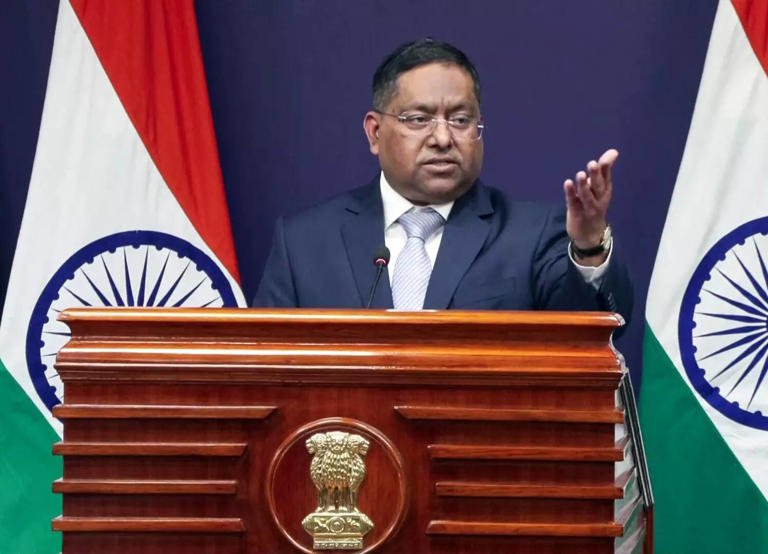
India is open to importing crude oil from Venezuela, provided such imports meet commercial viability and economic considerations, the Ministry of External Affairs (MEA) said. MEA spokesperson Randhir Jaiswal clarified that India’s energy decisions remain guided by market conditions and national interest, not political pressure or speculation.
Responding to queries on India’s stance regarding Venezuelan oil, Jaiswal said New Delhi continuously evaluates all possible sources to ensure reliable and affordable energy supplies. The statement reinforces India’s long-standing position that energy security for its population remains a top priority.
The comment on India Venezuela oil imports comes amid evolving global energy dynamics and renewed discussions on sourcing crude from diverse suppliers.
Read More: Cancer Awareness and Screening Camp Held in Digboi
India Venezuela oil imports depend on commercial viability
MEA spokesperson Randhir Jaiswal stressed that India Venezuela oil imports would depend entirely on commercial viability. He said India does not rule out any supplier in principle, but decisions are taken based on price, logistics, and overall economic benefit.
According to him, India’s approach to energy procurement is pragmatic. If Venezuelan crude proves competitive and feasible under prevailing conditions, India may consider it. However, if market conditions do not support such imports, India will continue sourcing oil from other suppliers.
This approach, he said, ensures flexibility and stability in India’s energy strategy.
Energy security remains India’s priority
Jaiswal reiterated that ensuring energy security for India’s large population remains the government’s supreme priority. India, one of the world’s largest crude oil importers, depends heavily on external sources to meet domestic demand.
Therefore, diversification of suppliers plays a crucial role in reducing risk and ensuring uninterrupted supply. India Venezuela oil imports, if resumed, would fit into this broader diversification strategy rather than represent a shift away from existing partners.
The MEA emphasised that India’s decisions are driven by economic logic and energy needs rather than geopolitical alignments.
India–Venezuela energy ties in perspective
India and Venezuela have shared energy ties in the past, particularly before international sanctions disrupted oil trade. Indian public sector companies previously engaged in upstream oil projects and crude imports from Venezuela.
Venezuelan crude, known for its heavy nature, suits certain Indian refineries equipped to process such grades. As a result, Venezuela once emerged as a significant supplier to India.
The current openness to India Venezuela oil imports reflects continuity rather than a new policy direction.
Market-driven approach to oil sourcing
The MEA spokesperson made it clear that India follows a market-driven approach to oil sourcing. Price competitiveness, transportation costs, insurance, and refining compatibility all factor into procurement decisions.
India regularly adjusts its import basket to respond to global price fluctuations and supply disruptions. This flexibility allows refiners to minimise costs while maintaining steady supply.
Jaiswal said India does not commit to long-term political preferences in oil sourcing. Instead, it responds to market signals and commercial realities.
Global context and speculation
The MEA’s statement came amid global discussions on shifting energy trade patterns. Reports and political claims from abroad have suggested changes in India’s crude sourcing preferences.
Responding indirectly to such narratives, Jaiswal clarified that India’s oil import decisions are sovereign and independent. India Venezuela oil imports, he said, would follow the same logic applied to all suppliers.
Analysts view this clarification as a reaffirmation of India’s strategic autonomy in energy policy.
Refinery capability and logistics
India’s refining sector possesses the technical capacity to process a wide range of crude oils, including heavy grades like those from Venezuela. This capability gives India flexibility in sourcing from diverse producers.
However, logistical considerations remain critical. Distance, shipping costs, and insurance significantly affect landed prices. Therefore, even technically suitable crude must meet cost benchmarks.
Officials said these factors would determine whether India Venezuela oil imports become commercially viable.
Economic and diplomatic implications
Resuming oil imports from Venezuela could have economic as well as diplomatic implications. Economically, competitive pricing could benefit Indian refiners and consumers. Diplomatically, it may signal continuity in bilateral engagement.
However, the MEA emphasised that diplomacy does not override economic prudence. India’s engagement with any country in the energy sector remains guided by national interest.
Experts note that such a balanced stance helps India navigate complex global energy politics without compromising domestic priorities.
India’s diversified energy basket
India currently sources crude oil from multiple regions, including West Asia, Russia, Africa, and the Americas. This diversified basket reduces dependence on any single supplier and enhances resilience against shocks.
India Venezuela oil imports, if revived, would add another option to this basket. However, officials stress that diversification does not mean overcommitment to any one source.
The MEA’s statement underlines this philosophy of flexibility and balance.
Public and expert reactions
Energy experts have welcomed the MEA’s clarity, saying it reflects consistency in India’s energy policy. They note that keeping options open allows India to respond quickly to favourable market conditions.
At the same time, experts caution that commercial viability remains uncertain due to logistical and financial considerations. Therefore, any immediate resumption of imports remains speculative.
Public discourse has largely focused on the reassurance that India’s energy decisions remain insulated from external political pressure.
What lies ahead
India’s openness to Venezuela oil imports signals policy continuity rather than a definitive shift. Much will depend on pricing, global regulatory conditions, and market feasibility.
For now, the MEA’s message remains clear. India Venezuela oil imports are possible, but only if they make economic sense.
As global energy markets continue to evolve, India is likely to maintain its flexible, market-driven approach. This strategy aims to protect energy security, manage costs, and preserve strategic autonomy in an increasingly complex global environment.
Read More: Tripura CM Lays Foundation Stone of Manu River Bridge