


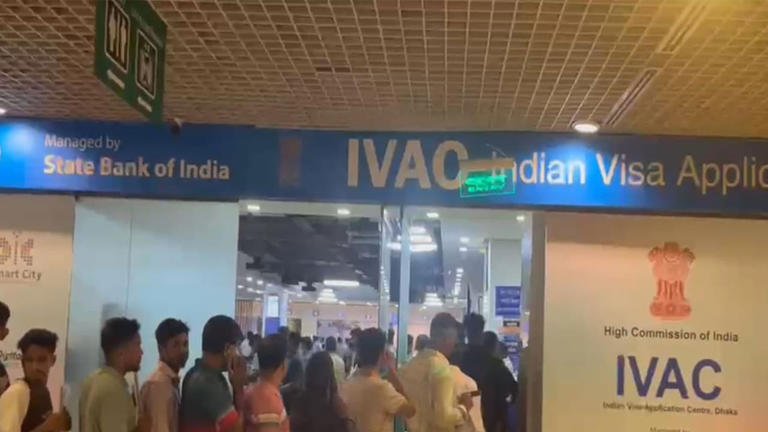
India has officially resumed issuing tourist visas to Bangladeshi nationals after nearly two years, prompting a massive rush of applicants at the Indian Visa Application Centre (IVAC) in Dhaka. The decision marks a significant step towards restoring normal people-to-people exchanges between the two neighbouring countries and is being viewed as an important milestone in the gradual normalisation of bilateral relations.
The resumption of tourist visa services comes after India had suspended the issuance of tourist visas following the political developments and security concerns in Bangladesh in 2024. While medical and certain other categories of visas continued to be issued on a limited basis during the intervening period, tourist visas remained suspended until the latest announcement.
Soon after applications opened, hundreds of prospective travellers gathered outside the Indian Visa Application Centre in Dhaka, resulting in long queues and a significant increase in footfall as people sought to submit their visa applications for leisure travel, family visits, and other personal purposes.
Huge Crowd at Dhaka IVAC
The reopening of tourist visa services witnessed an overwhelming response from Bangladeshi citizens eager to travel to India after a prolonged suspension.
Long queues were reported outside the Indian Visa Application Centre (IVAC) in Dhaka from the very first day of the reopening, with applicants arriving early to complete documentation and submit their applications.
Officials at the visa centre managed the increased footfall while ensuring that application procedures continued smoothly. Authorities also implemented crowd management measures to facilitate orderly submission of applications.
The large turnout reflects the strong demand for travel between the two countries, which share deep historical, cultural, educational, medical, and economic ties.
Tourist Visa Services Resume from June 28
The announcement regarding the resumption of tourist visas was made by India’s High Commissioner to Bangladesh, Dinesh Trivedi, during his visit to the Indian Visa Application Centre after formally assuming charge of the mission.
He announced that applications for tourist visas would be accepted from June 28, restoring one of the most significant categories of visas that had remained suspended for nearly two years.
The High Commissioner described the decision as an important step towards strengthening people-to-people relations between India and Bangladesh.
He also reiterated that urgent medical visas would continue to receive priority on humanitarian grounds.
Visa Services Initially Available Through Five Centres
According to the Indian High Commission, tourist visa applications are initially being accepted through five Indian Visa Application Centres located in Dhaka, Rajshahi, Chattogram, Sylhet, and Khulna.
Officials indicated that visa operations are expected to expand gradually to additional centres as administrative arrangements are strengthened.
The phased approach aims to efficiently manage the anticipated increase in applications while ensuring smooth processing across the country.
Authorities stated that the existing infrastructure would continue to be upgraded to accommodate growing demand in the coming weeks.
Suspension Followed Security Concerns
India had suspended tourist visa services following the political unrest in Bangladesh in August 2024, when attacks on Indian diplomatic establishments and visa centres raised significant security concerns.
According to the Indian High Commission, several Indian Visa Application Centres came under attack, while the Indira Gandhi Cultural Centre in Dhaka was vandalised. Security threats to Indian personnel working on various development projects also contributed to the decision to scale down visa operations.
Despite the suspension of tourist visas, India continued issuing medical visas and certain other categories of visas to address humanitarian requirements and essential travel needs.
Positive Step Towards Normalising Bilateral Relations
The restoration of tourist visa services is being viewed as an important confidence-building measure between India and Bangladesh.
Relations between the two neighbours experienced strains following political developments in Bangladesh during 2024. However, diplomatic engagement has gradually increased over recent months, with both governments taking steps aimed at restoring normal cooperation.
Observers believe the reopening of tourist visa services will contribute positively to people-to-people exchanges and improve bilateral engagement across multiple sectors.
The decision also follows several diplomatic interactions aimed at strengthening cooperation between New Delhi and Dhaka.
Significant Relief for Travellers
The resumption of tourist visas has brought considerable relief to thousands of Bangladeshi citizens who had been waiting for the opportunity to travel to India.
Many travellers visit India regularly for tourism, family reunions, religious pilgrimages, educational purposes, shopping, and cultural exchanges.
Travel operators and tourism stakeholders believe the reopening of visa services will gradually revive cross-border tourism while benefiting airlines, hotels, transport providers, and businesses associated with the travel industry.
Applicants at the Dhaka IVAC expressed optimism that the reopening would make travel planning considerably easier after an extended period of uncertainty.
Medical Visas Continue to Receive Priority
While tourist visa services have resumed, Indian authorities have reaffirmed that urgent medical visas will continue to receive special attention.
Medical travel has traditionally formed a significant component of India-Bangladesh people-to-people exchanges, with many Bangladeshi patients travelling to Indian hospitals for specialised treatment.
During the period when tourist visas remained suspended, India continued issuing a substantial number of medical visas on humanitarian grounds to ensure uninterrupted healthcare access for Bangladeshi patients.
Officials stated that this humanitarian approach would continue alongside the restoration of normal tourist visa services.
Boost to Tourism and Economic Activity
Industry experts believe the restoration of tourist visas is likely to generate positive economic outcomes for both countries.
Increased travel is expected to benefit tourism operators, airlines, hospitality businesses, retailers, and transport services while encouraging greater cultural and commercial interaction.
Cross-border tourism has historically played an important role in strengthening economic cooperation between India and Bangladesh, with millions of travellers moving between the two countries annually before the suspension.
The reopening is therefore expected to gradually revive travel-related economic activity that had slowed during the suspension period.
Authorities Prepare for Higher Demand
With applications resuming, authorities are preparing to handle a sustained increase in visa requests over the coming weeks.
Officials at the Indian Visa Application Centres are expected to continue implementing crowd-management measures while ensuring efficient processing of applications.
Applicants have been advised to complete documentation carefully and follow official procedures to facilitate timely processing.
The Indian High Commission also indicated that visa operations may be expanded further depending on demand and operational requirements.
Strengthening People-to-People Ties
The resumption of tourist visa services represents an important milestone in the gradual restoration of normal travel between India and Bangladesh. The overwhelming response at the Dhaka IVAC reflects the strong desire among citizens of both countries to reconnect through tourism, family visits, cultural exchanges, and personal travel after a prolonged interruption.
As visa operations resume across designated centres, the initiative is expected to strengthen bilateral ties, revive tourism, and promote greater interaction between the people of the two neighbouring nations. With authorities preparing to expand services further in the coming months, the reopening marks a positive step towards rebuilding one of South Asia’s most significant cross-border travel corridors.