


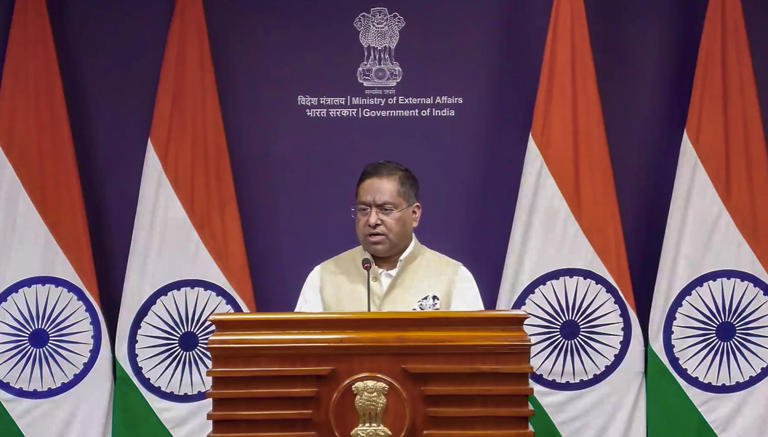
India has reiterated its desire to build positive, constructive and forward-looking relations with Bangladesh, with the Ministry of External Affairs (MEA) stressing that bilateral ties should rest on mutuality of interests and reciprocity. The statement comes at a sensitive stage in relations between the two neighbouring countries, with several issues requiring diplomatic attention.
MEA spokesperson Randhir Jaiswal made the remarks amid uncertainty over Bangladesh Prime Minister Tarique Rahman’s proposed visit to India. New Delhi has maintained that it remains hopeful about the visit and wants to continue engaging with Dhaka through dialogue.
The statement also comes against the backdrop of Bangladesh’s request for the extradition of former Prime Minister Sheikh Hasina, who is currently in India. The Indian government said the request is being examined through established legal processes.
India Emphasises Mutual Interests and Reciprocity
India’s latest position places mutual interests and reciprocity at the centre of its approach towards Bangladesh. New Delhi wants the relationship to move forward while ensuring that both countries’ concerns receive consideration.
The MEA’s comments indicate that India is not seeking a relationship based on one-sided expectations. Instead, it wants both sides to identify areas where cooperation can benefit their respective people.
This approach could become important as India and Bangladesh navigate several sensitive issues. The two countries share a long border and have deep economic, cultural and historical connections. However, recent political developments have created new challenges.
Therefore, continued diplomatic engagement remains important for maintaining stability and preventing disagreements from affecting broader cooperation.
Tarique Rahman’s India Visit Remains in Focus
The proposed visit of Bangladesh Prime Minister Tarique Rahman has emerged as one of the key issues in the current diplomatic engagement.
India has invited Rahman to visit New Delhi for bilateral discussions. The invitation also includes participation in the outreach session of the BRICS summit. However, reports have indicated uncertainty over whether the Bangladesh Prime Minister will undertake the visit soon.
India has nevertheless expressed hope that the visit will take place. A meeting between Prime Minister Narendra Modi and Rahman could provide an opportunity to discuss several bilateral matters directly.
High-level political engagement could also help both sides establish a clearer framework for future cooperation. Direct discussions can reduce misunderstandings and create space for negotiations on difficult issues.
Dinesh Trivedi Pushes for Dialogue
India’s High Commissioner to Bangladesh, Dinesh Trivedi, has also stressed the importance of direct engagement. He recently met Bangladesh’s political leadership in Dhaka before travelling to New Delhi and briefing Prime Minister Narendra Modi.
During his meetings in Dhaka, Trivedi conveyed India’s willingness to work with Bangladesh in a positive, constructive and forward-looking manner. He also discussed ways to strengthen bilateral relations through a people-centric approach.
Trivedi has argued that dialogue remains essential for resolving differences between the two countries. He has also expressed hope that Rahman will visit India soon.
His comments are consistent with the MEA’s latest position. Both sides need to maintain communication even when disagreements arise.
Extradition Request for Sheikh Hasina
The issue of Sheikh Hasina’s extradition remains one of the most sensitive matters in India-Bangladesh relations.
Bangladesh has formally requested India to extradite the former Prime Minister. New Delhi has acknowledged receiving the request and said it is examining the matter through established legal procedures.
The issue has become a source of tension between the two governments. Bangladesh has repeatedly raised the matter, while India has avoided making a commitment on the outcome.
The Indian government’s decision to describe the request as a matter under examination reflects its preference for following legal procedures rather than making a political announcement.
At the same time, New Delhi has continued to express its willingness to engage with the current Bangladeshi government on broader bilateral issues.
Economic Cooperation Remains Important
Trade and economic cooperation remain major pillars of India-Bangladesh relations. The geographical proximity of the two countries provides significant opportunities for greater commercial engagement.
Bangladesh is also important for India’s connectivity with the Northeast. Road, rail, river and port links through Bangladesh can improve access between India’s northeastern states and the rest of the country.
India has historically supported infrastructure and connectivity projects in Bangladesh. These projects have helped strengthen trade links and people-to-people movement.
Greater economic cooperation can also create employment and investment opportunities. Therefore, maintaining stable bilateral relations remains important for the economic interests of both countries.
Connectivity Can Strengthen Bilateral Ties
Connectivity remains another area where India and Bangladesh share significant interests. The two countries have worked on railway, road, inland waterways and other transport links.
These connections can benefit both sides by reducing transportation costs and making regional trade easier. They can also strengthen India’s access to the Northeast while providing Bangladesh with greater connectivity to the Indian market.
The India-assisted Akhaura-Agartala railway link, for example, has strengthened connectivity between Bangladesh and India’s northeastern region.
Further development of such infrastructure could deepen economic interdependence. It could also create stronger incentives for both governments to maintain stable relations.
Security Cooperation Also Matters
India and Bangladesh share a long and sensitive international border. As a result, security cooperation remains an important part of their relationship.
The two countries have common concerns involving cross-border crime, trafficking and other security challenges. Cooperation between security agencies can help address these issues more effectively.
During his recent meeting with Bangladesh Home Minister Salahuddin Ahmed, Trivedi discussed security cooperation and other areas of common interest. He also conveyed India’s willingness to strengthen people-centric cooperation based on mutual interest, mutual benefit and mutual sensitivities.
Such cooperation can contribute to stability along the border and support wider economic engagement.
People-Centric Approach to Relations
India has also emphasised the importance of people-to-people ties with Bangladesh. The two countries share close cultural, linguistic and historical connections.
Education, healthcare, tourism and cultural exchanges can strengthen these links further. Such engagement can also help maintain public goodwill even during periods of political tension.
A people-centric approach can ensure that bilateral relations are not limited to government-to-government contacts. Students, businesses, professionals and cultural groups can all contribute to closer ties.
This approach could become increasingly important as India and Bangladesh seek to rebuild confidence.
Managing Differences Through Diplomacy
India’s latest statement suggests that New Delhi wants to manage disagreements without allowing them to dominate the entire relationship.
The two countries have differences on several issues. However, they also share considerable common ground in trade, connectivity, security and regional development.
The challenge for both governments will be to separate areas of disagreement from areas where cooperation remains possible.
Regular diplomatic consultations can help achieve this balance. They can also provide opportunities to address emerging concerns before they develop into larger disputes.
India Wants a Forward-Looking Relationship
The MEA’s emphasis on a positive, constructive and forward-looking relationship reflects India’s broader approach towards Bangladesh. New Delhi wants bilateral ties to remain focused on shared interests while ensuring reciprocity.
The proposed visit of Tarique Rahman could become an important opportunity to put this approach into practice. A high-level meeting could help both governments discuss sensitive issues and identify areas for cooperation.
At the same time, the extradition request involving Sheikh Hasina will continue to require careful handling. India has made it clear that the matter remains under established legal processes.
Road Ahead for India-Bangladesh Ties
India-Bangladesh relations are currently at an important stage. Political changes in Bangladesh have altered the dynamics between the two countries, while several sensitive issues continue to require attention.
Despite these challenges, India has reiterated its desire for constructive engagement. The emphasis on mutual interests and reciprocity suggests that New Delhi wants both sides to contribute equally to the relationship.
Dialogue, economic cooperation and people-to-people connections can provide a foundation for future progress. Stronger connectivity and security cooperation can also benefit both countries.
The proposed visit of Bangladesh Prime Minister Tarique Rahman could provide a significant opportunity for direct political engagement. Meanwhile, diplomats on both sides will need to continue working through difficult issues.
For India, the message from the MEA is clear: differences should be addressed through established diplomatic and legal channels, while cooperation should continue wherever mutual interests exist. A balanced and forward-looking approach could help India and Bangladesh move towards a more stable and constructive relationship in the months ahead.