

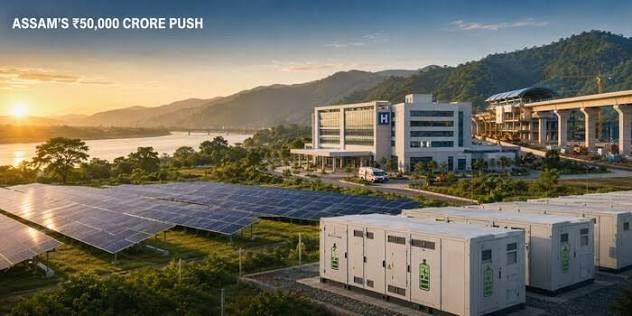
The Integrated Goalpara Solar Project has received approval from the Assam Cabinet as the state expands its renewable-energy and power-storage plans. The approved facility will combine 30 MW of solar generation with a 25 MW/100 MWh Battery Energy Storage System at Rakhyasini Jungle Block under Matia Revenue Circle in Goalpara district.
The decision came during the Assam Cabinet meeting on August 30, 2026, as part of the broader Viksit Assam: Infra Vision initiative. However, the approval does not yet mean that the facility has entered construction or commercial operation.
Pakyong Light Vehicle Access Allowed as Routes Remain Under Strict Surveillance
Integrated Goalpara Solar Project Gets Cabinet Approval
The Integrated Goalpara Solar Project represents a combined renewable-generation and energy-storage development rather than a standalone solar plant. The Cabinet has approved 30 MW of solar capacity alongside a Battery Energy Storage System with 25 MW of power capacity and 100 MWh of energy-storage capacity.
The project will come up at Rakhyasini Jungle Block under the Matia Revenue Circle in Goalpara district. Therefore, the Cabinet decision establishes both the project’s broad technical scope and its proposed location.
The approval formed part of a series of decisions taken by the state government during its August 30 meeting. Moreover, the Cabinet simultaneously approved a wider ₹50,000-crore infrastructure programme under Viksit Assam: Infra Vision, covering capital-intensive projects across multiple sectors.
However, available details do not establish that the Goalpara project itself will cost ₹50,000 crore. That figure refers to the broader infrastructure package rather than the specific solar-and-storage facility. The government has not publicly specified a separate project cost in the Cabinet announcement.
Solar Generation Combined With Battery Storage
The most important feature of the Integrated Goalpara Solar Project is the combination of solar generation with battery storage. The proposed solar component will have a generation capacity of 30 MW, while the BESS will have a 25 MW power rating and 100 MWh storage capacity.
A battery-storage system can store electricity and make it available later when generation and demand do not coincide. Consequently, pairing storage with solar can help address one of the central operational challenges of renewable power: solar generation changes according to daylight and weather conditions.
The distinction between MW and MWh is also important. The 25 MW figure represents the battery system’s power capacity, while 100 MWh represents the amount of energy the system can store. Therefore, the Cabinet approval should be described accurately as a 25 MW/100 MWh BESS rather than simply a “25 MW battery.”
The project details currently available do not identify the battery technology, equipment supplier, number of battery units or final system configuration. Similarly, no commissioning date has been announced.
Furthermore, the available Cabinet information does not establish the precise grid-connection arrangement or transmission infrastructure that will connect the project to Assam’s power network. Those details would need confirmation through subsequent project documents and implementation decisions.
Goalpara Project Fits Assam’s Wider Energy Plans
The approval comes as Assam seeks to strengthen its electricity infrastructure alongside broader development initiatives. The state government has placed the renewable-energy project within the Viksit Assam: Infra Vision programme, which includes major investments in infrastructure and public services over the coming years.
According to the Cabinet announcement, the wider Viksit Assam programme involves a ₹50,000-crore package for capital-intensive projects. The government has said the programme will draw on state resources, with additional financing expected through NABARD and central government schemes.
The broader programme covers sectors including healthcare, education, roads, electricity networks, industrial infrastructure and flood-management works. Therefore, the Goalpara solar-and-storage facility forms one component of a much larger infrastructure strategy rather than an isolated energy decision.
Assam has also previously pursued grid-connected solar procurement in Goalpara and neighbouring districts. Earlier APDCL tender documents included Goalpara within a regional group for procurement of 25 MW of grid-connected solar power through competitive bidding.
The new project differs in its integrated design because the Cabinet approval specifically combines solar generation and battery storage. Consequently, its implementation could provide a further test of how renewable generation and storage can be developed together within Assam’s power system.
Project Status and Implementation Details
The Cabinet’s approval provides an important administrative step, but the Integrated Goalpara Solar Project should not yet be described as an operational or under-construction power facility. Available reporting indicates that the project has received approval, while several implementation details remain to be announced.
No confirmed construction contractor, private developer, battery manufacturer or engineering company has been identified in the Cabinet announcement. Likewise, the government has not publicly announced a commercial operation date.
The project will therefore require further stages before electricity generation begins. These could include detailed project planning, technical assessments, procurement arrangements, grid-connection planning and construction approvals, depending on the eventual implementation structure.
Moreover, the government has not yet publicly provided a detailed project-level financing structure. The broader Viksit Assam initiative has a proposed funding framework, but that should not be automatically treated as the financing mechanism for the Goalpara facility.
This distinction is important because Cabinet approval establishes the government’s decision to develop the facility, while subsequent documents will determine how the project moves from approval to implementation.
Renewable Energy and Storage Could Strengthen Grid Planning
The combination of solar generation and storage gives the Goalpara project a different profile from a conventional solar-only facility. Solar plants generate electricity primarily during daylight hours, while storage can shift some of that energy to periods when solar output falls.
Consequently, a properly integrated battery system can help manage variations in renewable generation. It can also potentially support better alignment between electricity availability and demand, although the exact operating strategy for the Goalpara facility has not yet been announced.
The 100 MWh storage capacity provides the project with a substantial energy-storage component relative to its 25 MW power rating. However, the actual duration and operating profile will depend on how the battery is dispatched and the final technical configuration.
Therefore, it would be premature to assign specific grid-stability or reliability outcomes to the project before authorities publish detailed operating plans. The Cabinet has approved the infrastructure, but its eventual contribution to Assam’s power system will depend on implementation.
Additionally, the project highlights the growing role of energy storage in renewable-energy planning. As solar capacity expands, storage can become increasingly relevant for managing the difference between when renewable electricity is produced and when consumers need it.
What Comes Next for the Goalpara Facility
The next stage will involve converting the Cabinet decision into an implementable project. Authorities will need to establish the project’s detailed technical, financial and administrative framework before construction can begin.
The project location is already identified as Rakhyasini Jungle Block under Matia Revenue Circle. However, publicly available information does not yet specify the final land requirement, evacuation infrastructure, construction schedule or commercial operation date.
Similarly, the government has not announced whether the project will be developed directly through a state agency, through a competitive procurement process or through another implementation model. Future tenders, agreements or government notifications are likely to provide greater clarity.
Meanwhile, the broader Viksit Assam programme is expected to support infrastructure development across the state. The Cabinet’s decision on the Goalpara facility therefore fits into a wider effort to expand Assam’s infrastructure base while incorporating renewable energy and storage technologies.
For now, the confirmed facts remain straightforward: Assam has approved a 30 MW solar project with a 25 MW/100 MWh BESS at Rakhyasini Jungle Block in Goalpara. Further claims about construction, investment value or commissioning should wait for additional official project information.
Conclusion
The Integrated Goalpara Solar Project marks a significant addition to Assam’s renewable-energy planning, combining 30 MW of solar generation with a 25 MW/100 MWh Battery Energy Storage System. The Cabinet approved the project on August 30, 2026, at Rakhyasini Jungle Block under Matia Revenue Circle in Goalpara district.
The project forms part of the wider Viksit Assam: Infra Vision programme and comes alongside a broader ₹50,000-crore infrastructure package. However, that amount represents the wider programme and not a confirmed cost for the Goalpara solar-and-storage facility.
At present, the project remains Cabinet-approved rather than operational. Details concerning the developer, procurement process, construction schedule, grid connection, financing and commissioning remain to be established through subsequent official decisions.
FAQs
What is the Integrated Goalpara Solar Project?
The Integrated Goalpara Solar Project is a Cabinet-approved renewable-energy facility combining 30 MW of solar generation with a 25 MW/100 MWh Battery Energy Storage System in Goalpara district, Assam.
Where will the Goalpara solar project be located?
The facility is planned at Rakhyasini Jungle Block under Matia Revenue Circle in Goalpara district, Assam.
How large is the battery storage system?
The approved BESS has a power capacity of 25 MW and an energy-storage capacity of 100 MWh.
Is the Goalpara solar project already operational?
No. The available information confirms Cabinet approval, but it does not establish that construction has been completed or that the facility has started commercial operations.
Is the project part of the ₹50,000-crore Assam infrastructure plan?
Yes. The solar-and-storage project was approved alongside the broader Viksit Assam: Infra Vision programme. However, the ₹50,000-crore figure refers to the wider infrastructure package and is not the announced cost of the Goalpara facility.