

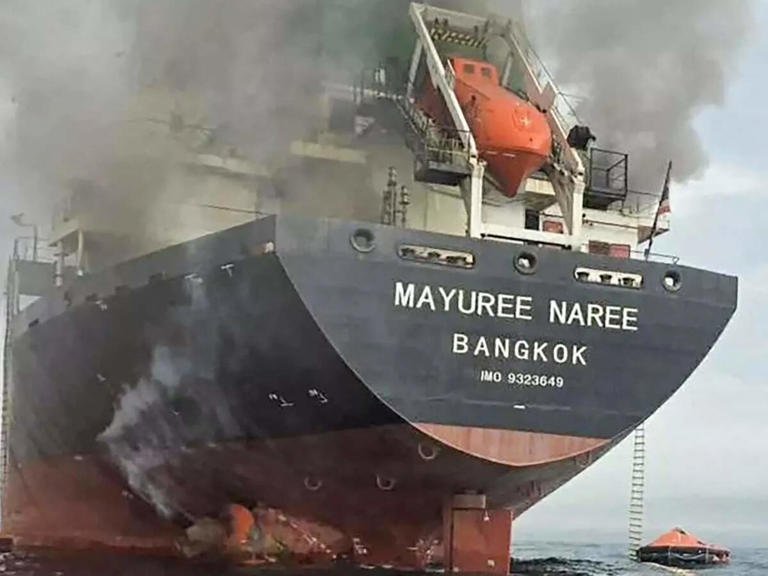
Amid the escalating conflict between Israel and Iran, a Thai-flagged cargo vessel headed for India was struck by projectiles in the strategically crucial Strait of Hormuz. The Indian government confirmed that the ship was en route to Gujarat when the attack occurred and strongly condemned the targeting of commercial shipping in the region.
The vessel, identified as the MV Mayuree Naree, had departed from the United Arab Emirates and was heading toward Kandla port in Gujarat when it came under attack while passing through the Strait of Hormuz. The incident highlights the growing risks faced by civilian vessels navigating one of the world’s busiest maritime trade routes as the Middle East conflict intensifies.
India’s Ministry of External Affairs (MEA) described the incident as deplorable and warned against attacks that endanger innocent civilian seafarers and disrupt global commerce.
Read More: 2028 Tripura CM Will Be From Indigenous Community: Pradyot Debbarma
India Confirms Gujarat-Bound Vessel Targeted
According to Indian officials, the Thai-registered bulk carrier was carrying cargo toward Kandla port when it was struck by two projectiles of unknown origin in waters near Oman. The attack caused a fire on board and damaged the ship’s engine room, forcing much of the crew to abandon the vessel.
There were 23 crew members on board at the time of the attack. Emergency rescue efforts managed to evacuate 20 sailors safely, while three crew members were reported missing and feared trapped in the engine compartment.
Images released after the incident showed thick black smoke rising from the vessel as life rafts floated nearby. The Omani Navy assisted in rescue operations and transported the rescued sailors to safety.
India Condemns Attacks on Commercial Shipping
India reacted strongly after confirming that the ship was bound for its western coast. The Ministry of External Affairs expressed concern over the increasing danger faced by merchant vessels operating in the Gulf region.
The government stated that commercial shipping should never become a target during military conflicts. Officials emphasized that such attacks put civilian lives at risk and threaten the stability of international trade routes.
India also noted that several previous incidents during the ongoing Middle East conflict have already resulted in casualties involving civilian seafarers. The government therefore urged all parties involved in the conflict to respect international maritime norms and ensure the safety of shipping lanes.
Diplomatic efforts are also underway as India engages with international partners to assess the situation and safeguard maritime commerce.
Part of Wider Israel–Iran Conflict Escalation
The attack on the Thai vessel occurred during an intense phase of the ongoing Israel–Iran war, which has triggered widespread instability across the Middle East. The conflict began after joint military strikes by the United States and Israel targeted Iranian facilities earlier in the year, prompting retaliatory actions from Tehran.
Since then, Iran has threatened to disrupt shipping through the Strait of Hormuz, a narrow waterway connecting the Persian Gulf to the Arabian Sea. The strait is one of the most critical maritime chokepoints in the world, handling roughly 20 percent of global oil and gas shipments.
Iran’s Revolutionary Guard forces have warned that vessels linked to countries supporting Israel or the United States could be targeted. These threats have significantly reduced ship traffic through the strait and raised fears of a broader maritime crisis.
Multiple Ships Targeted in the Strait
The Thai vessel was not the only ship affected during the recent escalation. Reports indicate that several commercial vessels were struck by projectiles or explosive attacks in the Gulf region during the same period.
At least three ships were hit in separate incidents in and around the Strait of Hormuz, including vessels registered in Japan and the Marshall Islands. Some ships caught fire while others sustained structural damage.
These attacks have forced shipping companies to reconsider routes through the region. Several global maritime firms have already suspended operations in the strait due to security risks.
As tensions continue to rise, naval forces from various countries are assessing options to protect merchant ships transiting the area.
Strategic Importance of the Strait of Hormuz
The Strait of Hormuz is widely considered one of the most strategically important waterways in the world. It serves as the main export route for oil and gas from major Gulf producers such as Saudi Arabia, Iraq, Kuwait, and the United Arab Emirates.
Because nearly a fifth of the world’s energy supply passes through this narrow passage, any disruption to shipping can have immediate consequences for global markets.
Recent attacks on vessels in the strait have already triggered sharp fluctuations in oil prices. Energy markets remain highly sensitive to developments in the region, with analysts warning that prolonged conflict could disrupt global energy supplies.
For countries like India, which rely heavily on energy imports from the Gulf region, maintaining the safety of maritime trade routes is particularly important.
Diplomatic Engagement Amid Growing Tensions
India has been actively engaging with international partners to monitor the evolving situation in West Asia. External Affairs Minister S. Jaishankar has held discussions with several global leaders regarding the ongoing conflict and its implications for regional stability.
Indian diplomats are also coordinating with governments in the Gulf region to ensure the safety of Indian citizens and seafarers working aboard commercial vessels.
Officials stressed that diplomatic dialogue remains the most effective way to reduce tensions and restore stability in the region.
Impact on Global Trade and Shipping
The attack on the Gujarat-bound cargo vessel reflects a broader pattern of risks facing international shipping as geopolitical tensions escalate. Shipping companies are increasingly concerned about the safety of crews and cargo moving through conflict zones.
Insurance costs for vessels operating in the Persian Gulf have surged, and some companies are rerouting ships to avoid high-risk areas.
Industry experts warn that if attacks on merchant ships continue, global trade flows could face severe disruptions. Delays in oil shipments, higher freight costs, and longer shipping routes could impact economies around the world.
Conclusion
The attack on the Thai cargo vessel bound for Gujarat underscores the growing dangers facing commercial shipping amid the Israel–Iran war. India’s condemnation of the incident highlights concerns about civilian safety and the need to protect global maritime trade routes.
As tensions continue to escalate in the Middle East, the Strait of Hormuz remains a focal point of geopolitical risk. Ensuring the safety of shipping lanes will be critical not only for regional stability but also for the functioning of global trade and energy markets.
Read More: LPG Shortage Forces Hostels to Switch from Rotis to Rice