

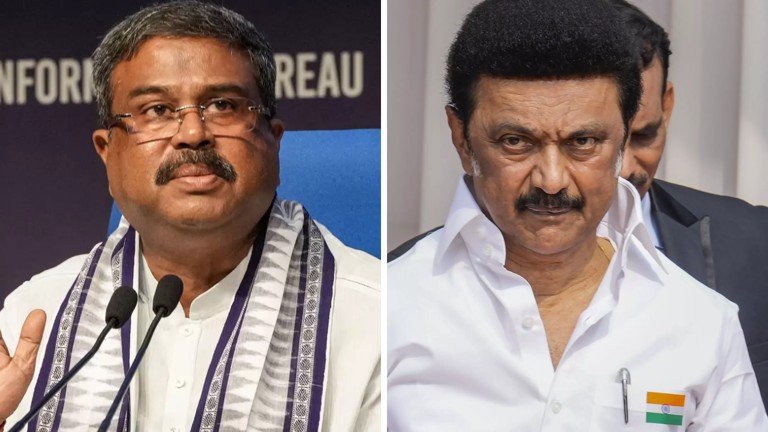
A significant political confrontation has erupted between Tamil Nadu Chief Minister M.K. Stalin and Union Education Minister Dharmendra Pradhan over the National Education Policy (NEP) 2020 and its associated three-language formula. The dispute centers on allegations of Hindi imposition and conditional allocation of educational funds, highlighting the ongoing tension between state and central government policies.
Allegations of Conditional Funding
On February 16, 2025, Chief Minister Stalin accused Minister Pradhan of “blackmail” for allegedly withholding educational funds until Tamil Nadu adopts the NEP and the three-language policy. Stalin referenced a video clip of Pradhan’s remarks in Varanasi, where the Union Minister purportedly stated that Tamil Nadu must align with the Indian Constitution and adhere to the three-language policy, describing it as the “rule of law.” In response, Stalin asserted that such coercion is unacceptable and that the people of Tamil Nadu would not tolerate it. He emphasized that the state’s request for funds is a rightful claim, not a favor, and challenged Pradhan to specify the constitutional provision mandating the three-language policy.
Union Minister’s Rebuttal
In an exclusive interview, Minister Pradhan refuted Stalin’s allegations, accusing the Tamil Nadu Chief Minister of creating a “false narrative” of Hindi imposition. Pradhan emphasized that the NEP’s three-language formula is designed to promote multilingualism and provide students with diverse opportunities. He argued that the policy does not impose any language but offers flexibility, allowing states to choose the languages they wish to include. Pradhan suggested that the Tamil Nadu government’s resistance is politically motivated and not in the best interest of students.
Political Reactions and Cultural Concerns
The controversy has sparked reactions across the political spectrum in Tamil Nadu. State BJP President K. Annamalai questioned the state’s adherence to a two-language policy, labeling it an “obsolete policy from the 1960s.” He pointed out that many private schools in Tamil Nadu, including those run by individuals affiliated with the ruling party, follow the Central Board of Secondary Education’s three-language system. Annamalai questioned the fairness of denying government school students the opportunity to learn multiple languages while private school students, including those of state leaders, receive such education.
The Tamil Nadu Congress Committee also condemned Pradhan’s alleged stance, with President K. Selvaperunthagai describing the Union Minister’s approach as “arrogant.” He warned that the people would teach the central government a lesson if it continued to impose policies against the state’s interests.
Constitutional and Educational Implications
Chief Minister Stalin emphasized that education falls under the Concurrent List of the Indian Constitution, granting both state and central governments authority over the subject. He argued that the Union government cannot unilaterally impose policies like the NEP on states. Stalin reiterated Tamil Nadu’s commitment to its two-language policy, which includes Tamil and English, and expressed concerns that the three-language formula could undermine the prominence of Tamil and dilute the state’s cultural identity.
The NEP 2020 aims to revamp India’s educational landscape, with the three-language formula intended to promote multilingualism and national integration. However, its implementation has faced resistance in states like Tamil Nadu, where language is a sensitive and emotive issue deeply intertwined with cultural and regional identity.
The escalating dispute between Chief Minister M.K. Stalin and Union Education Minister Dharmendra Pradhan underscores the complexities of implementing a uniform education policy in a linguistically diverse nation like India. As both state and central governments navigate this contentious issue, the resolution will have significant implications for federal relations, cultural preservation, and the future of educational reforms in the country.