


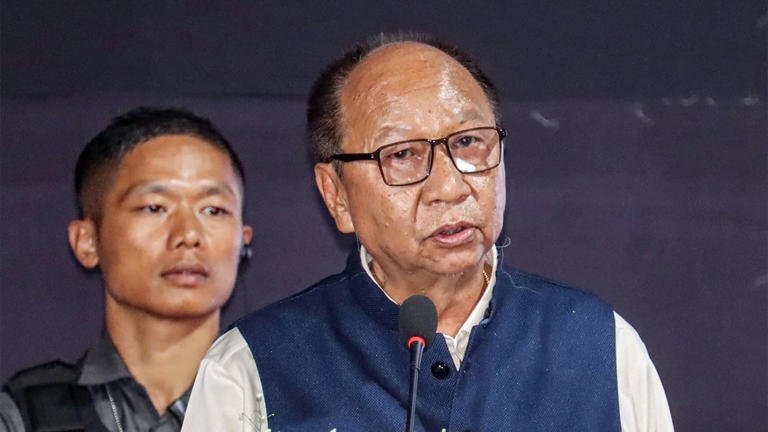
The Manipur government has approved a new women empowerment initiative under which around 3.5 lakh women associated with recognised Self-Help Groups (SHGs) will receive a Rs 10,000 grant in the first year.
The initiative, known as the Women Empowerment (WE)-Manipur Scheme, is aimed at strengthening women’s financial independence, supporting livelihood activities and improving the economic position of women across the state.
The scheme was approved by the Manipur Cabinet as part of a series of decisions focused on welfare, public service delivery and economic development. The government plans to follow the initial grant with interest-free financial assistance in subsequent years.
3.5 Lakh Women to Benefit
The WE-Manipur Scheme is expected to cover approximately 3.5 lakh women belonging to recognised Self-Help Groups across the state.
SHGs have become an important platform for women to participate in income-generating activities, access financial services and build collective enterprises.
The new scheme is intended to provide additional financial support to these groups and help women expand existing livelihood activities or start new ventures.
The initial Rs 10,000 grant is expected to provide beneficiaries with seed capital that can be used according to the requirements of their respective livelihood activities.
Rs 10,000 Grant in First Year
Under the scheme, each eligible woman will receive a Rs 10,000 grant during the first year.
The financial assistance is intended to help women strengthen their economic activities and improve their ability to generate sustainable income.
Depending on the nature of their activities, beneficiaries may use the assistance to support small businesses, agriculture-related activities, handicrafts, food processing, livestock-related enterprises or other livelihood initiatives.
Providing initial capital can be particularly important for women who have limited access to formal credit or lack sufficient funds to expand their enterprises.
Interest-Free Loans in Second and Third Years
The scheme is designed as a multi-year financial support programme rather than a one-time grant.
After receiving the initial grant, eligible beneficiaries will be provided interest-free loans during the second and third years.
The multi-stage approach is intended to help women move from initial financial assistance towards larger and potentially more sustainable economic activities.
Interest-free credit can reduce the financial burden associated with borrowing and allow beneficiaries to invest more of their earnings into their businesses.
The structure could also encourage women to develop long-term livelihood plans rather than relying solely on one-time assistance.
Focus on Women’s Economic Empowerment
The primary objective of the WE-Manipur Scheme is to strengthen women’s economic empowerment.
Financial independence can improve women’s ability to contribute to household income and make decisions concerning family finances.
For women in rural and semi-urban areas, access to capital and organised support can create opportunities to develop small enterprises close to their communities.
The scheme could therefore have benefits extending beyond individual beneficiaries, particularly if women-led businesses generate additional employment or stimulate local economic activity.
Self-Help Groups as Key Partners
Self-Help Groups are expected to play a central role in implementing the initiative.
SHGs enable women to pool resources, develop collective enterprises and access financial services. They can also provide a support network for members who are beginning new livelihood activities.
By working through recognised groups, the government can potentially improve outreach and monitoring while encouraging collective responsibility among beneficiaries.
The success of the scheme will depend partly on the ability of SHGs to use the financial assistance productively and develop activities capable of generating sustainable returns.
Potential Support for Rural Livelihoods
A large share of women participating in SHGs are involved in livelihood activities linked to agriculture, handicrafts, food products, livestock and small-scale trade.
The Rs 10,000 grant could help beneficiaries purchase raw materials, equipment, livestock, seeds or other inputs required for their activities.
For women already running small enterprises, additional working capital could help increase production or improve their ability to reach markets.
The subsequent interest-free loans could provide further resources as these enterprises expand.
Encouraging Women-Led Enterprises
The scheme could also encourage more women to establish independent businesses.
Limited access to capital is one of the challenges faced by small entrepreneurs, particularly those operating at the household or community level.
By providing grant assistance followed by interest-free loans, the government is creating a pathway for women to access capital without immediately facing the repayment pressure associated with conventional commercial loans.
The initiative could consequently support the growth of women-led enterprises across different sectors of Manipur’s economy.
Strengthening Financial Inclusion
The WE scheme can also contribute to greater financial inclusion among women.
Participation in SHGs can help women become more familiar with savings, credit, banking and enterprise management.
Government-backed financial support can further strengthen this process by connecting beneficiaries with formal financial systems.
Training in financial management, bookkeeping and business planning could increase the effectiveness of the financial assistance and help women manage their enterprises more sustainably.
Need for Skill Development and Market Access
Financial assistance alone may not guarantee the long-term success of women-led businesses.
Beneficiaries may also require training, technical assistance, access to markets and reliable supply chains.
Skill development programmes can help women improve the quality of their products and services, while market linkages can enable them to reach customers beyond their immediate communities.
Digital platforms and organised marketplaces could also help SHGs promote and sell their products more effectively.
Combining financial assistance with these measures could increase the long-term impact of the scheme.
Importance of Transparent Implementation
The scale of the initiative makes transparent implementation particularly important.
With around 3.5 lakh women expected to benefit, authorities will need to ensure that eligibility criteria are clearly communicated and that funds reach the intended beneficiaries.
Efficient verification, timely disbursement and accessible grievance mechanisms can help prevent administrative difficulties.
SHGs and local authorities can also assist beneficiaries in understanding the scheme and completing the necessary formalities.
Potential Impact on Manipur’s Economy
Empowering women economically can have wider implications for Manipur’s development.
Women often reinvest a significant portion of their income in household needs, education and community welfare. Increasing women’s earning capacity can therefore generate benefits beyond individual businesses.
A larger number of financially independent women can also contribute to stronger local economies by increasing household purchasing power and creating demand for goods and services.
The WE-Manipur Scheme could thus become an important component of the state’s broader efforts to strengthen livelihoods and inclusive economic development.
Women’s Empowerment Linked to Long-Term Recovery
The scheme also comes at a significant time for Manipur, where communities continue to face social and economic challenges following prolonged conflict.
Supporting women’s livelihoods can help affected families strengthen their economic resilience and create more stable sources of income.
Women-led community networks can also play an important role in strengthening social support systems and local cooperation.
While the scheme is primarily an economic initiative, its benefits could therefore extend into broader community development.
A Three-Year Financial Support Model
The structure of the WE scheme provides beneficiaries with a phased approach to financial assistance.
The first year will provide a Rs 10,000 grant, while the second and third years will provide interest-free loans.
This model is intended to provide initial capital and then support beneficiaries as their economic activities grow.
The effectiveness of the approach will depend on whether beneficiaries receive adequate guidance to use the funds productively and build sustainable enterprises.
3.5 Lakh Women Set to Gain New Opportunities
The Manipur government’s WE scheme represents a significant investment in women’s economic empowerment, with approximately 3.5 lakh women expected to receive financial assistance.
The initial Rs 10,000 grant can provide valuable seed capital, while interest-free loans in the following two years could help beneficiaries expand their livelihood activities.
For the scheme to achieve its full potential, financial support will need to be complemented by skill development, market access, financial literacy and effective implementation.
If successfully delivered, the initiative could help thousands of women strengthen their livelihoods, increase household incomes and build greater financial independence.
The WE-Manipur Scheme therefore represents not just a financial assistance programme, but an effort to create a stronger foundation for women-led economic growth across the state.